Astrophotography diagnosis of M 42: Clipped stars and astigmatism
MasterLP15x60s, 30x30s, 90x10s31 oct. 2026
The Doc examined this image of M 42 (master, LP, 15x60s, 30x30s, 90x10s). Estimated overall technical quality: 7/10. 2 defects found: Clipped stars (severity 3/5), Astigmatism (severity 2/5).

Info
- Cible
- M 42
- Date
- 31 oct. 2026, 16:16
- Lune
- Croissant croissant 37.6% (2° d'alt., 43° de la cible)
- Site
- Bortle 7 · périurbain pollué (saisi)
- Position
- 5h35m35s · -5°20'12"
Average but workable conditions for this target. Bortle 7 mainly penalises the sky background, and it shows: chromatic mottling and a need for gradient removal. The Moon is marginal here, 37.6% illumination only 2 degrees above the horizon and 43 degrees from the target: at that altitude it is heavily dimmed by atmospheric extinction, so its impact is negligible. Fortunately M42 is an extremely bright emission nebula, exactly the kind of target that tolerates a suburban sky. The real limiting factor is not the sky but the total duration: about 45 minutes across all exposures, which is short for cleanly pulling the faint extensions in Bortle 7.
Setup
- Type d'image
- Master
- Télescope
- S50 Pro
- Filtre
- LP
- Exposition
- 15x60s, 30x30s, 90x10s
- Phase de lune
- Waning gibbous (71 %)
- FOV
- 1.33°
The setup matches the target well. At 260mm focal length, the 1.33 degree wide field frames M42 comfortably with the Running Man in the same frame, with room to spare: the vertical composition is well handled. Sampling at 2.30 arcsec/px is slightly undersampled for fine detail, but that is the normal smartscope compromise and the 3.4 px FWHM at centre shows the optics keep up. Two settings deserve a review: gain 200 is high and costs dynamic range on a core as bright as the Trapezium, and the 28.9C sensor temperature is distinctly high since the S50 is not actively cooled, which feeds the thermal noise visible in the background. The histogram is otherwise healthy, with the background well clear of the black point (e_margin 19.6) and no problematic dark clipping.
The diagnosis in detail
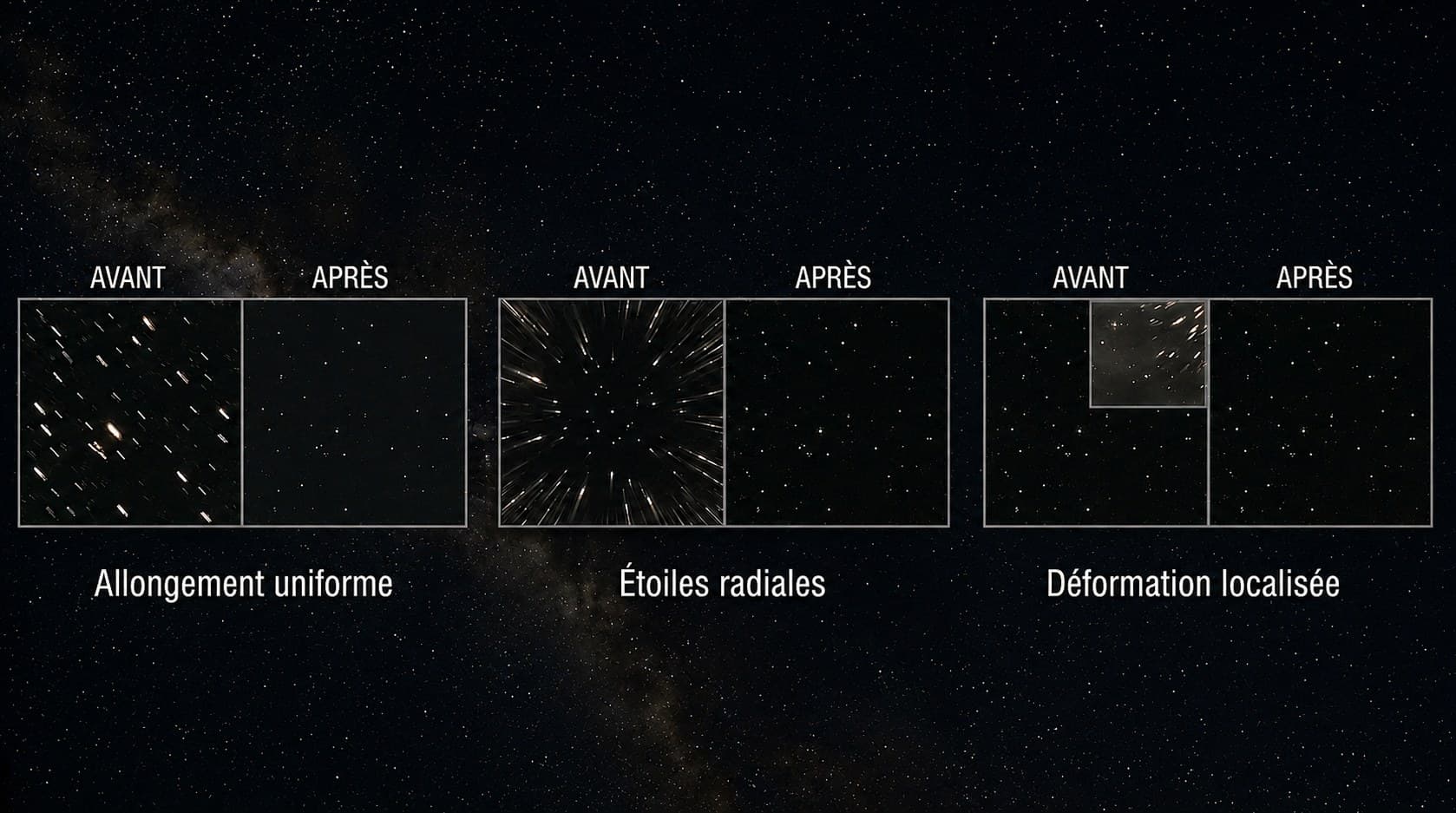
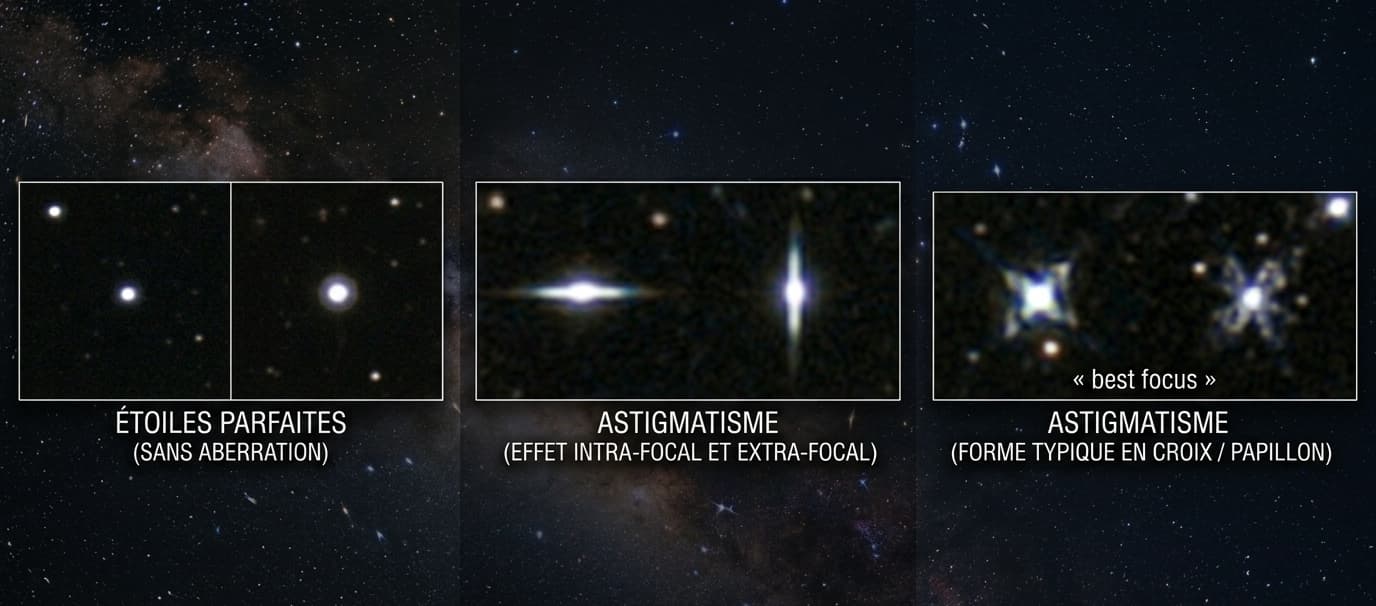
The strength of this master is its central area: elongation of 1.02 at the field floor and FWHM of 3.43 px, meaning perfectly point-like stars at centre. That immediately rules out any tracking or focus problem: the S50 Pro is doing its job. The degradation is strictly peripheral and structured: the bottom edge rises to 1.37-1.38 elongation with a horizontal major axis (PA near 0 degrees), while the top shows 1.17-1.21 with a major axis around 85 degrees, hence orthogonal. This 90 degree rotation of the elongation axis between top and bottom, combined with FWHM rising only 10% from centre to corners, is the textbook signature of field astigmatism rather than tilt or backfocus. On a sealed instrument this is not adjustable: accept it or crop.
The second issue is different in nature and far easier to solve: the M42 core is saturated across a broad white plateau. This is not an optical defect but an acquisition choice. The 10s subs, present in the series, were evidently not used as a separate composite layer and got drowned in the global integration. Yet that is exactly the material needed to recover the Trapezium.
Finally, the background betrays the brevity of the session: roughly 45 cumulative minutes under a Bortle 7 sky, with a sensor near 29C, leave visible chromatic mottling in the dark areas. Nothing fatal, but this is where more exposure time will pay off most.
Priority actions
- Acquire a series of very short exposures (1 to 3s) on M42 and build an HDR composite to recover the Trapezium lost in the white plateau
- Greatly increase total integration time, aiming for at least 3h and favouring 60s subs, to cut down the chromatic mottling in the background
- Lower the gain towards 100 (unity gain) to gain highlight headroom on such a high contrast target
- Start the session later in the night to let the sensor drop below the current 29C and limit thermal noise
- Crop the bottom edge slightly, or apply BlurXTerminator PSF correction, to soften the ovalisation of peripheral stars