Astrophotography diagnosis of M 42: Light pollution gradient, clipped stars and 4 others
Masterantlia quadband45×180s20 sept. 2026
The Doc examined this image of M 42 (master, antlia quadband, 45×180s). Estimated overall technical quality: 7/10. 6 defects found: Light pollution gradient (severity 3/5), Clipped stars (severity 3/5), Oversaturation (severity 3/5), Astigmatism (severity 2/5), Noise / underexposure (severity 2/5), Background chroma noise (severity 2/5).

Info
- Cible
- M 42
- Date
- 20 sept. 2026, 04:16
- Lune
- Croissant décroissant 38% (sous l'horizon)
- Site
- Bortle 5 · banlieue résidentielle (VIIRS)
- Position
- 5h35m10s · -4°50'26"
Favorable conditions: the Moon is below the horizon and 143 degrees from the target, so no lunar contribution is possible, which rules out a moon gradient outright. That leaves Bortle 5, which is enough to explain the background plane measured at 34 degrees, especially since M42 culminates fairly low from European latitudes. The Antlia quadband filter is exactly the right tool here: M42 emits strongly in Ha and OIII, so you keep most of the signal while cutting the polluted bands. On a night like this, the gains come from total integration time and from picking the window when the nebula crosses the meridian, rather than from extra hardware.
Setup
- Type d'image
- Master
- Télescope
- iOptron CEM40/GEM45/HAE43 210101+
- Caméra
- ZWO ASI533MC Pro
- Filtre
- antlia quadband
- Exposition
- 45×180s
- Phase de lune
- Gibbeuse croissante (61 %)
- FOV
- 1.25°
The setup matches the target very well. At 519 mm and 1.494 arcsec/px, sampling lands right in the comfortable zone for typical seeing, and the measured 4.5 px FWHM confirms you are neither oversampled nor optics-limited. The 1.25 degree field fits M42, M43 and the Running Man with room to spare, which is ideal framing. On settings: gain 101 (unity on the ASI533) and a sensor at -10C are healthy. The debatable point is the single 180 s exposure on an extreme dynamic range target: it saturates the Trapezium without being long for the background (e_margin 1.76, far from saturation, which is normal in narrowband). A complementary short set would solve it. The 6.71% dark clipping also deserves an offset check.
The diagnosis in detail
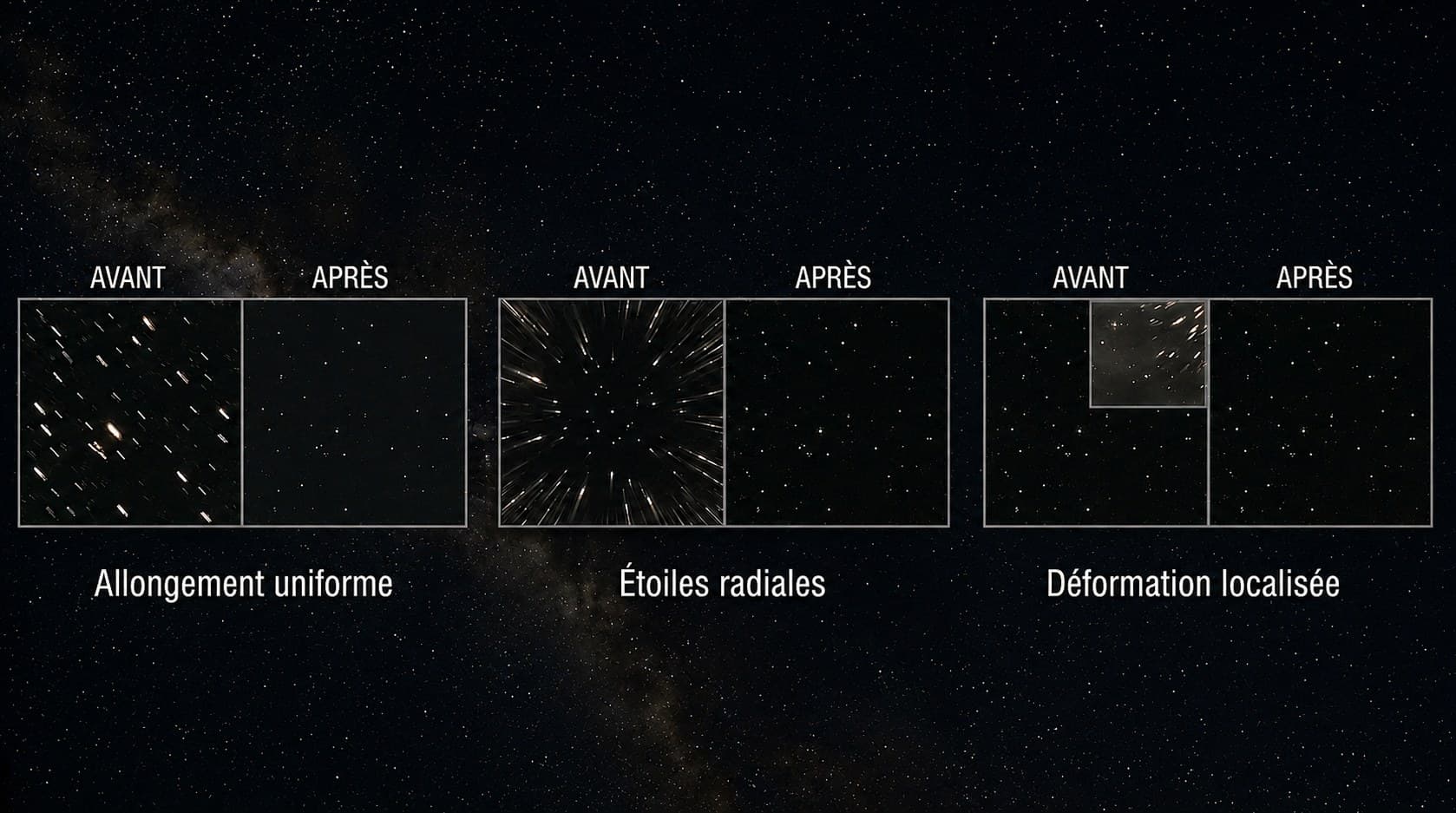
The starting point is solid: the PSF panel shows consistent stars across all nine zones, with a corner/center FWHM ratio of only 1.076 and a central elongation of 1.11, barely above the 1.06 OSC floor. So there is no tracking problem, no backfocus error and no coma. The only optical signal is rising elongation toward the edges (1.20 at TL, 1.22 at BR) without an FWHM increase, the classic signature of mild field astigmatism: a point of attention, not a blocking defect, and the optical train should be checked for tightness before anything heavier.
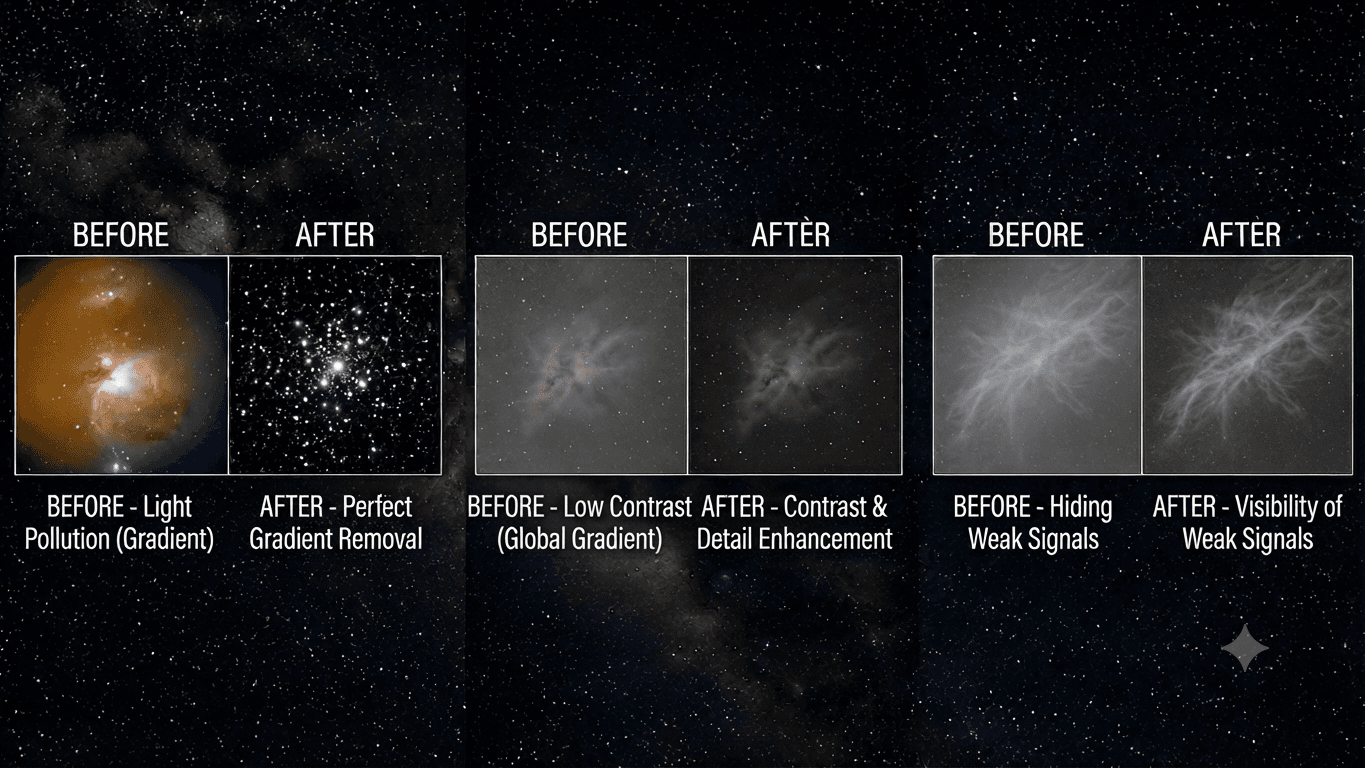
The real subjects lie elsewhere and overlap. The gradient measured at 95% oriented 34 degrees dominates the radial component by 3.6x, and the DSS comparison confirms no real nebulosity occupies that area: this is light pollution, to be handled with background extraction before any other processing. That uncorrected gradient also pushes the stretch, which makes background grain and color mottling more visible, already weakened by 6.71% dark clipping.
Finally, dynamic range: the Trapezium core is a flat white plateau while the DSS still shows filaments in the same place. That is a direct result of a single 180 s exposure on the highest contrast object in the sky, not a processing mistake. A short-exposure set blended in HDR is the only clean route, and it will visibly transform the final rendering.
Priority actions
- Extract the background gradient with GraXpert or DBE before any stretch, placing samples away from the nebula
- Acquire a short-exposure set (5 to 15 s) and rebuild the Trapezium core in HDR
- Check the sensor offset and stacking normalization to remove the 6.71% dark clipping
- Extend total integration to 4-5 h to bring out faint outer structures without forcing denoising
- Check the optical train tightness and corrector backfocus before concluding instrumental astigmatism