Astrophotography diagnosis of M 42: Sensor tilt, background chroma noise and 1 other
Masterquadband376×60s15 sept. 2026
The Doc examined this image of M 42 (master, quadband, 376×60s). Estimated overall technical quality: 7/10. 3 defects found: Sensor tilt (severity 2/5), Background chroma noise (severity 2/5), Clipped stars (severity 2/5).

Info
- Cible
- M 42
- Date
- 15 sept. 2026, 03:31
- Lune
- Gibbeuse décroissante 82.7% (sous l'horizon)
- Site
- Bortle 5 · banlieue résidentielle (VIIRS)
- Position
- 5h35m20s · -5°22'55"
Favorable conditions. The 82.7% waning gibbous Moon was below the horizon during acquisition and 126.9 degrees from the target: no lunar contribution is possible, which explains the clean background and the absence of any measured gradient. The sky is Bortle 5, average, but M42 is a very bright emission target and the quadband filter cuts most of the urban light pollution: this is the ideal use of that filter. With 376 subs kept, the night was clearly stable and transparent. To push the faint outer extensions of the Orion complex, a Bortle 3-4 site would mainly help on the blue continuum of NGC 1977, less on Ha.
Setup
- Type d'image
- Master
- Télescope
- iOptron CEM40/GEM45/HAE43 210101+
- Caméra
- ZWO ASI533MC Pro
- Filtre
- quadband
- Exposition
- 376×60s
- Phase de lune
- Premier croissant (12 %)
- FOV
- 1.25°
Setup well matched to the target. At 519 mm on the ASI533MC Pro, the 1.25 degree field frames M42 and M43 with room to spare and NGC 1977 enters at the left edge: a tight but complete composition. Sampling at 1.494 arcsec/px sits in the comfortable range, consistent with the measured FWHM of 3.7 to 5.2 px (about 5.5 to 7.8 arcsec, dominated by seeing and tilt rather than optics). Gain 101 is the sensor unity gain, offset 70 produces no dark clipping (0%), and -6C is acceptable although -10C would further cut dark current. The only limit: a single 60s exposure cannot cover the extreme dynamic range of M42.
The diagnosis in detail
The master is healthy overall. The background map detects no instrumental profile: the +113% variation corresponds to the nebula itself, confirmed point by point against the DSS, so there is neither residual vignetting nor a gradient to correct. Tracking is good, with center elongation of 1.04 and a PA dispersion of 15 degrees, showing no drift or guiding oscillation signature.
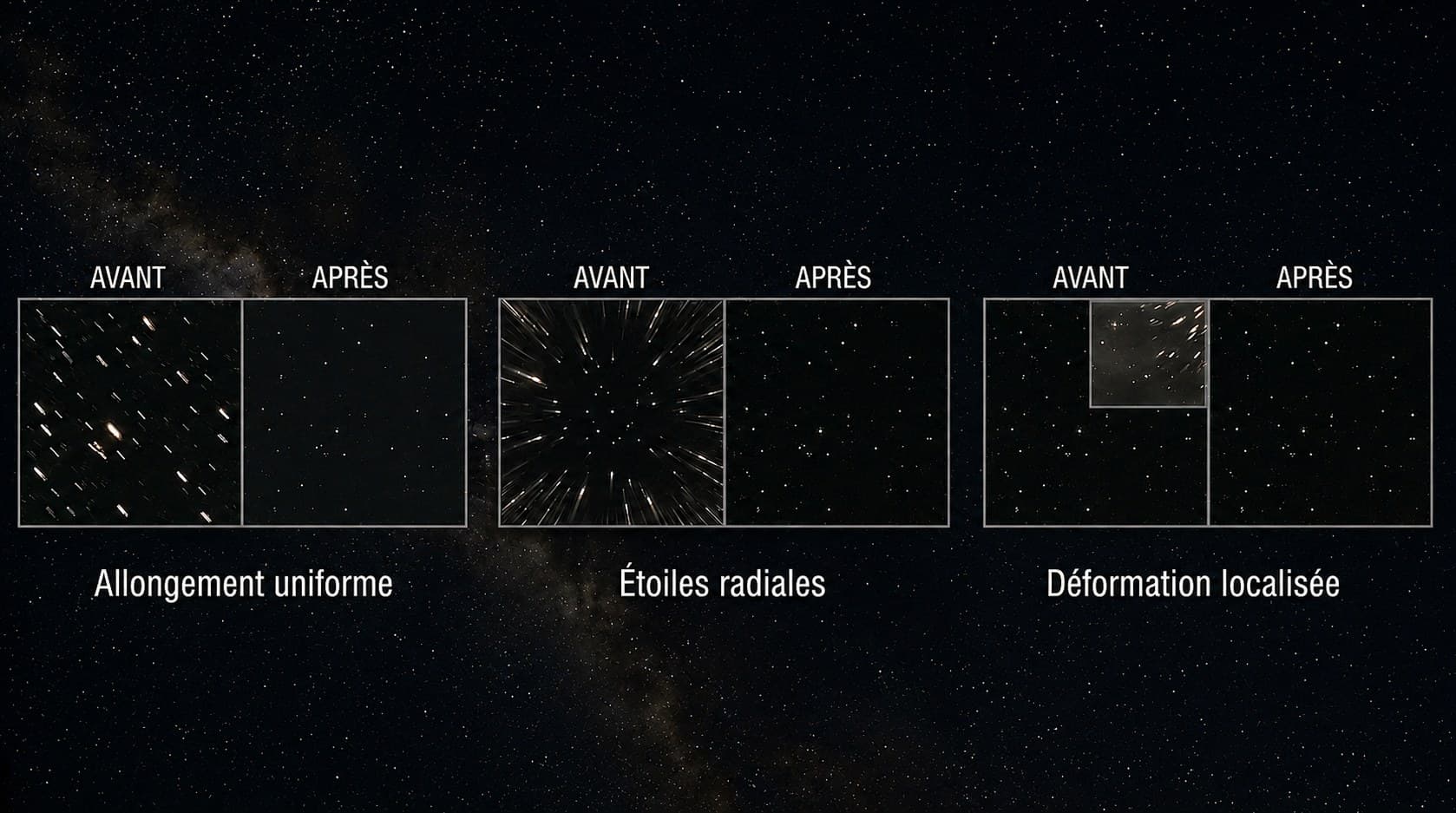
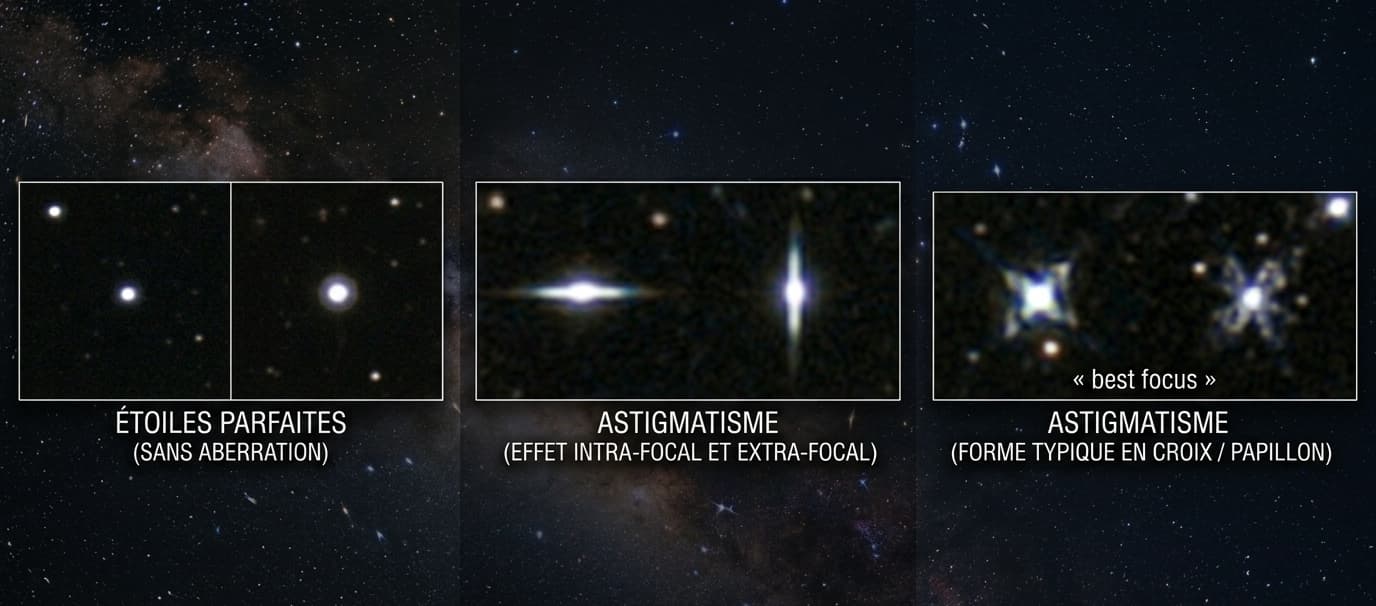
The only instrumental defect is a tilt of the imaging train. It reads as a strictly horizontal asymmetry: left at 3.7 px FWHM against 5.0-5.2 px on the right, center at 4.1 px, with stars staying round everywhere. That is the signature of a focal plane not perpendicular to the optical axis, not a field aberration. The impact stays moderate at this sampling, but it costs roughly 30% of resolution across the right third of the frame.
The two remaining points belong to acquisition. Chroma noise in the dark corners stems from short subs and a background barely lifted off the black point (e_margin 0.91), and the clipping of the Trapezium and bright stars comes from the lack of short exposures on a target whose dynamic range exceeds what a single exposure can hold.
Priority actions
- Fix the imaging train tilt: evenly retighten camera, filter and corrector, then revalidate with an aberration inspector run
- Acquire a set of 5 to 15s short subs on M42 and blend in HDR to recover the Trapezium and stellar cores
- Lengthen subs to 120-180s to lift the background further and reduce chroma noise in the corners
- Lower cooling to -10C to gain further on dark current