Astrophotography diagnosis of M 42: Oversaturation, sensor tilt and 2 others
Processed
The Doc examined this image of M 42 (processed). Estimated overall technical quality: 7/10. 4 defects found: Oversaturation (severity 3/5), Sensor tilt (severity 2/5), Clipped stars (severity 2/5), Background chroma noise (severity 2/5).

Info
- Cible
- M 42
- Position
- 5h35m17s · -5°23'49"
Waning crescent at 1%: the night is genuinely dark, no parasitic contribution from that side, and the image background confirms it (no veil or usable gradient). On a target as bright as M42 these conditions are ideal, but the difficulty here is not sky background, it is the huge dynamic range between the Trapezium and the outer extensions. In other words, the night is not your limiting factor, your exposure strategy is. Use this kind of moonless night to pile up long exposures on the faint extensions and the nebulosity around NGC 1977, and reserve a few minutes of very short frames for the core.
Setup
- Type d'image
- Traitée
- Caméra
- ZWO ASI2600MM Duo
- Phase de lune
- Waning crescent (1 %)
- FOV
- 1.57°
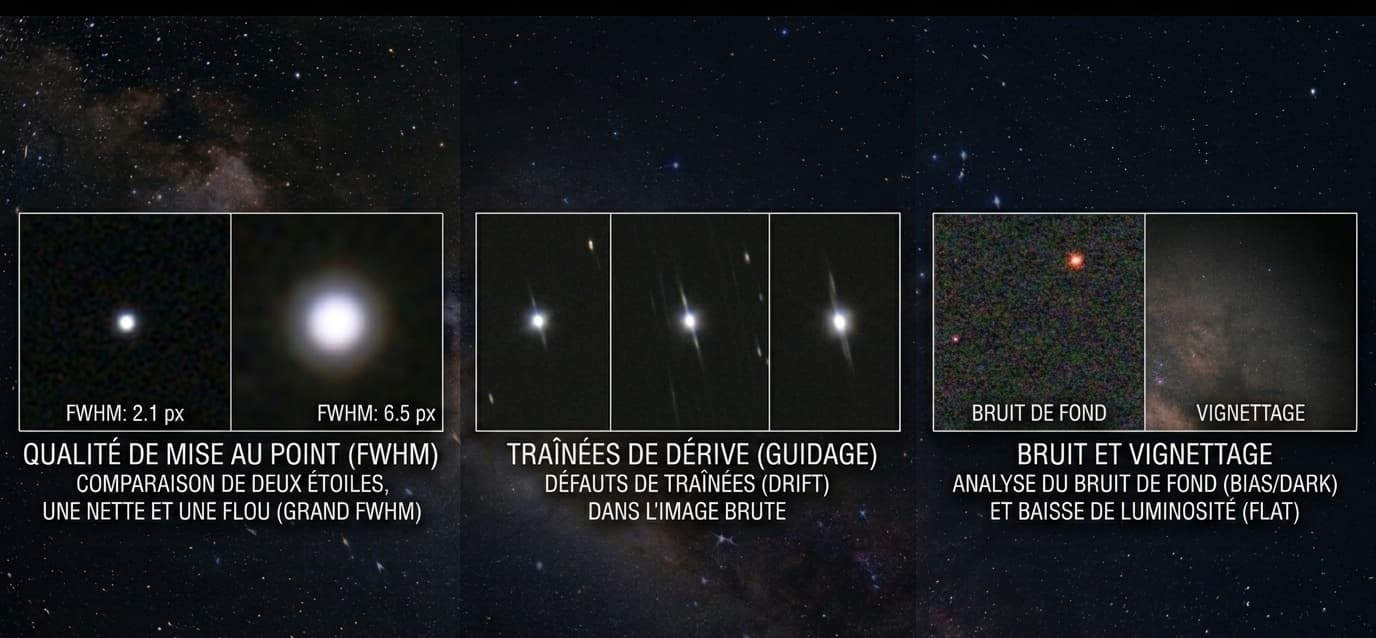
The ASI2600MM Duo over a 1.57 degree field frames M42 comfortably, with NGC 1977 included at lower right and margin all around: the framing is well chosen, neither cramped nor lost. Measured FWHM runs between 5.6 and 7.1 px, which is high in pixels: on this small-pixel camera that reflects generous sampling rather than a sharpness problem, but it leaves little margin, and the slightest tilt becomes visible, which is exactly what the left/right spread shows. Binning 2 at processing, or adjusting the tilt, would restore a more uniform PSF across the field.
The diagnosis in detail
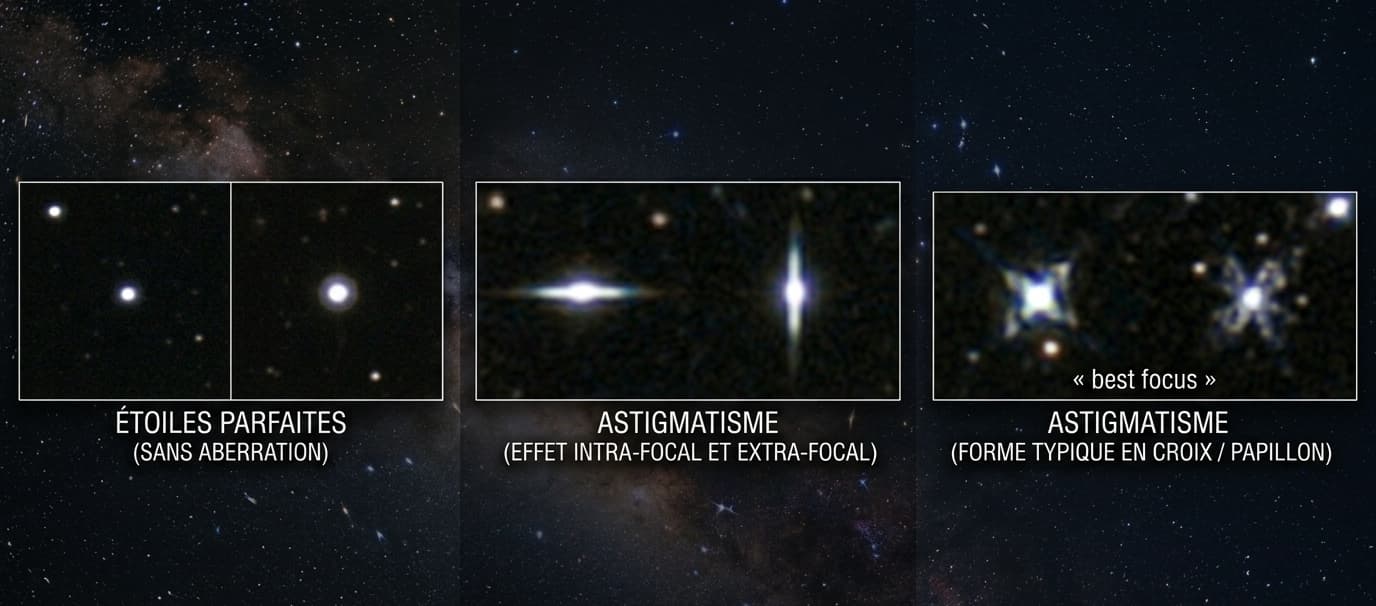
The most structural point is mechanical. The field center is the sharpest (FWHM 5.61 px) and the degradation is not radial: it is clearly lateral, with the whole right flank between 6.9 and 7.1 px while the left and bottom stay between 5.7 and 6.2 px. Horizontal asymmetry (0.151) is three times the vertical one (0.052), and elongations stay low everywhere (1.01 to 1.10), which rules out tracking trouble or astigmatism. This is a slight tilt of the sensor plane along the horizontal axis, not field curvature, which would be symmetric across all four corners.
The second axis is dynamic range handling. The M42 core is a classic case: comparison with the DSS shows structure where your image displays a uniform plateau. The bright stars follow the same logic, white cores with no chromatic gradient. This is not an acquisition error on the extensions, which are very well rendered, it is the absence of short exposures to cover the three orders of magnitude of brightness in this nebula.
Finally, the background shows light colored mottling, consistent with chrominance less integrated than luminance. It is the least urgent point and is largely fixable in post-processing.
Priority actions
- Acquire a short-exposure set (5 to 15 s) on M42 and blend the core as HDR to recover the Trapezium
- Check and crosswise retighten the imaging train between corrector and camera, then recheck the left/right FWHM spread
- Soften the highlight curve to preserve the chromatic gradient of bright stars
- Increase integration time on the color channels, then apply masked chroma noise reduction on the background