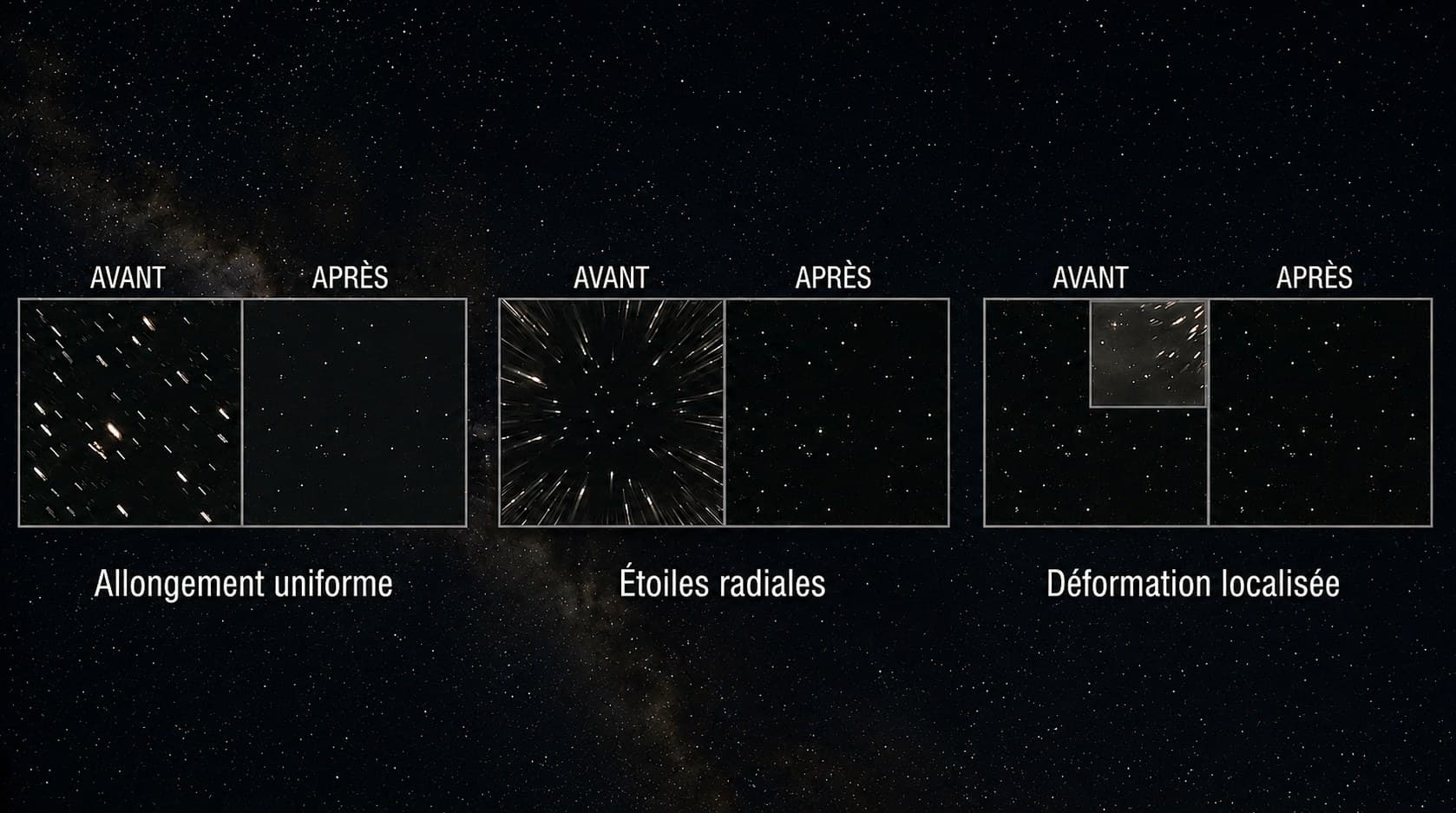
Astrophotography diagnosis of M 45_150926: Astigmatism
Raw120s15 sept. 2026
The Doc examined this image of M 45_150926 (raw, 120s). Estimated overall technical quality: 8/10. 1 defect found: Astigmatism (severity 2/5).
&w=1920&q=75)
Info
- Cible
- M 45_150926
- Date
- 15 sept. 2026, 03:00
- Lune
- Gibbeuse décroissante 83% (sous l'horizon)
- Site
- Bortle 2 · rural typique (VIIRS)
- Position
- 3h46m50s · +24°09'39"
Excellent conditions: Bortle 2 and the Moon below the horizon at 160.7 degrees from the target, so no lunar contribution is possible and the sky background is naturally very low. This is exactly the context M45 needs, since its reflection nebulosity is faint and broadband, hence entirely dependent on sky darkness: no light pollution filter would help here, it would only cut useful blue signal. The background to black point margin of 2.02 reflects a very dark sky rather than underexposure, but in broadband under Bortle 2 you can safely push the exposure to 180-240s to lift the background further above read noise.
Setup
- Type d'image
- Brut
- Télescope
- EQMod Mount
- Caméra
- ZWO ASI585MM Pro
- Exposition
- 120s
- Phase de lune
- Premier croissant (12 %)
- FOV
- 3.36°
A coherent setup but clearly undersampled: 3.15 arcsec/px against a measured FWHM of 1.7 to 1.9 px, meaning stars spread over barely two pixels. You lose potential resolution, though it is a deliberate and effective trade-off on M45, which sits comfortably within the 3.36 degree field with the main cluster members and the nebulosity around Merope well contained. On the settings side, gain 90 and offset 15 are healthy, no dark clipping (0%), only 0.07% saturated pixels (the bright cluster stars, unavoidable), and a sensor at -20C. Nothing to fix apart from lengthening the exposure.
The diagnosis in detail
Technically this sub is very well executed. The Moffat measurements give a uniform FWHM of 1.65 to 1.91 px across the nine zones, with a corner/center ratio of 1.042: in other words, sharpness barely degrades from center to edges, which rules out a mistuned backfocus or significant field curvature. Focus is good and tracking leaves no trace: the central elongation of 1.08 is barely above the field floor (1.03), so no drift or periodic error is visible over 120s.
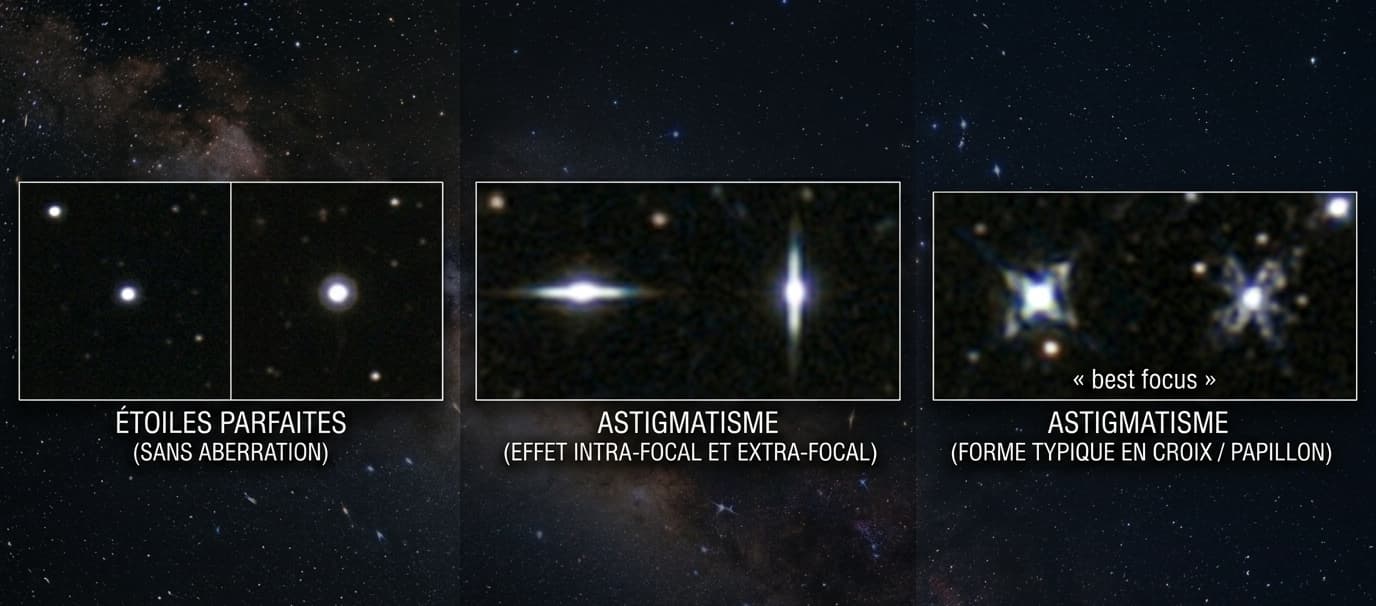
The only residual signal is an elongation climbing to 1.21 in the bottom-left corner and 1.16 on the left edge, while FWHM does not increase. That dissociation between stretch and width is the signature of field astigmatism, not a focus issue. The amplitude stays low and, on a single 120s sub sampled at 3.15 arcsec/px, noise and quantization weigh heavily on a fit spanning a few pixels: I therefore keep severity at 2, to be confirmed on a master.
The nebulosity around Merope and Alcyone overlays faithfully onto the DSS reference, so there is no reason to suspect a gradient or background artifact in that area. The slight measured peripheral darkening is low in amplitude and will be handled by flats anyway.
Priority actions
- Confirm the astigmatism on a stacked master before any mechanical intervention, a single sub at 3.15 arcsec/px is not enough to decide
- Check the clamping and orthogonality of the optical train if the edge elongation persists on the master
- Lengthen the sub exposure to 180-240s to lift the background above read noise, the Bortle 2 sky allows it easily
- Apply standard flats to remove the slight measured peripheral darkening