Astrophotography diagnosis of M 56: Backfocus error, tracking drift and 2 others
ProcessedL-eNhance90 x 20s
The Doc examined this image of M 56 (processed, L-eNhance, 90 x 20s). Estimated overall technical quality: 5/10. 4 defects found: Backfocus error (severity 3/5), Tracking drift (severity 2/5), Noise / underexposure (severity 2/5), Light pollution gradient (severity 2/5).

Info
- Cible
- M 56
- Site
- Bortle 5 · banlieue résidentielle (VIIRS)
Clearly unfavorable conditions for this target. M 56 is a globular cluster, an object radiating in continuum starlight: it gains nothing from a narrowband filter and takes the full hit of a 100 percent full moon, which lifts the sky background by several magnitudes. Bortle 5 alone would be manageable on a stellar target, but combined with the moon it directly explains the low measured background to black point margin (2.58) and the 5 percent gradient. On a cluster, aim for a moonless night: the depth gained on faint outer members will be immediate, far more than any processing tweak.
Setup
- Type d'image
- Traitée
- Télescope
- Celestron C8
- Caméra
- Canon EOS 6D MkII
- Filtre
- L-eNhance
- Monture
- Wave 150I
- Exposition
- 90 x 20s
- Phase de lune
- Full moon (100 %)
- Seeing
- 2.5"
The C8 is a good focal length choice for M 56, a compact cluster about 9 arcminutes across: it fills a reasonable fraction of the frame without being lost. Pairing a full frame 6D MkII with a Schmidt-Cassegrain is demanding though, since the C8 corrected image circle is tight, which the corner FWHM 31 percent above center confirms. The most questionable element remains the L-eNhance filter: designed for emission nebulae, it cuts most of the stellar continuum and deprives a globular cluster of the bulk of its signal, forcing long stacks for a mediocre result. On this target, take it off.
The diagnosis in detail
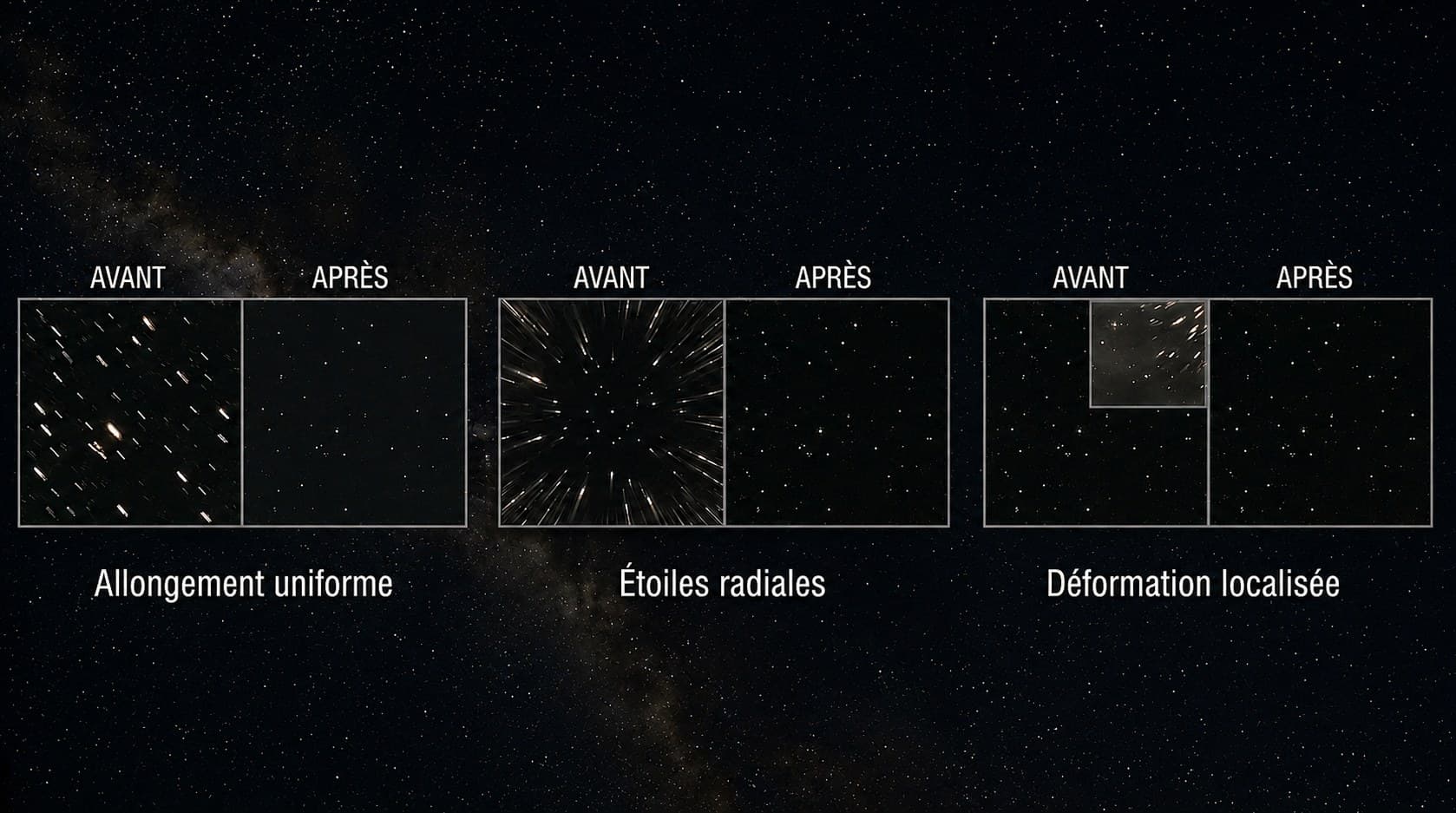
Two distinct signatures overlap on the stars. The first is global: elongation reaches 1.14 at field center while the measured floor is 1.01, and above all position angles stay grouped within an 11 degree spread from edge to edge. An optical aberration never does that at the center nor with a single direction, this is the signature of tracking drift despite the short 20 s subs.
The second is radial: FWHM goes from 8.7 px at center to 11.0 px top right and 10.3 px bottom right, a ratio of 1.31 with no marked diagonal asymmetry. That is the classic behavior of incorrect spacing or uncorrected field curvature, made worse by the 24x36 format behind a C8 whose corrected image circle is limited. The two defects are independent and are fixed separately.
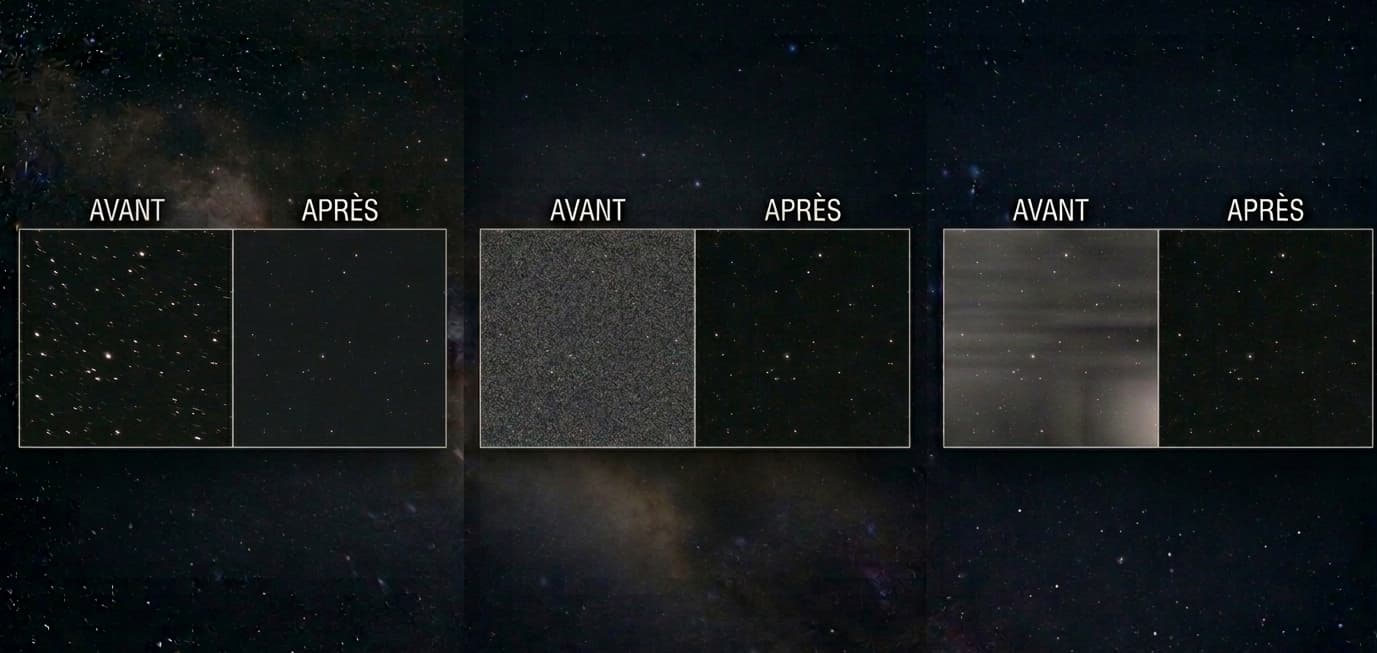
The rest follows from the shooting context: only 30 minutes of integration, under a full moon, behind a narrowband filter unsuited to a stellar target. The 2.58 background to black point margin confirms you are not sky-limited, and the 5 percent tilted plane at 264 degrees still needs clean extraction.
Priority actions
- Remove the L-eNhance filter on M 56: a globular cluster emits in continuum and the filter cuts most of its signal
- Extend integration to several hours with 60 to 120 s subs on a moonless night, to reach the sky-limited regime
- Adjust spacing in 1 mm steps comparing corner and center FWHM, filter thickness included in the budget
- Refine polar alignment and check autoguiding to bring central elongation back to the field floor
- Apply gradient extraction (GraXpert or DBE) to remove the 5 percent tilted plane