Astrophotography diagnosis of M42: Tracking drift, oversaturation and 2 others
ProcessedL-eNhance143x30s
The Doc examined this image of M42 (processed, L-eNhance, 143x30s). Estimated overall technical quality: 6/10. 4 defects found: Tracking drift (severity 3/5), Oversaturation (severity 3/5), Backfocus error (severity 2/5), Clipped stars (severity 2/5).

Info
- Cible
- M42
- Site
- Bortle 5 · banlieue résidentielle (VIIRS)
- Position
- 5h35m11s · -5°15'52"
A 64 percent waxing gibbous Moon under Bortle 5 is not the ideal window, but M42 is a very bright emission target and the L-eNhance efficiently cuts lunar and urban continuum. The measured background is indeed clean with no detected gradient, confirming the filter is doing its job. With 2.5 arcsecond seeing, the limiting factor is not the sky but the tracking. For a future session on a fainter or broadband target, aim for a Moon below 30 percent or wait until it sets; on M42 in dual-band these conditions remain workable.
Setup
- Type d'image
- Traitée
- Télescope
- Celestron C8
- Caméra
- Canon EOS 6D MKII
- Filtre
- L-eNhance
- Monture
- Skywatcher Wave 150i
- Exposition
- 143x30s
- Phase de lune
- Waxing gibbous (64 %)
- Seeing
- 2.5s
- FOV
- 49.8'
A coherent but demanding combination. The C8 with a 6D MkII gives a 0.83 degree field, M42 and its central region fit well in frame, and the framing is fine with the core slightly off-center, a valid compositional choice. The C8's long focal length demands very clean tracking: 143 subs of 30 s without drift requires rigorous polar alignment and tight guiding, which is exactly what gives way here. The other constraint is full frame behind a Schmidt-Cassegrain: the field curves at the periphery, hence the FWHM rise in the corners. A full-frame reducer-corrector would clearly improve the edges and shorten exposures.
The diagnosis in detail
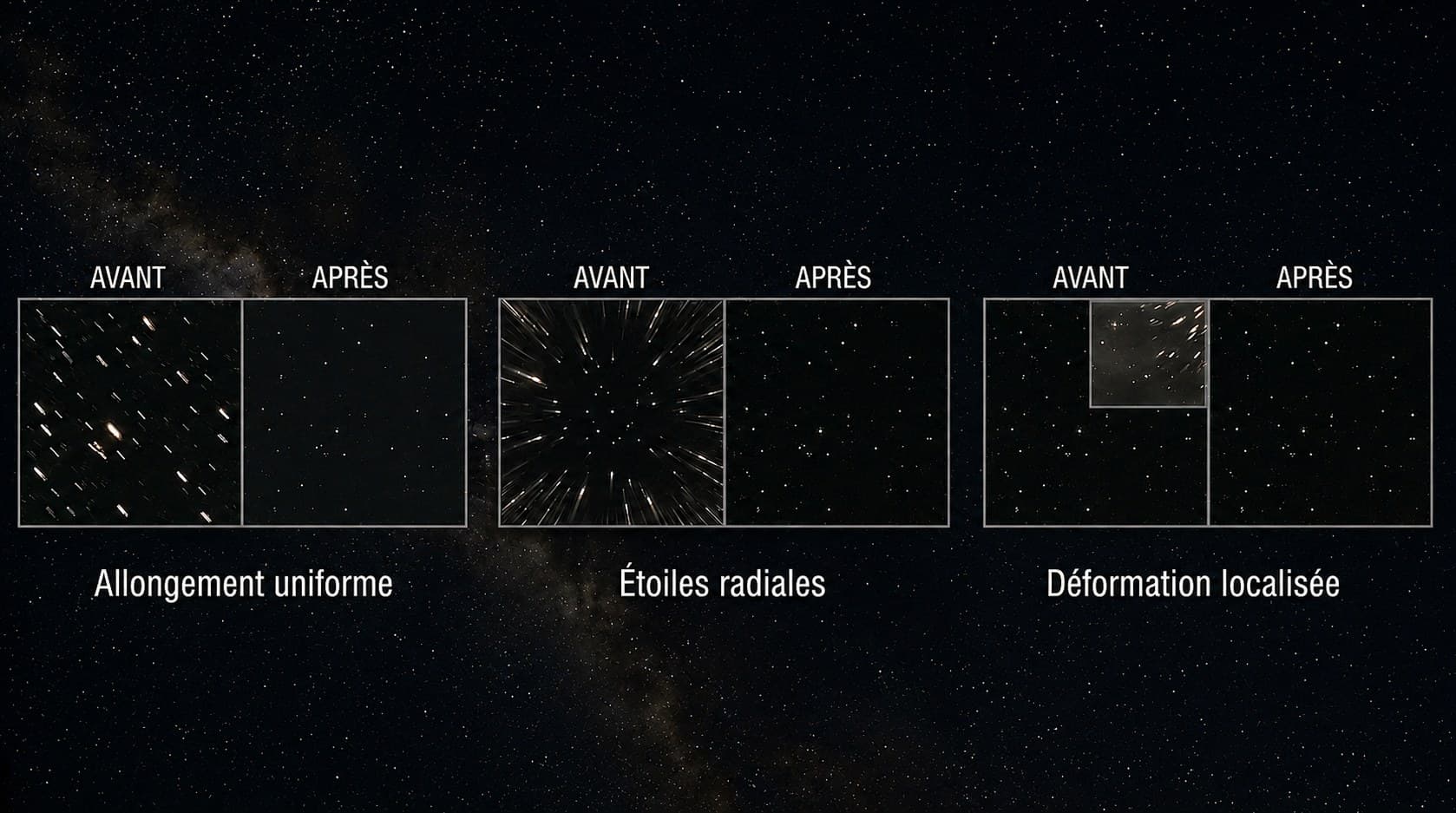
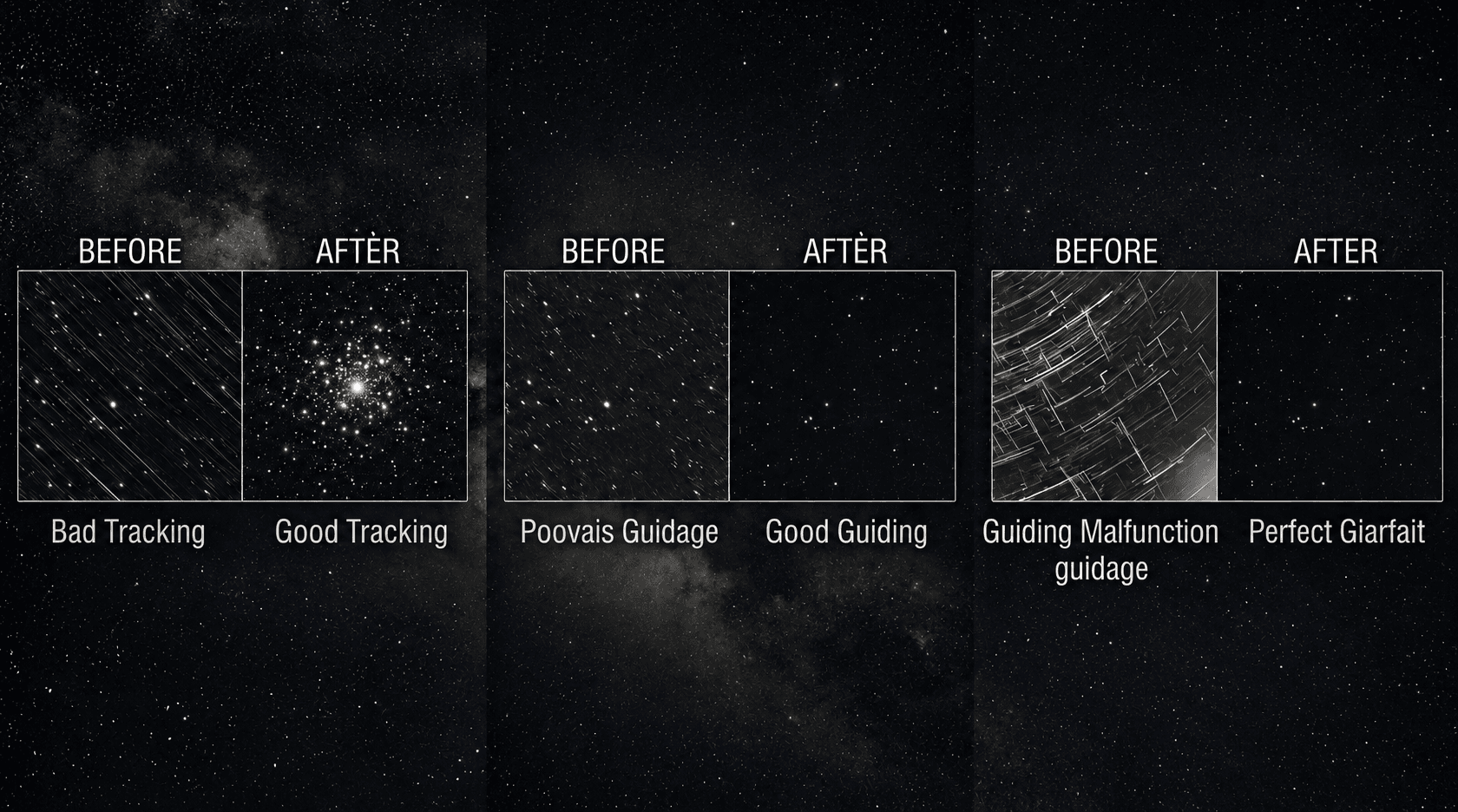
The primary diagnosis is mechanical. The PSF measurement shows 1.22 elongation at the center against a field floor of 1.08, with major-axis angles clustered around 50 degrees over most zones and a scatter of only 17.6 degrees. Elongation present at the center and oriented the same way everywhere cannot come from field optics: it is tracking drift during the exposure. At C8 focal length, 30 seconds is plenty to record it.
A softer optical component is superimposed: FWHM is minimal at the center, 12.0 pixels, and rises toward the corners up to 13.4, a ratio of 1.163 with no radial comet distortion. That is the signature of field curvature or slightly out-of-spec backfocus, amplified by the diagonal of a full-frame sensor behind a Schmidt-Cassegrain. Secondary to the tracking issue, but it adds to the general softness.
On the processing side, the nebula core and the brightest stars are clipped, with the Trapezium no longer resolved inside a white plateau. That is the classic M42 failure without a short-exposure layer. Finally, the bundle of thin arcs coming from the right edge is most likely a stray reflection in the imaging train rather than a real structure. The background itself is healthy: the measured variation corresponds to the nebula, not a gradient.
Priority actions
- Redo polar alignment and enable or tighten autoguiding, the biggest gain available on star sharpness
- Acquire a short 1 to 5 s exposure layer and blend in HDR to restore the Trapezium
- Adjust backfocus in 1 mm steps while watching corner FWHM, or move to a full-frame reducer-corrector
- Track down the stray reflection at the right edge: longer dew shield, nearby light sources, framing rotation
- Protect highlights during stretching to preserve the nebular core's tonal range