Astrophotography diagnosis of M20: Tracking drift, sensor tilt and 1 other
MasterUV IR CUT OPTOLONG16×15s
The Doc examined this image of M20 (master, UV IR CUT OPTOLONG, 16×15s). Estimated overall technical quality: 4/10. 3 defects found: Tracking drift (severity 4/5), Sensor tilt (severity 2/5), Clipped stars (severity 2/5).
&w=1920&q=75)
Info
- Cible
- M20
- Site
- Bortle 2 · rural typique (VIIRS)
- Position
- 18h02m24s · -23°01'48"
The Bortle 2 sky is excellent and the session's main asset: very dark background, negligible light-pollution gradient and M20's nebulosity already well detached despite only 4 min total integration. The 70% waxing-gibbous moon is the real caveat: although no clear lunar gradient shows here (target fairly high and background stayed clean), it caps the SNR on the Trifid's faint extensions. On an emission nebula like M20, aim for moonless nights, or at least wait for moonset, to reveal much more of the red Ha and the blue reflection halo.
Setup
- Type d'image
- Master
- Télescope
- DOBSON FLEXTUBE 300/1500 GOTO
- Caméra
- SmartEye IMX 533 color
- Filtre
- UV IR CUT OPTOLONG
- Exposition
- 16×15s
- Phase de lune
- Gibbeuse décroissante (70 %)
- FOV
- 48.0'
The Flextube 300/1500 yields a 0.80° field at 0.957"/px: comfortable framing for M20, the nebula fills the center nicely with margin. The ~1"/px sampling is ambitious and only makes sense if tracking and seeing keep up, which they don't here (FWHM ~13", drift-dominated). The real weak link is the alt-az GOTO Dobsonian mount: at 1500mm without guiding, 15s is already at the limit. Gain 350 is too high for this sensor and saturates bright stars; unity gain (~100) would be healthier. The UV/IR Cut filter suits this dark sky.
The diagnosis in detail
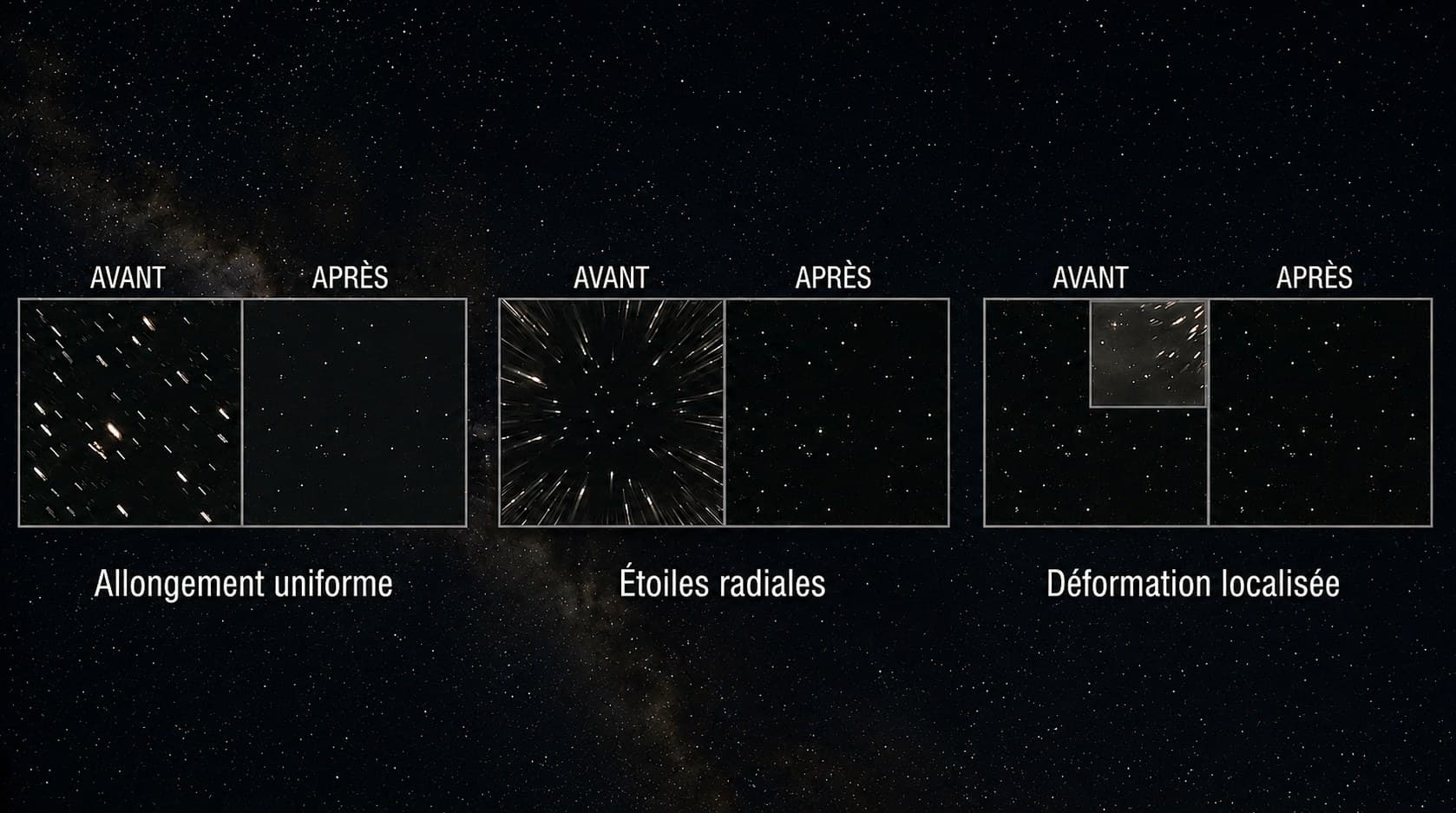
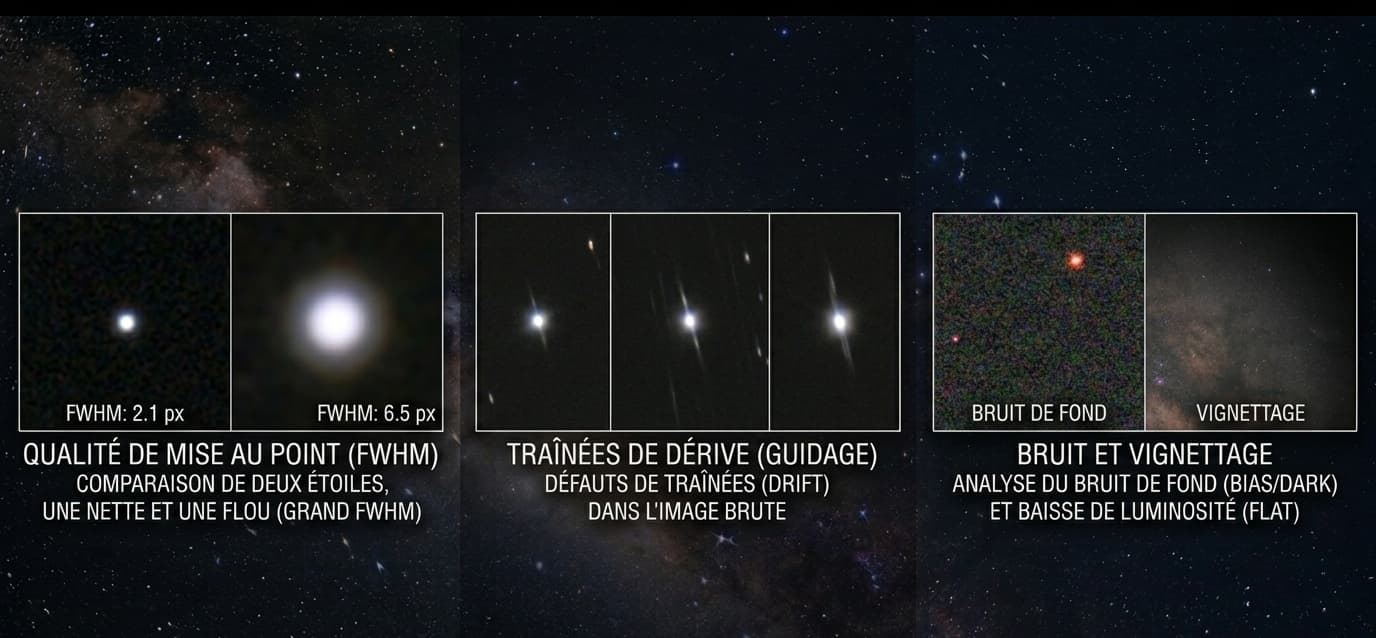
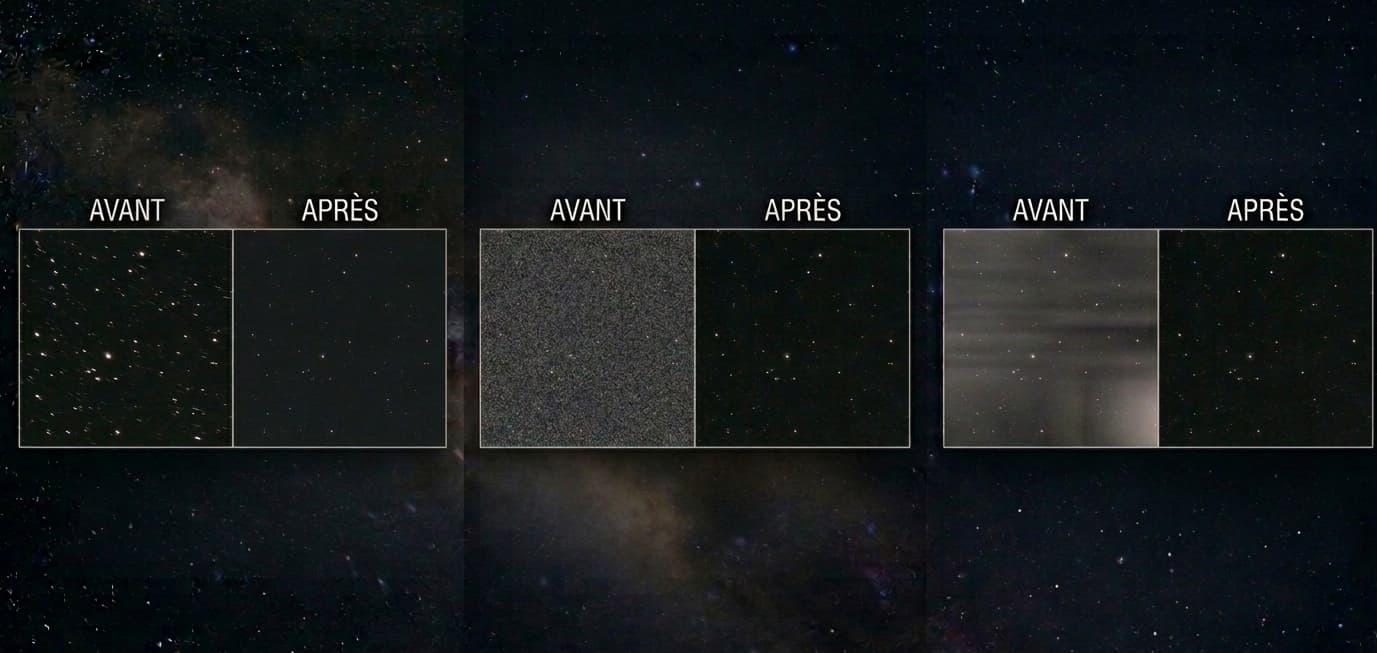
The diagnosis is unambiguous on the origin of the main defect: the PSF inspector shows nine zones all elongated in the same direction (PA 61-72°, dispersion of only 2.9°) with the MAXIMUM elongation at the center (1.67 vs a 1.41 field floor). This signature, coherent elongation present at the center, rules out an edge-of-field optical aberration and points to tracking/guiding drift: the expected behavior of an unguided GOTO alt-az Dobson at 1500mm focal length on 15s exposures. The huge FWHM (~14 px) follows directly.
The sensor-tilt candidate (slight inter-zone FWHM excess, upper/left corners a bit more spread) is measured but stays a doubtful secondary point: as long as the stars drift, the inter-zone comparison is biased and no flatness adjustment is relevant. Address it, if needed, only after fixing tracking.
On the acquisition side, gain 350 saturates a few bright star cores (loss of B-V color). The Bortle 2 sky and framing are excellent assets: with clean tracking and a more moderate gain, this setup can deliver a very fine Trifid.
Priority actions
- Fix tracking first: shorten the exposure (8-10s), refine GOTO alignment, consider an equatorial platform or EQ mount for 1500mm
- Lower the gain toward unity (~100) to stop clipping bright stars
- Take many more short subs and accumulate much more total time to offset rejected elongated frames
- Defer any tilt adjustment until the stars are round again