Astrophotography diagnosis of SH2-131: Sensor tilt, background chroma noise and 2 others
ProcessedANTLIA tri band RGB Ultra 230x240s
The Doc examined this image of SH2-131 (processed, ANTLIA tri band RGB Ultra 2, 30x240s). Estimated overall technical quality: 6/10. 4 defects found: Sensor tilt (severity 3/5), Background chroma noise (severity 3/5), Noise / underexposure (severity 3/5), Tracking drift (severity 2/5).
&w=1920&q=75)
Info
- Cible
- SH2-131
- Site
- Bortle 7 · périurbain pollué (saisi)
- Position
- 21h38m60s · +57°28'24"
Very unfavourable conditions for this target. A 97% gibbous Moon combined with a Bortle 7 sky sends the sky background through the roof: even behind an ANTLIA tri-band that cuts much of the continuum, the parasitic luminance strongly limits contrast on a faint emission nebula like SH2-131. The measurement confirms it, the background-to-black-point margin is 1.68 while a comfortably sky-limited background sits between 5 and 10. On this kind of target the tri-band saves part of the game, but 2h under these conditions is worth far less than the same time under dark skies. The right reflex is to keep full-moon nights for bright targets and reschedule SH2-131 around last quarter or new Moon.
Setup
- Type d'image
- Traitée
- Télescope
- skywatcher 80ED avec reducteur 0.85x
- Caméra
- ZWO ASI2600MC AIR
- Filtre
- ANTLIA tri band RGB Ultra 2
- Monture
- MLAStro SAL-33
- Exposition
- 30x240s
- Phase de lune
- Gibbeuse décroissante (97 %)
- FOV
- 2.33°
Setup consistent with the target. The 80ED reduced at 0.85x gives a 2.33 degree field, ample to frame the whole SH2-131 complex and its nebular surroundings, with the elephant trunk nicely placed in the upper third. Sampling lands in the comfortable zone for typical seeing, confirmed by FWHM around 2.9 to 3.3 px at center and on the healthy edges. The ANTLIA tri-band is the right call under Bortle 7, it is in fact what makes this image possible despite the Moon. The 240s subs are reasonable for this focal ratio, but they make the frame very sensitive to the measured tracking drift: polishing polar alignment and guiding pays off more here than extending the exposures further.
The diagnosis in detail
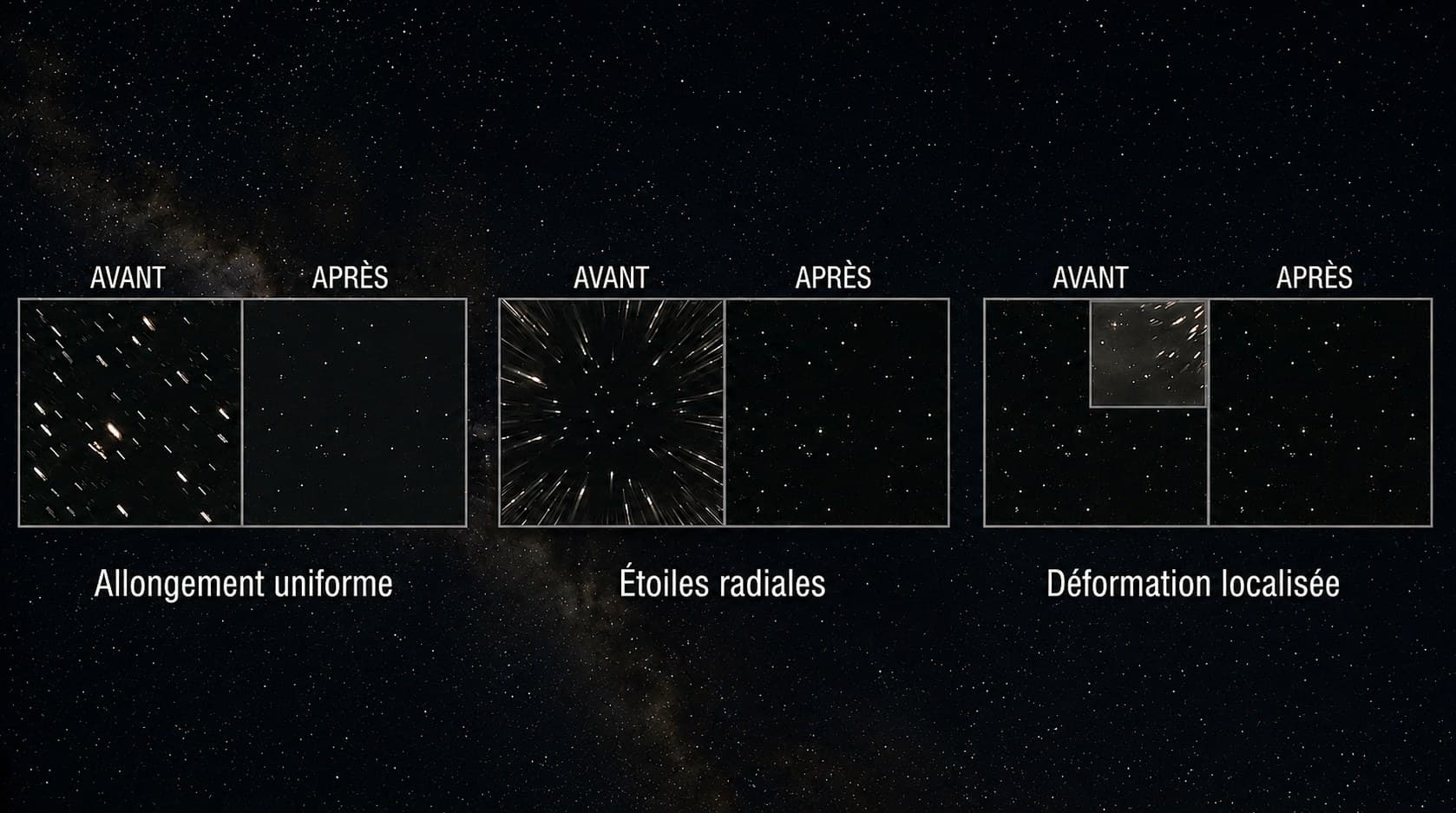
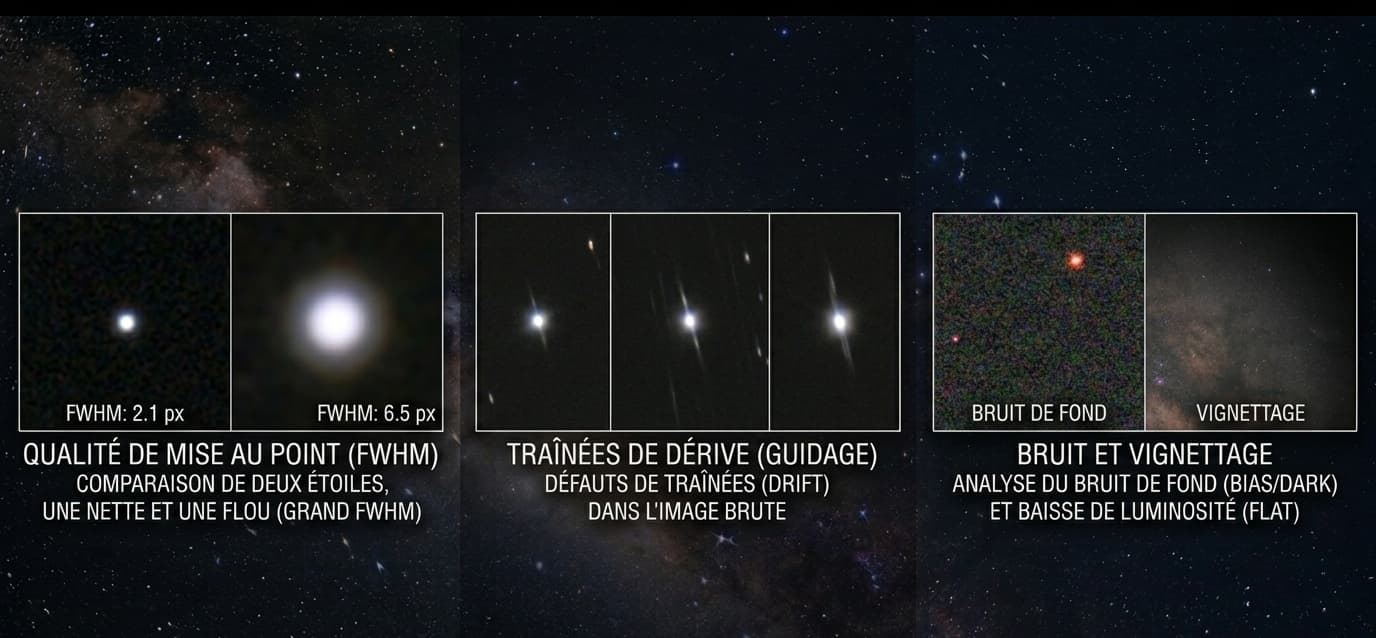
The diagnosis reads on two separate levels. On star shape, the PSF plate shows a sharp center (FWHM 2.9 px) and a degradation that is not symmetric: the whole left side is bloated (TL at 4.9 px, BL at 3.9 px with elong 1.22) while the right side stays clean (TR at 3.3 px, elong 1.03). This single-axis asymmetry, with a corner/center ratio of 1.81, is the classic signature of a tilted focal plane, not a backfocus error which would degrade all four corners equally. On top of it sits an elongation that reaches the center (1.23 against a 1.03 floor) with consistent angles from zone to zone, pointing to residual tracking drift over 240s subs.
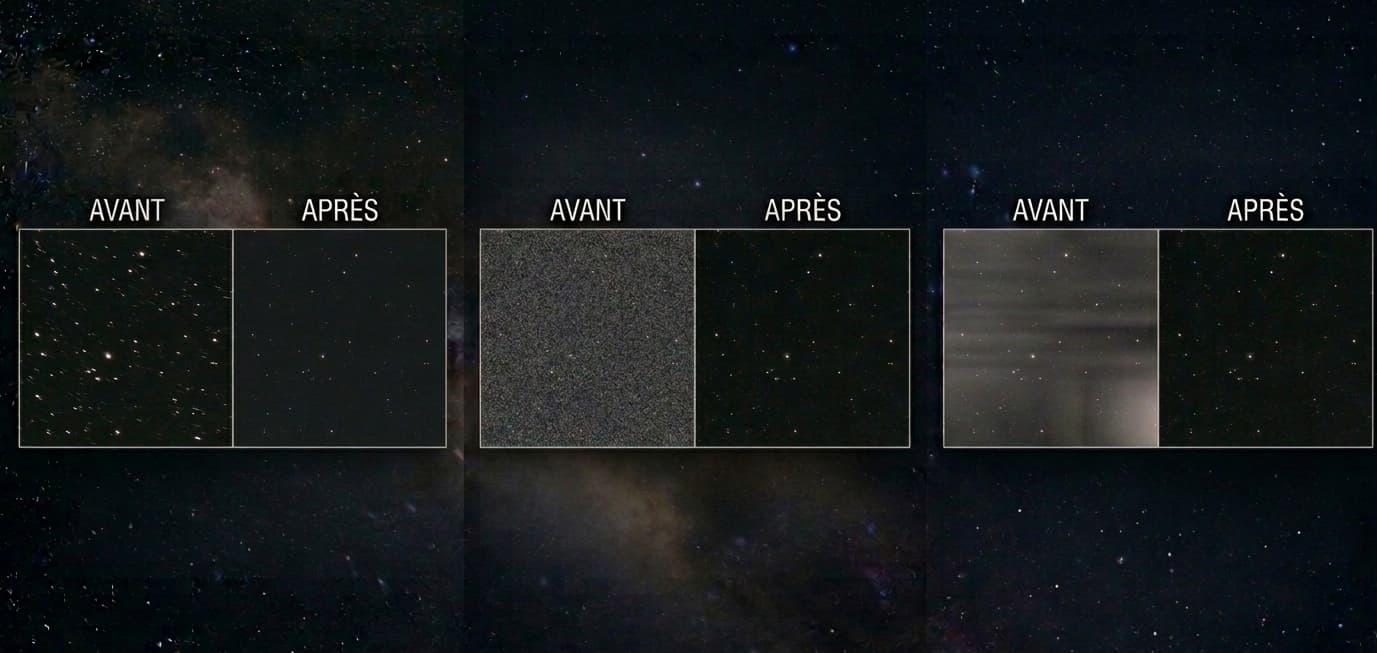
On the signal side, everything stems from the same cause: 2h of integration under Bortle 7 with a nearly full Moon. The background is not sky-limited, luminance grain remains clearly present, and the stretch needed to pull out the nebulosity raises distinct colour mottling in the dark areas. Comparison with the DSS does validate most of the structures: the dark clouds, the trunk and the outer filaments are real, there is no parasitic gradient to remove.
As a priority, cumulative exposure time on moonless nights is what will transform this image; the tilt comes next, since it is mechanically fixable and costs little time.
Priority actions
- Reschedule SH2-131 outside the moon window and accumulate at least 8 hours of integration
- Fix the coplanarity of the imaging train on the left side (threaded spacers, tilt adapter, checked with an aberration inspector)
- Refine polar alignment and guiding to bring central elongation below 1.10 on 240s subs
- Reprocess with dedicated chroma-only noise reduction before the final stretch
- Enable generous dithering between subs to decorrelate colour noise