Astrophotography diagnosis of M57: Tracking drift, backfocus error and 1 other
RawIr-Cut180s21 sept. 2026
The Doc examined this image of M57 (raw, Ir-Cut, 180s). Estimated overall technical quality: 6/10. 3 defects found: Tracking drift (severity 3/5), Backfocus error (severity 2/5), Light pollution gradient (severity 2/5).

Info
- Cible
- M57
- Date
- 21 sept. 2026, 18:42
- Lune
- Croissant décroissant 23.6% (21.6° d'alt., 66.5° de la cible)
- Site
- Bortle 6 · banlieue dense (VIIRS)
- Position
- 18h34m50s · +38°58'43"
Average but workable conditions. Bortle 6 and a gibbous Moon at 21.6° altitude, 66.5° from M57: the lunar contribution stays indirect at that separation, but it adds to the urban glow and explains much of the 11% background gradient measured. M57 works in your favour: a compact, bright planetary nebula with high surface brightness, far more tolerant of an elevated background than a galaxy or a faint diffuse nebula. The reported 2.5" seeing matches the 4.55 px central FWHM, roughly 2", so you are close to the atmospheric limit. Ideally, wait for moonset and meridian passage to gain contrast on the outer ring.
Setup
- Type d'image
- Brut
- Télescope
- C11
- Caméra
- ZWO ASI533MC Pro
- Filtre
- Ir-Cut
- Monture
- EQ6r pro
- Exposition
- 180s
- Phase de lune
- Gibbeuse croissante (76 %)
- Seeing
- 2.5
- FOV
- 22.0'
A coherent setup in principle, but oversampled. At 1764mm and 0.44"/px under 2.5" seeing, each star spreads over five to six pixels: you gain no real detail, you lose signal per pixel, and you make tracking unforgiving. Software binning 2 at stacking would return SNR at no cost in useful resolution. The 0.37° field, on the other hand, suits M57 perfectly, which sits comfortably centred with no risk of overflow. On the settings side: gain 100 at unity on the ASI533MC, offset 20 with no dark clipping, all healthy. Two points to watch: the 2.83 background-to-black-point margin means the exposure is a little short of being truly sky-limited in Ir-Cut, and the 17.9°C sensor temperature is high, cooling to -10°C would markedly cut dark current.
The diagnosis in detail
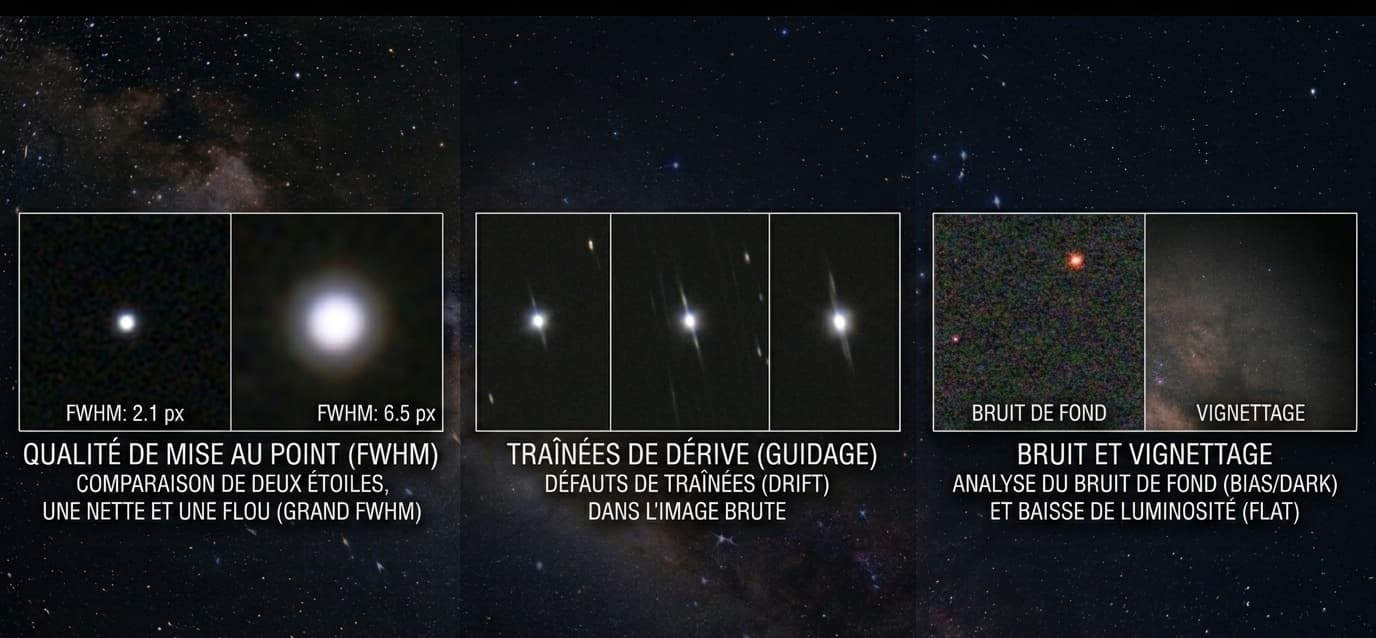
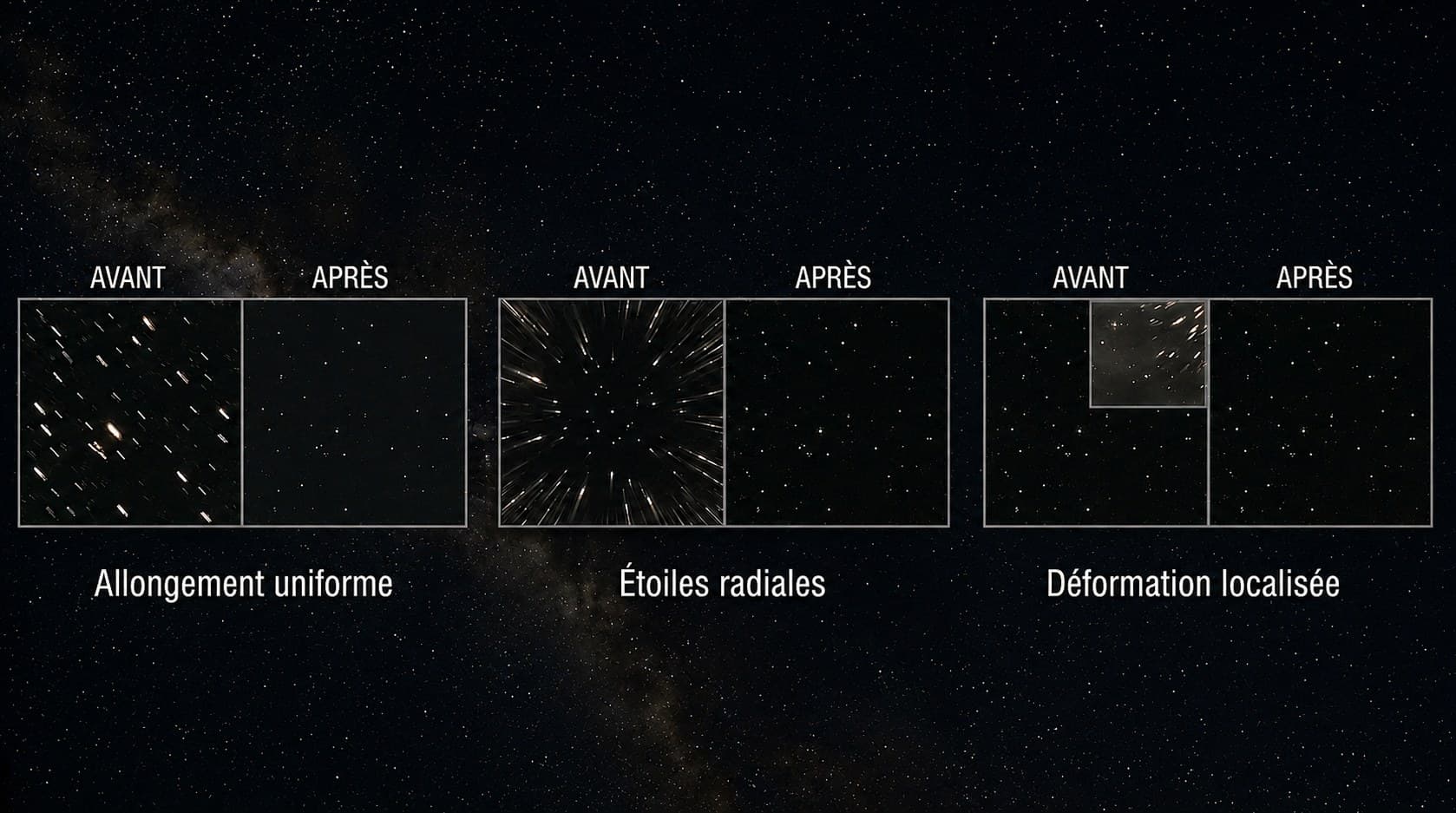
Two distinct causes overlap on star shape, and the measurements separate them cleanly. Centre elongation (1.18 against a 1.04 floor) cannot come from any field optic: on axis, a refractor as much as an SCT delivers round stars. That elongation, with position angles clustered around 40-60° and a spread of only 16°, points to mechanical drift during the 180 second exposure. At 0.44"/px, a single arcsecond of guiding error is enough to produce exactly what you see: this setup forgives nothing.
On top of that, FWHM rises from 4.55 px at centre to 5.85 px in the upper-left corner, a ratio of 1.274. Corner stars are enlarged ovoids, not radial commas: so this is not coma but residual field curvature or a mis-set backfocus. With the TR corner staying sharper than the other three, a mild tilt component is probably superimposed, but it is too faint to assert on a single noisy sub.
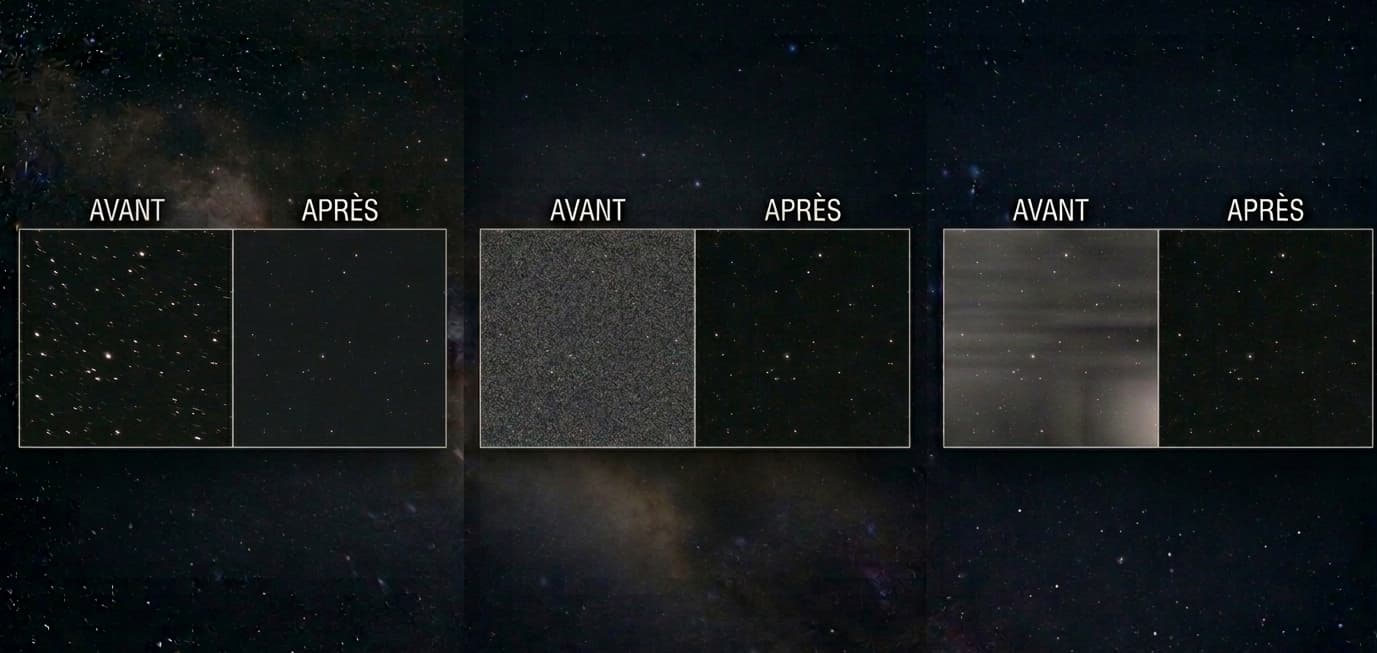
The rest is healthy. M57 is well exposed, its ring shows the turquoise-to-red gradient with no clipped plateau, no bright star burns out, framing is centred. The background gradient and the satellite trail are handled respectively in post-processing and by sigma rejection.
Priority actions
- Fix guiding first: recalibrate near the meridian and target RMS below 0.5" before anything else
- Adjust the backfocus distance between corrector and sensor, Ir-Cut filter included, to bring the corner/centre FWHM ratio below 1.15
- Enable sensor cooling at -10°C instead of the current 17.9°C
- Stack with binning 2 to offset the 0.44"/px oversampling and regain SNR
- Enable dithering and accumulate at least 15 subs so sigma rejection removes satellite trails