Astrophotography diagnosis of NGC 6992: Sensor tilt
Raw300s03 juil. 2026
The Doc examined this image of NGC 6992 (raw, 300s). Estimated overall technical quality: 7/10. 1 defect found: Sensor tilt (severity 3/5).
&w=1920&q=75)
Info
- Cible
- NGC 6992
- Date
- 03 juil. 2026, 22:18
- Lune
- Croissant croissant 14.1% (2.4° d'alt., 47.9° de la cible)
- Site
- Bortle 2 · rural typique (VIIRS)
- Position
- 20h57m38s · +31°44'28"
Excellent conditions: Bortle 2 (VIIRS) is a very dark sky, ideal for an emission target like the Veil, with a favorable background SNR from 300s onward. The Moon is a non-issue: a ~14% crescent only 2.4 degrees above the horizon and 47.9 degrees from the target, its contribution is negligible, especially since in Hα moonlight is strongly rejected by the filter. The background/black-point margin (e_margin 1.89) is low but that is NORMAL in narrowband at 300s, not underexposure. Nothing to change sky-side, you can fully exploit these nights.
Setup
- Type d'image
- Brut
- Télescope
- EQMod Mount
- Caméra
- ZWO ASI585MM Pro
- Exposition
- 300s
- Phase de lune
- Gibbeuse décroissante (83 %)
- FOV
- 1.70°
Setup well matched to the target. At 375mm focal length, the 1.70 degree field comfortably frames the eastern segment of the Veil (NGC 6992/6995) with margin around it: sound composition. The 1.595"/px sampling is ideal under typical seeing, neither over- nor under-sampled. The ASI585MM Pro cooled to -17C is thermally healthy (no amp glow expected at this temperature). Gain 220 is high for this sensor: watch bright-star saturation on the subs, but the well capacity is managed here. The only hardware point to fix is mechanical (optical-train tilt), not an instrument-choice issue.
The diagnosis in detail
The image is a very good starting point: the center of the field is sharp, the filamentary nebulosity of the eastern Veil shows finely, and the Bortle 2 background delivers contrast few sites allow. Comparison with the DSS reference confirms that all diffuse structures are the real nebula, no stray gradient is present (the background map shows only a 5% micro-variation, not significant).
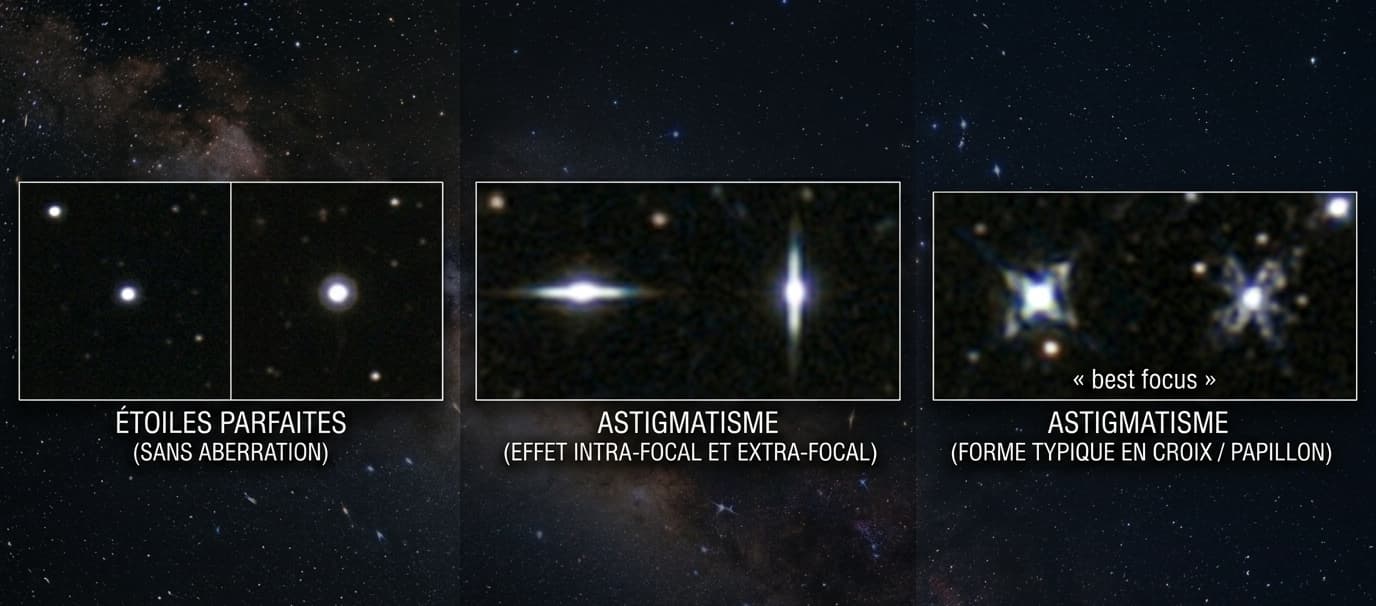
The defining defect is optical and purely mechanical: sensor tilt. The aberration plate is unambiguous, the center is round (elong 1.08, at the field floor) while both top corners blow up to elong 1.8-1.9 as the bottom corners stay under 1.4. This is neither coma (no radial symmetry across the 4 corners) nor backfocus (clear diagonal asymmetry), but a sensor plane tilted relative to the optical axis. Tracking, on the other hand, is good: dispersed PAs and a round center rule out mount drift.
The satellite trail at the top is anecdotal on a single sub and will vanish under sigma rejection. The path forward is clear: dial out the tilt before launching the night's series, under this sky every sub counts.
Priority actions
- Adjust sensor tilt with a push-pull device and iterate on the aberration plate until the 4 corners match, before collecting the series
- Evenly tighten all optical-train rings and check focuser/filter-drawer flatness
- Stack enough dithered subs so sigma rejection removes the satellite trail
- Watch bright-star saturation at gain 220 on the 300s exposures