Astrophotography diagnosis of M57: Sensor tilt
ProcessedZwo ircut 2h59
The Doc examined this image of M57 (processed, Zwo ircut, 2h59). Estimated overall technical quality: 8/10. 1 defect found: Sensor tilt (severity 2/5).
&w=1920&q=75)
Info
- Cible
- M57
- Site
- Bortle 5 · banlieue résidentielle (VIIRS)
- Position
- 18h53m35s · +33°01'44"
Average conditions well handled. Bortle 5 and a 71% gibbous Moon normally impose a milky background, yet your 3h integration plus processing fully neutralized the gradient (measured background flat, negative plane R2 = no detectable slope). On a compact, bright planetary nebula like M57, rich in O III and Halpha, the lunar impact stays limited even in broadband IR-cut. To push the faint ring extensions further, a moonless night would clearly improve the outer halo SNR, but for this result the conditions were workable.
Setup
- Type d'image
- Traitée
- Télescope
- C11 reducteur focale celestron 6.3
- Caméra
- Asi585mc
- Filtre
- Zwo ircut
- Monture
- Eq6r pro
- Exposition
- 2h59
- Phase de lune
- Gibbeuse croissante (71 %)
- Seeing
- 2.5
- FOV
- 2.50°
Coherent setup with one caveat. The C11 with a 0.63 reducer (~1764 mm) yields very fine sampling with the ASI585 (~0.34"/px), heavily oversampled for 2.5" seeing: you are not exploiting the full theoretical resolution, but the compact target M57 tolerates this tight framing well. The 2.5 degree field leaves the nebula small and off-center top-right, which remains an acceptable composition choice. The broadband IR-cut filter suits a colorful planetary. Watch the orthogonality of the optical train (reducer + camera) that produces the slight measured tilt.
The diagnosis in detail
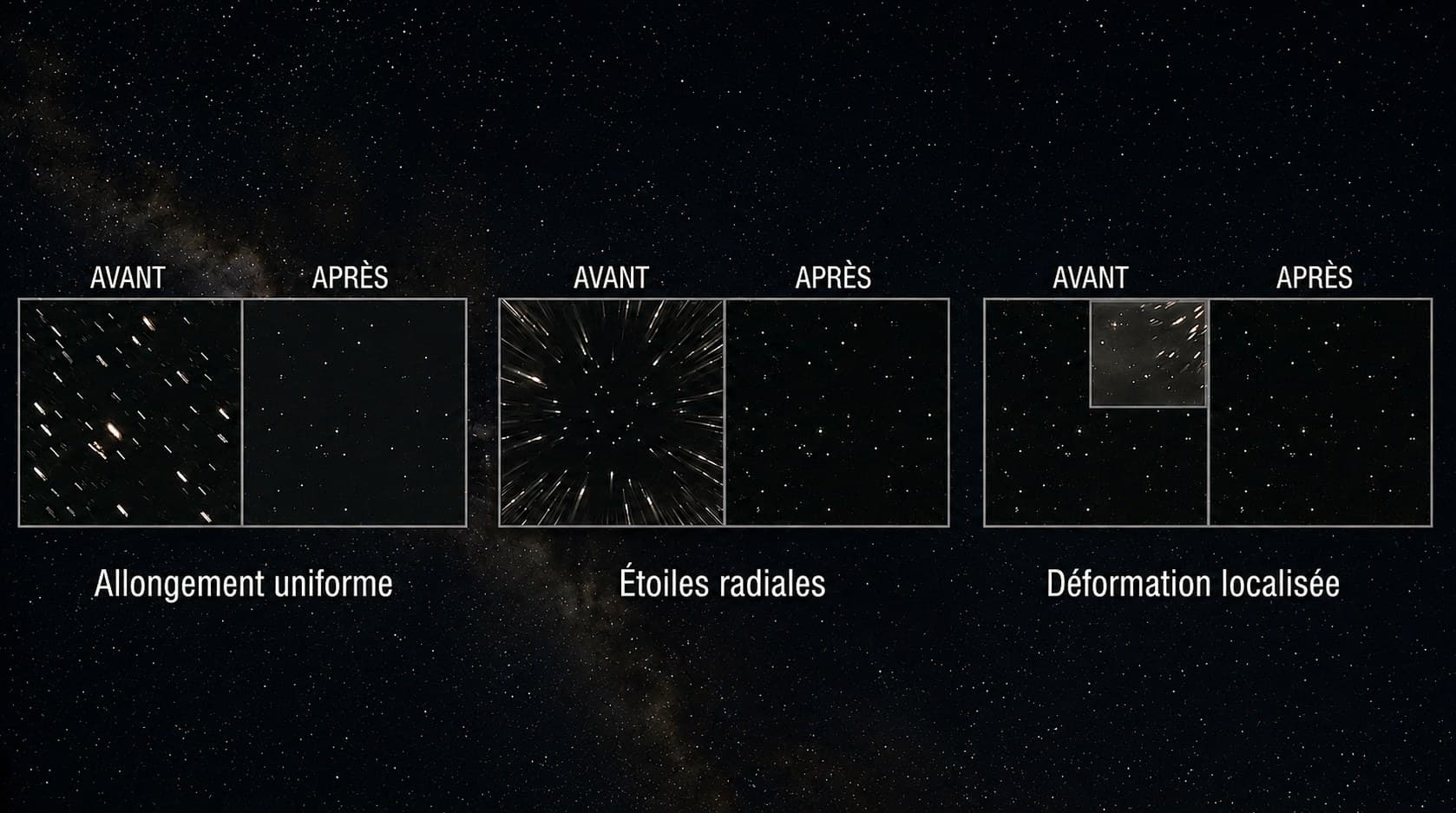
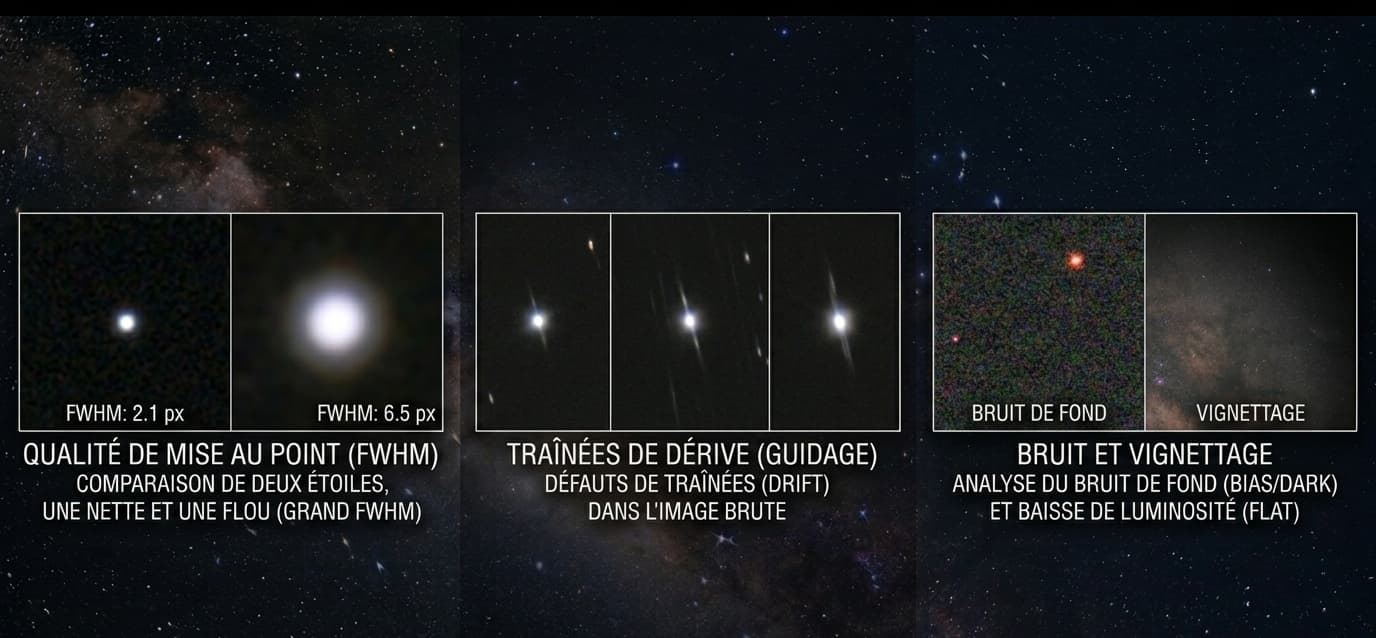
The diagnosis is very favorable. The PSF panel shows clean, near-round stars at center (elong 1.08 against a field floor of 1.05, PA scatter of only 8 degrees), the signature of flawless EQ6R-Pro tracking over subs of this length: no drift, oscillation or periodic error visible. FWHM of 3.6 to 4.9 px confirm fine stars, slightly oversampled relative to the seeing, hence optics-limited rather than mount-limited.
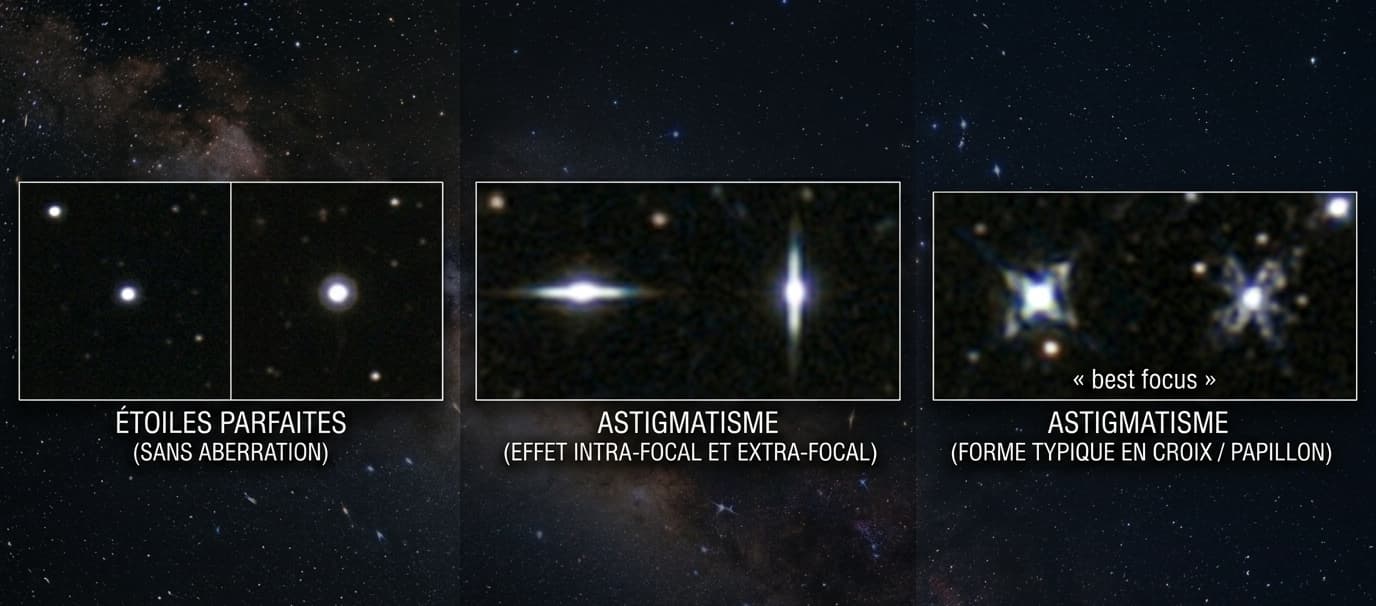
The only measurable deviation is a mild sensor tilt: the corner/center ratio of 1.214 stays below the critical threshold, but the asymmetry is clearly horizontal (0.097 versus 0.036 vertical), with the right side (R/TR around 4.9 px) more bloated than the left (around 3.7-3.9 px). This is an orthogonality flaw of the optical train, not coma or backfocus (which would be symmetric). At this amplitude it does not hurt the M57 rendering but is worth correcting for future wide star fields.
On calibration and processing, nothing to fault: flat and neutral sky background, no walking noise, no dust donuts, no marked chroma noise in the dark areas, faithful ring colors. Clean work.
Priority actions
- Correct the orthogonality of the optical train (reducer + camera) to resolve the slight horizontal tilt
- Re-validate corner-to-corner symmetry with a fresh aberration panel after adjustment
- To gain on the ring's outer halo, target a moonless night to improve the faint-extension SNR