Astrophotography diagnosis of NGC 6888: Tracking drift and sensor tilt
Raw300s20 juin 2026
The Doc examined this image of NGC 6888 (raw, 300s). Estimated overall technical quality: 6/10. 2 defects found: Tracking drift (severity 3/5), Sensor tilt (severity 2/5).
&w=1920&q=75)
Info
- Cible
- NGC 6888
- Date
- 20 juin 2026, 21:56
- Lune
- Gibbeuse décroissante 60.6% (13.3° d'alt., 122° de la cible)
- Site
- Bortle 2 · rural typique (VIIRS)
- Position
- 20h13m14s · +38°32'36"
Excellent conditions for this target. Bortle 2 ensures a very dark background and favorable SNR, ideal for the Crescent's low surface brightness. The gibbous Moon (60.6%) is neutralized by its low altitude (13.3°) and especially the 122° separation, and in Hα lunar light sensitivity is minimal anyway. No sky-side constraint: you can stack long runs without fear of a lunar gradient. Use this sky to pile up integration and bring out the nebula's faint extensions.
Setup
- Type d'image
- Brut
- Télescope
- EQMod Mount
- Caméra
- ZWO ASI585MM Pro
- Exposition
- 300s
- Phase de lune
- Premier croissant (33 %)
- FOV
- 1.70°
Setup is well matched to the target. At 375mm and 1.595''/px, NGC 6888 (about 20'x10') is comfortably framed within the 1.70° field, with room for the background and the surrounding nebulosity seen in the DSS. Sampling at 1.6''/px suits current seeing and is not the limiting factor here (center FWHM ~3 px). Gain 220 on the ASI585MM and -13°C are healthy. The 2.19 sky/black-point margin is low but NORMAL for Hα at 300s under a dark sky, do not penalize it. The real lever is tracking quality, not the optical setup.
The diagnosis in detail
This is a solid starting sub: the Bortle 2 sky gives a smooth background and the Crescent's structure is already readable, with faint interstellar cirrus in the corners that match the nebulosity visible in the DSS (real, not an artifact). The diagnosis therefore focuses on star shape, measured by the PSF panel.
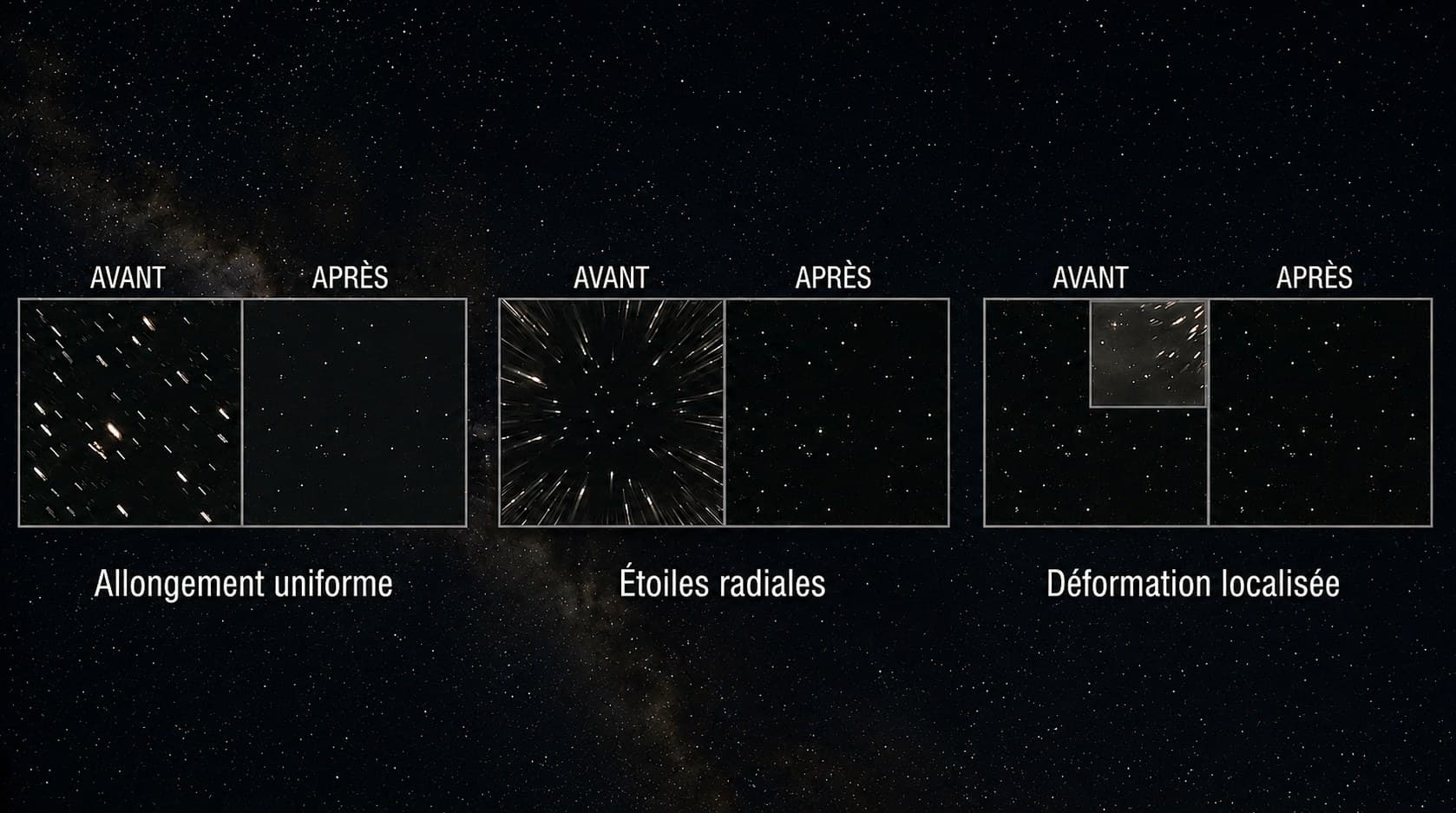
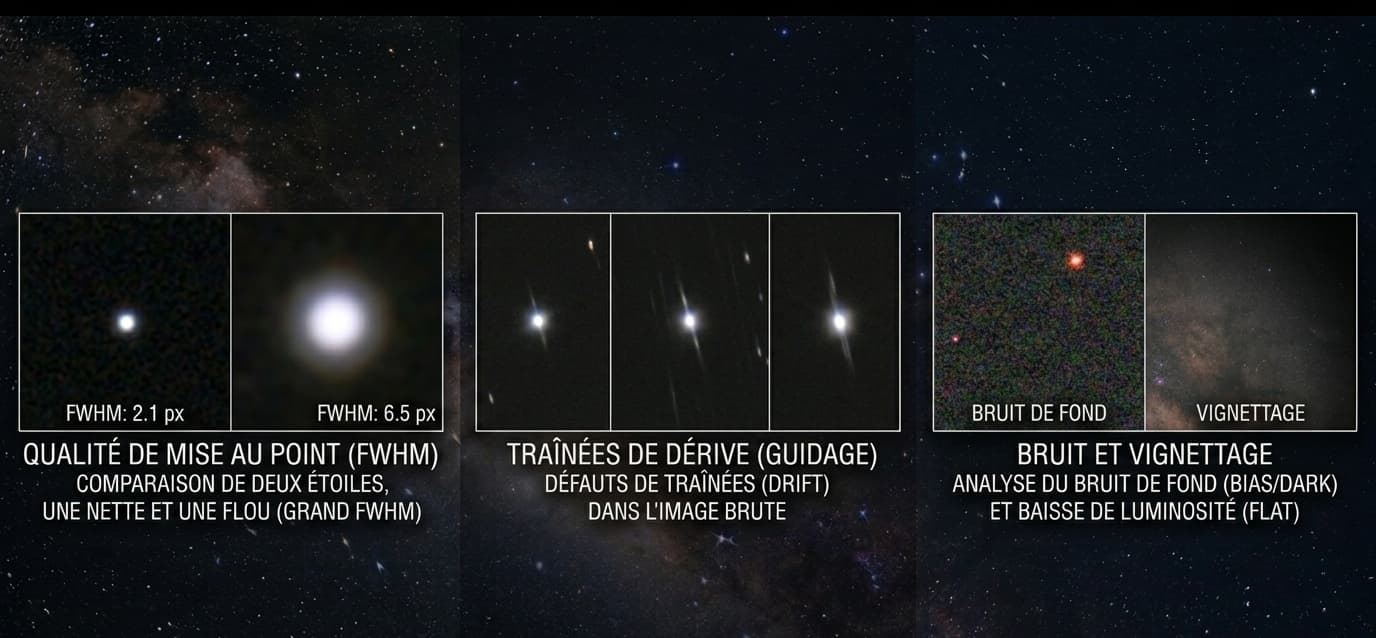
The dominant defect is tracking drift: elongation reaches the field center (elong 1.51 vs a 1.36 floor) and above all the stretch direction is very uniform across zones (PA clustered around -40°, 11° dispersion). This signature, a uniform oriented stretch everywhere, points unambiguously to mount/guiding rather than an optical field aberration, which would spare the center.
A more subtle tilt component is layered on: the left side (BL/L) is clearly more degraded than the right (BR/R), a single-axis asymmetry that drift alone does not explain. It stays secondary and hard to quantify until tracking is fixed. The path forward is sequential: fix tracking first, then re-run a PSF panel on a well-guided sub to confirm and quantify the residual tilt.
Priority actions
- Fix tracking: refine polar alignment, enable/optimize autoguiding, or shorten subs to 120-180s
- Check balance and eliminate flexure in the optical train during the exposure
- Re-run a PSF test on a well-guided sub to isolate and confirm sensor tilt
- If tilt is confirmed, adjust sensor orthogonality (shims/tip-tilt) and adapter tightness