Astrophotography diagnosis of NGC 6995: Sensor tilt
ProcessedAntlia Triband II RGB Ultra Filter - 2"96×6020 juin 2026
The Doc examined this image of NGC 6995 (processed, Antlia Triband II RGB Ultra Filter - 2", 96×60). Estimated overall technical quality: 8/10. 1 defect found: Sensor tilt (severity 2/5).
&w=1920&q=75)
Info
- Cible
- NGC 6995
- Date
- 20 juin 2026, 00:00
- Site
- Bortle 7 · périurbain pollué (saisi)
- Position
- 20h56m18s · +31°24'14"
35% Moon and Bortle 7 sky: average conditions on paper, but your target is an emission supernova remnant (Ha/OIII) and your Antlia Triband filter isolates exactly those lines, neutralizing most of the urban light pollution and lunar background. This is precisely the case where you can image despite a bright sky. The result confirms it: well-controlled background and contrasty nebulosity. If you want to push SNR on the faintest OIII extensions, aim for a moonless window, but it's not required here.
Setup
- Type d'image
- Traitée
- Télescope
- Celestron Origin
- Caméra
- Celestron Origin 678C
- Filtre
- Antlia Triband II RGB Ultra Filter - 2"
- Monture
- Celestron Origin Single Fork-Arm Mount
- Exposition
- 96×60
- Phase de lune
- 35%
- Notes
- PixInsight
- FOV
- 1.51°
Setup perfectly matched to the target. At 335 mm f/2.2 the 1.51deg field frames the Eastern Veil well, and the 0.62''/px sampling is oversampled relative to typical seeing, which isn't penalizing here since your FWHM drop to ~1.7 px: you are using the resolution well. The triband filter is the right choice for a remnant under Bortle 7 with Moon. The 96x60s give 1h36 of integration, enough for this signal level, but doubling or tripling total time would clearly strengthen the faintest blue OIII filaments.
The diagnosis in detail
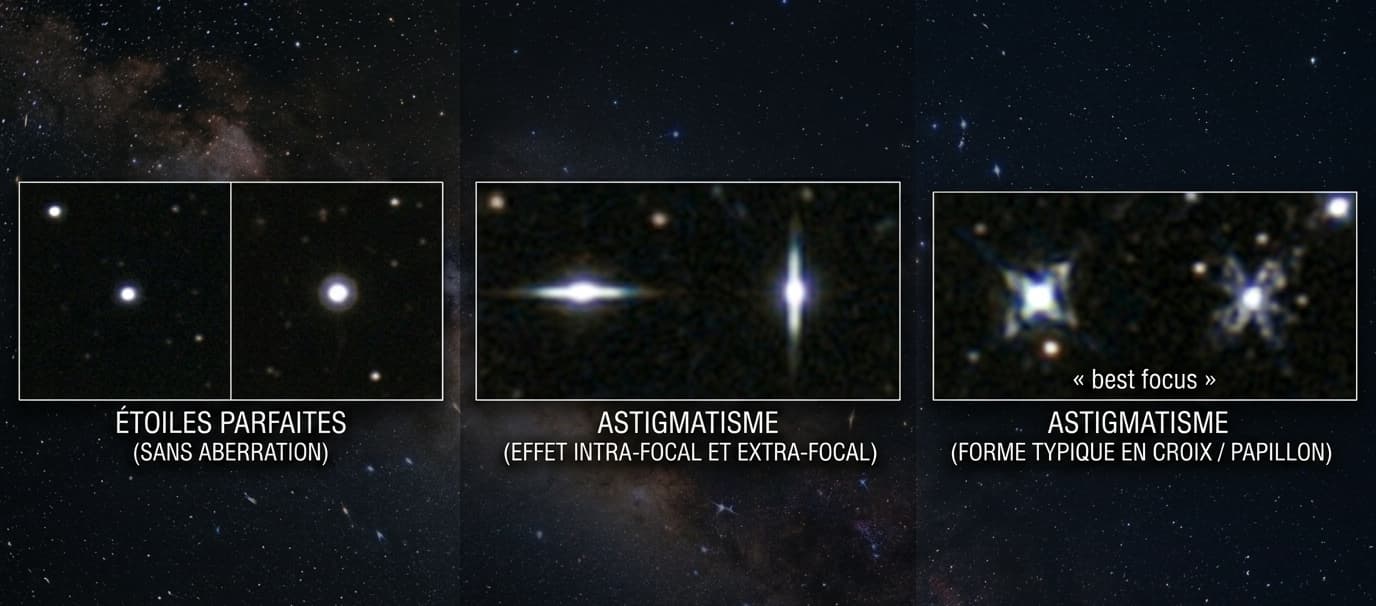
Overall an excellent image, and the diagnosis amounts to a quantified validation rather than a defect list. The PSF plate is exemplary: elongation between 1.03 and 1.08 across all nine zones, FWHM from 1.57 to 1.98 px, PA dispersion of 36deg (a sign of round stars rather than coherent directional elongation). Both the fork-arm mount tracking and the focus are therefore on point, which explains tight pinpoint stars over the whole field.
The only measured item is a very mild residual sensor tilt: the center is sharpest and the bottom-right corner the most spread (corner/center ratio 1.19, just below a real tilt threshold). It is cosmetically invisible and I classify it as a simple point of attention, severity 2, with no action required on a factory-sealed sensor.
On the background, the illumination map shows edges slightly brighter than the center (-12%) and a weak 10% plane, but with very low R2 (0.17-0.18): the model doesn't hold, because the field is dominated by real nebulosity and a rich star background, confirmed by the DSS. So it is neither vignetting nor an instrumental gradient, and no background defect is retained.
Priority actions
- Increase total integration time (aim for 3-5h) to bring out the faintest blue OIII extensions
- Prefer a moonless night to further improve background SNR, no urgency given the triband filter