Astrophotography diagnosis of N?buleuse de la Grotte: Tracking drift
Raw180s13 oct. 2026
The Doc examined this image of N?buleuse de la Grotte (raw, 180s). Estimated overall technical quality: 7/10. 1 defect found: Tracking drift (severity 2/5).

Info
- Cible
- N?buleuse de la Grotte
- Date
- 13 oct. 2026, 19:41
- Lune
- Gibbeuse décroissante 90% (sous l'horizon)
- Site
- Bortle 1 · ciel pristine (VIIRS)
- Position
- 22h59m20s · +62°22'29"
Near ideal conditions: Bortle 1 and a gibbous Moon below the horizon, 122 degrees from the target, so no lunar contribution is possible. The sky background is indeed very low (median 0.02, background to black point margin e_margin 1.93) and no instrumental gradient is measurable. On a faint emission nebula like the Cave (Sh2-155), this dark sky is exactly what you need: you can work in broadband RGB without a light pollution filter and recover the diffuse H-alpha without fighting a parasitic background. The low e_margin simply reflects a very dark sky combined with a 180s exposure at f/1.9, not a problematic underexposure.
Setup
- Type d'image
- Brut
- Télescope
- C11+Hyper+Uranus
- Caméra
- Poseidon-C PRO
- Exposition
- 180s
- Phase de lune
- Premier croissant (7 %)
- FOV
- 2.49°
A coherent combination: 540mm at f/1.9 gives a 2.49 degree field, plenty to frame Sh2-155 and its surroundings, and the nebula sits well inside the frame. Sampling at 1.44 arcsec/px is comfortable for typical seeing, and the measured FWHM (4.2 px, about 6 arcsec) shows that tracking and the atmosphere are the limiting factors, not the optics or the sensor. Gain 125 on the Poseidon-C PRO and offset 50 are healthy: no dark clipping (0%) and only 0.03% saturated pixels, so dynamic range is preserved. Cooling at -20C is perfectly suited. With such a focal ratio, 120s exposures would be enough to stay sky-limited under this sky while reducing sensitivity to drift.
The diagnosis in detail
The diagnosis is simple and clear: a single measured anomaly, mechanical in origin, on an otherwise technically very successful frame. Star elongation is 1.18 at field centre while the field floor sits at 1.04, and the major axis direction stays consistent from zone to zone (PA dispersion of 14 degrees). This signature rules out field aberrations: if the problem came from the optics or backfocus, the centre would be round and only the edges would degrade. Yet the corner/centre FWHM ratio is 1.023, essentially perfect for a C11 at f/1.9, which is remarkable at such an aperture ratio.
The cause therefore lies with tracking over the 180 second exposure: slow drift, polar alignment, or flexure in the imaging train. The amplitude stays modest (degradation does not exceed about fifteen percent relative to the floor), which explains why the sub still looks good overall.
Every other indicator is green. The sky background is very low and homogeneous, no instrumental gradient is measurable, the histogram shows no dark clipping and only 0.03% saturated pixels. Comparison with the DSS confirms that the faintly reddish central nebulosity is indeed Sh2-155, not a background artefact. It simply needs far more integration to stand out.
Priority actions
- Tighten tracking: check polar alignment and enable autoguiding, aiming for RMS below 0.7 arcsec
- Try 120s exposures to limit the impact of drift, the Bortle 1 sky and f/1.9 allow it with no SNR loss
- Check mechanical flexure in the C11 imaging train before the next session
- Accumulate several hours of integration: the Cave is faint and a single sub only hints at the nebulosity
Similar diagnoses

N?buleuse de la Grotte
Light pollution gradient

N?buleuse de la Grotte
Residual vignetting

M 27
Sensor tilt
Related articles
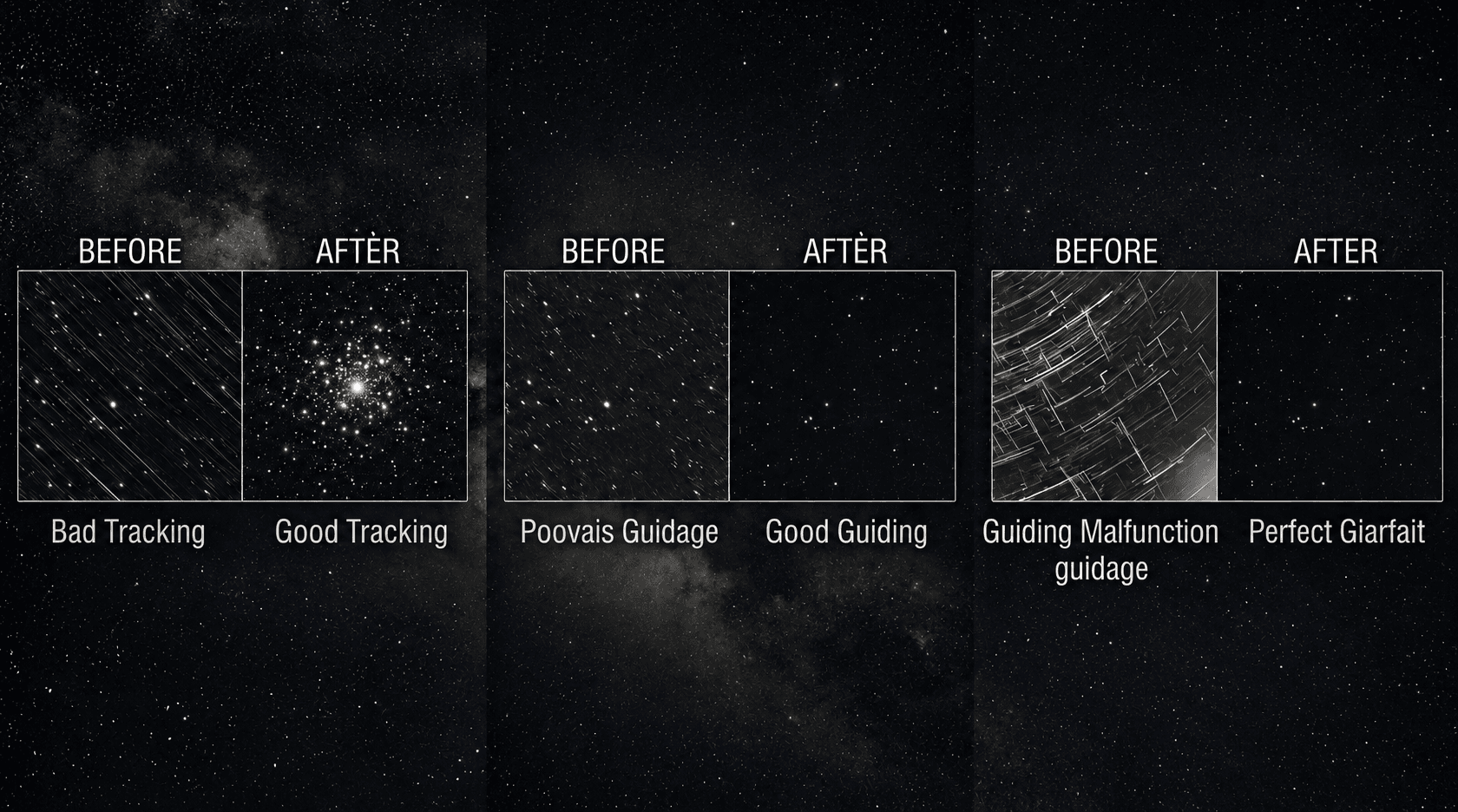 Astrophotography guiding: tuning PHD2 and correcting tracking
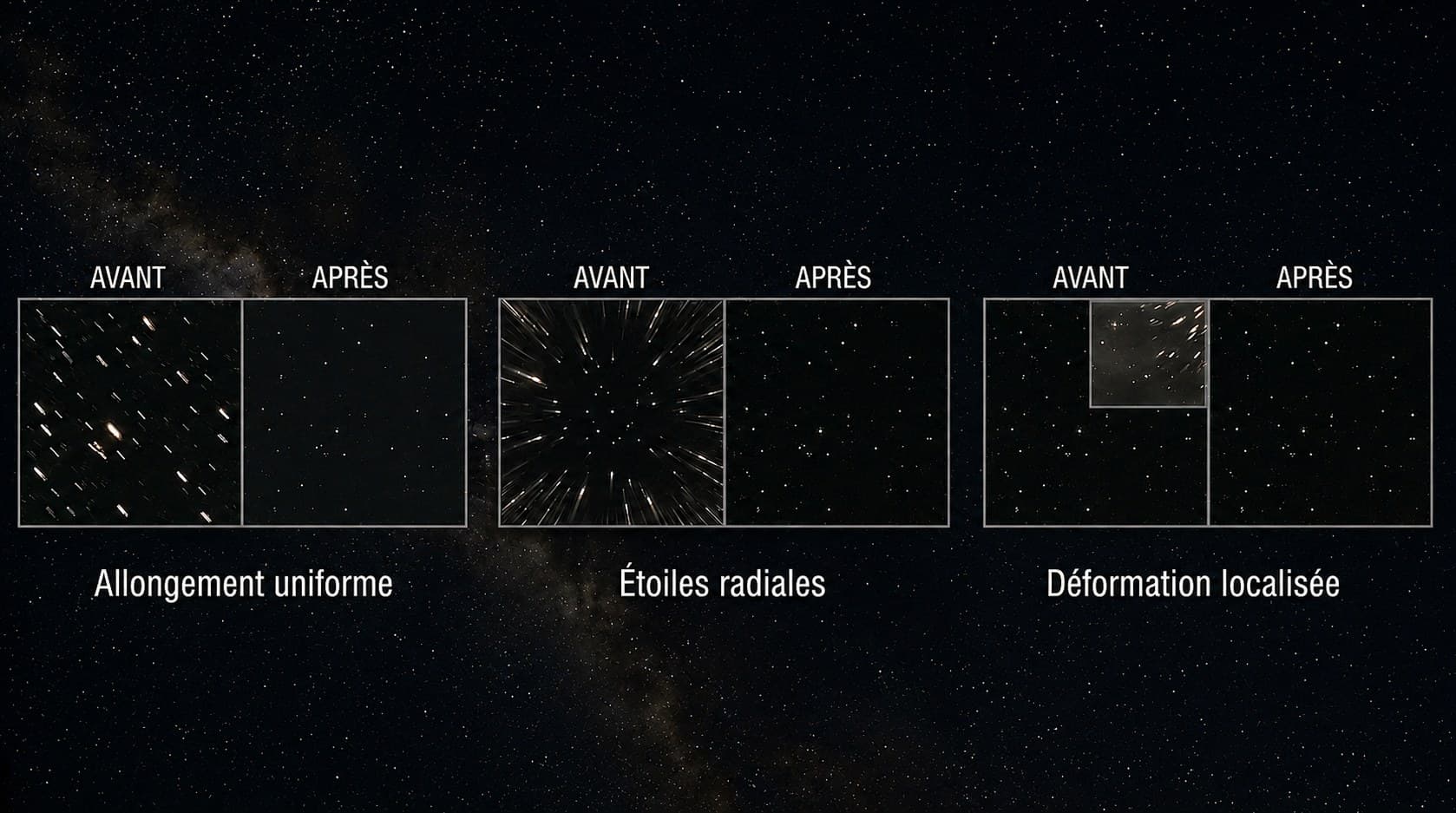 Elongated Stars in Astrophotography: Causes and Solutions
 How to Analyze an Astrophoto Light Frame Before Stacking