Astrophotography diagnosis of N?buleuse de la Grotte: Light pollution gradient and noise / underexposure
Masterastronomik L2 ir uv cut70×180s13 oct. 2026
The Doc examined this image of N?buleuse de la Grotte (master, astronomik L2 ir uv cut, 70×180s). Estimated overall technical quality: 7/10. 2 defects found: Light pollution gradient (severity 3/5), Noise / underexposure (severity 2/5).

Info
- Cible
- N?buleuse de la Grotte
- Date
- 13 oct. 2026, 22:38
- Lune
- Gibbeuse décroissante 89.3% (sous l'horizon)
- Site
- Bortle 1 · ciel pristine (VIIRS)
- Position
- 22h59m22s · +62°21'27"
Excellent conditions: Bortle 1 and a gibbous Moon below the horizon at 121 degrees from the target, so no lunar contribution is possible and the measured gradient is not lunar. On an emission nebula like Sh2-155, such a sky lets you work with a plain L filter and reach the faint Ha as well as the bluish reflection nebulae visible top right. In this context the only real lever is exposure time: with a background this dark, 180s subs leave the signal close to read noise. Lengthen the subs and stack more hours, the sky is not your limit.
Setup
- Type d'image
- Master
- Télescope
- C11+Hyper+Uranus
- Caméra
- Poseidon-C PRO
- Filtre
- astronomik L2 ir uv cut
- Monture
- AZ EQ6
- Exposition
- 70×180s
- Phase de lune
- Premier croissant (8 %)
- Notes
- 70*180s corrigé des DOF
- FOV
- 2.36°
The C11 reduced to 541mm with the Poseidon-C PRO gives 2.36 degrees of field and 1.433 arcsec/px, a coherent pairing: the Cave fits comfortably in the frame and the sampling suits the measured seeing (FWHM 3.8 px, around 5.4 arcsec, suggesting average seeing or a slight focus softness to watch). Gain 125 and offset 50 at -20C are healthy, with no significant saturation (0.01%) and no problematic shadow clipping on the electronics side. On this emission target under Bortle 1, the L2 IR/UV cut is a defensible choice; a dual-band would add nothing here and would cost continuum signal.
The diagnosis in detail
The strength of this image is its PSF signature. The centre measures 3.79/3.59 px for 1.06 elongation, right at the field floor (1.05), and the corner/centre FWHM ratio is 1.087, far below the 1.25 threshold that would indicate field curvature or a backfocus error. Horizontal (0.022) and vertical (0.016) asymmetries are negligible, and the panel visually confirms well rounded cyan ellipses everywhere, including BR where elongation rises to 1.18 without any comatic tail. Conclusion: no tilt, no backfocus to revisit, no tracking drift, the Hyperstar corrector and the mount are doing their job.
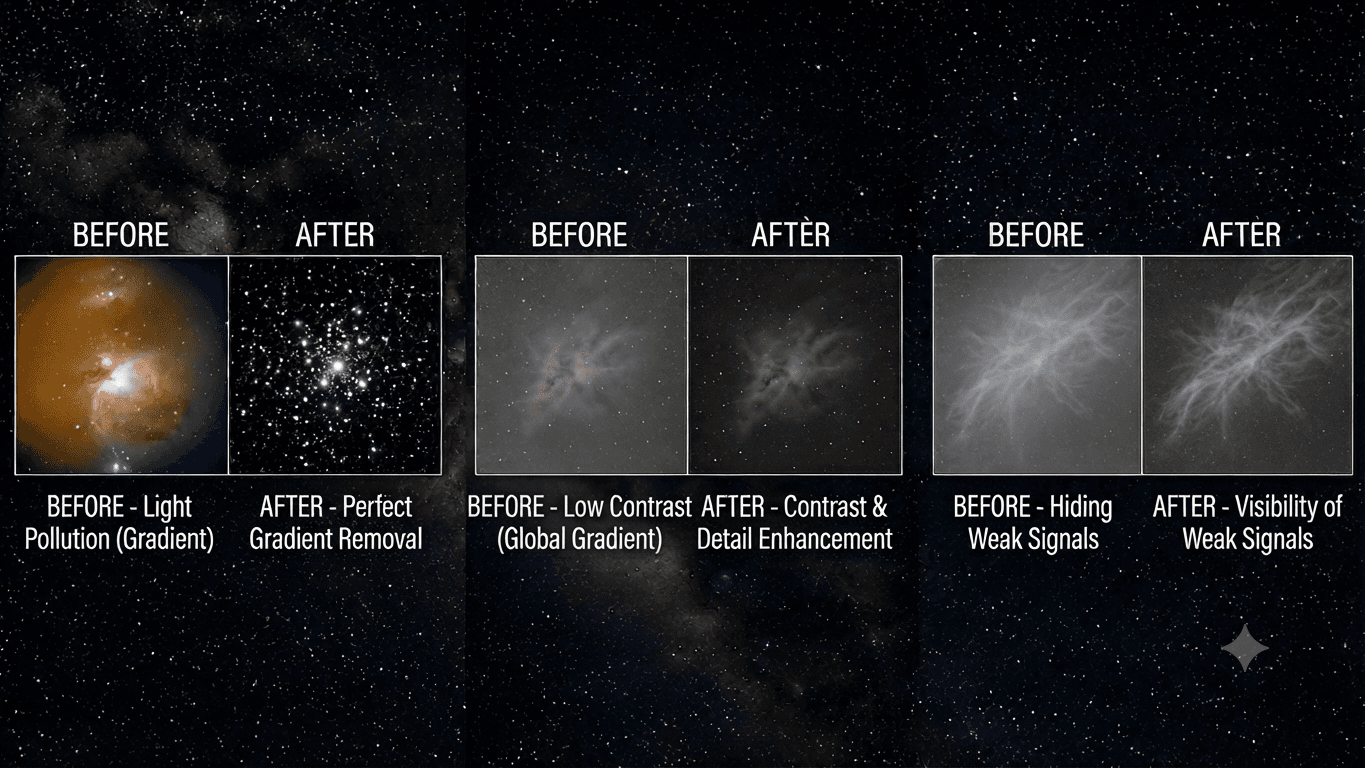
What remains concerns the background and the depth. The background map gives a dominant plane (plane/radial ratio 2.66) of 12% oriented 23 degrees, a structure the DSS does not reproduce: this is a genuine instrumental or atmospheric gradient, not IFN. It is modest but will get in the way of an aggressive stretch if you do not remove it first.
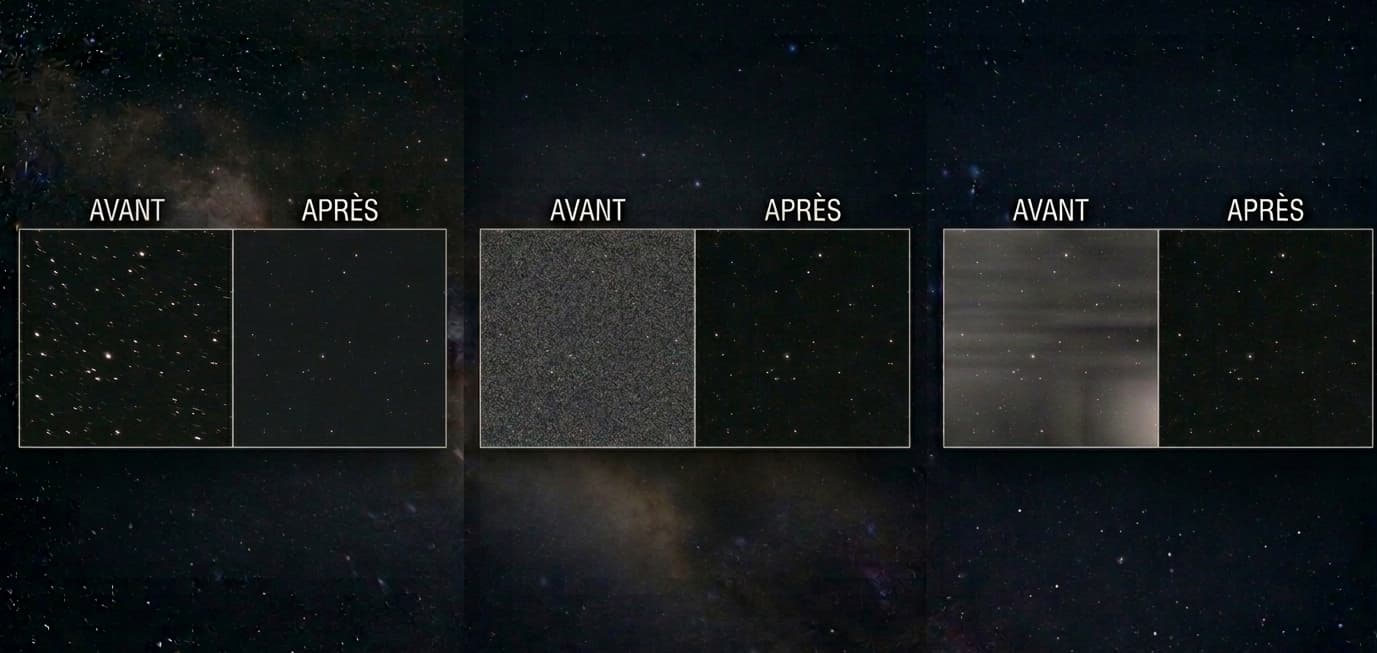
Finally, the histogram tells the story of a still-short image: e_margin of 1.76 and skew of 0.68 show a background nearly touching the black point. Under a Bortle 1 sky that is partly normal, but at 180s per sub you are working close to read noise. More time and longer subs will bring out the faint Cave extensions far more than any processing will.
Priority actions
- Remove the background gradient (GraXpert or DBE) before any non-linear stretch
- Lengthen subs to 300s to lift the background further above read noise
- Accumulate 8 to 10 hours of integration to bring out the faint extensions of Sh2-155
- Keep the optical configuration as is, the PSF is clean across the whole field