Astrophotography diagnosis of NGC 253: Sensor tilt and clipped stars
Processed60s09 oct. 2026
The Doc examined this image of NGC 253 (processed, 60s). Estimated overall technical quality: 7/10. 2 defects found: Sensor tilt (severity 2/5), Clipped stars (severity 1/5).

Info
- Cible
- NGC 253
- Date
- 09 oct. 2026, 14:24
- Position
- 0h47m33s · -25°17'17"
Very favourable conditions: a waning crescent at 3% illumination, so no lunar contamination of the sky background, which the background map confirms (gradient amplitude of only 1%, zero azimuthal anisotropy). For a broadband galaxy like NGC 253 this is exactly the window you want, since that kind of target does not tolerate moonlight the way a filtered emission nebula does. The measured background stays close to the black point (e_margin 2.51), a sign of a dark sky rather than a problematic underexposure with stacked 60s subs. Make the most of these moonless nights to push total integration on the faint outer halo.
Setup
- Type d'image
- Traitée
- Caméra
- ZWO ASI2600MM Duo
- Exposition
- 60s
- Phase de lune
- Waning crescent (3 %)
- FOV
- 33.0'
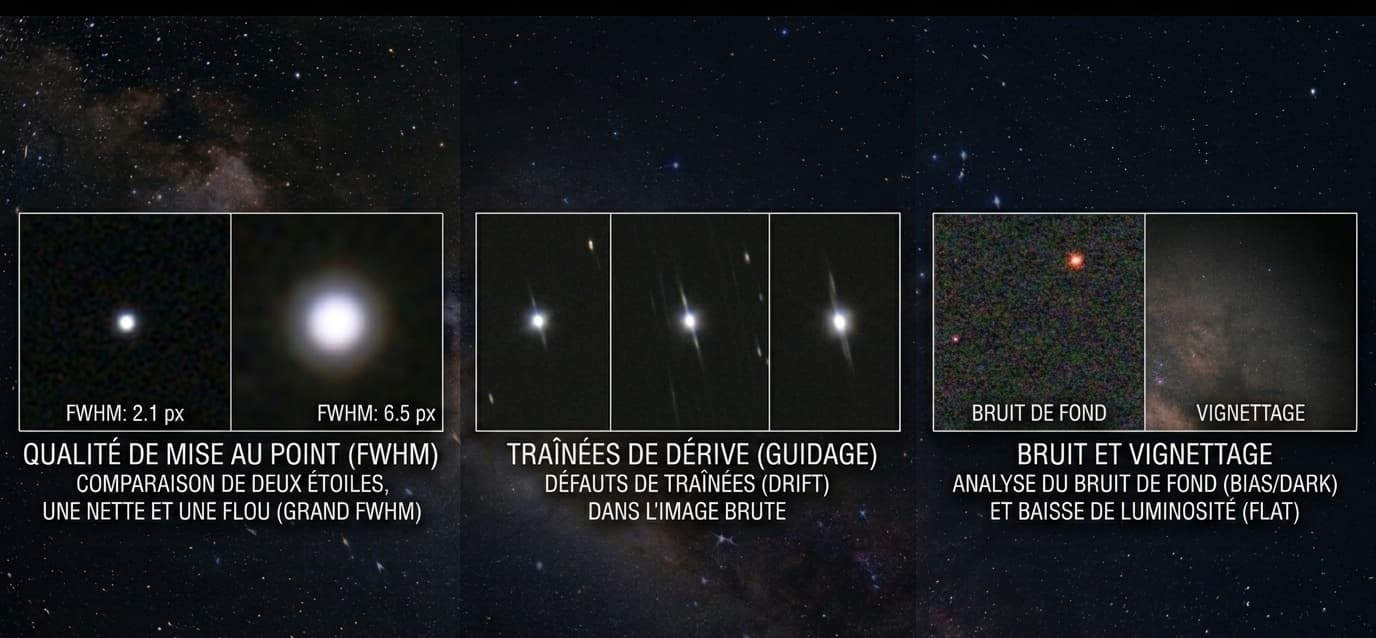
The setup matches the target. With a 0.55° wide field and a galaxy filling roughly a third of the frame, NGC 253 is comfortably contained with margin for the outer halo, although a slightly wider field would let the extensions breathe. The central FWHM of 5.4 px is a little generous: it mixes seeing and sampling, and suggests a somewhat oversampled setup at this focal length, which is not penalising but limits how much sharpness you can gain. The 60s subs are short for a broadband galaxy: the background to black point margin of 2.51 shows you are not firmly sky-limited, so longer subs or a higher gain would improve the signal to read noise ratio.
The diagnosis in detail
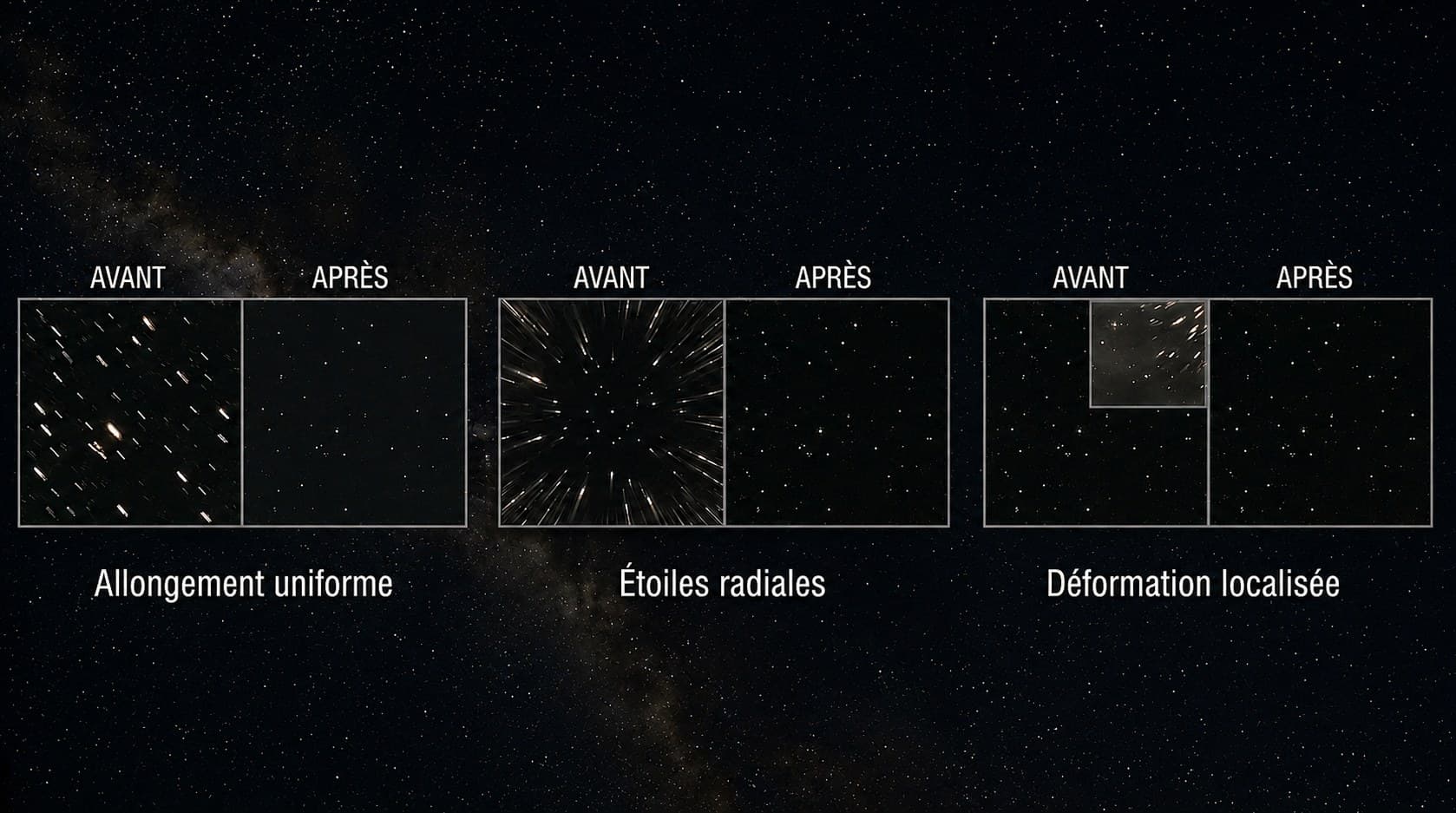
The overall verdict is positive. The Moffat measurements give a centre elongation of 1.12 against a field floor of 1.03, with a PA dispersion of only 4.3°, which points to a slight elongation consistent across the whole field rather than a genuine tracking fault: at this level, on a monochrome camera, you remain within normal tolerance and no mount defect should be retained.
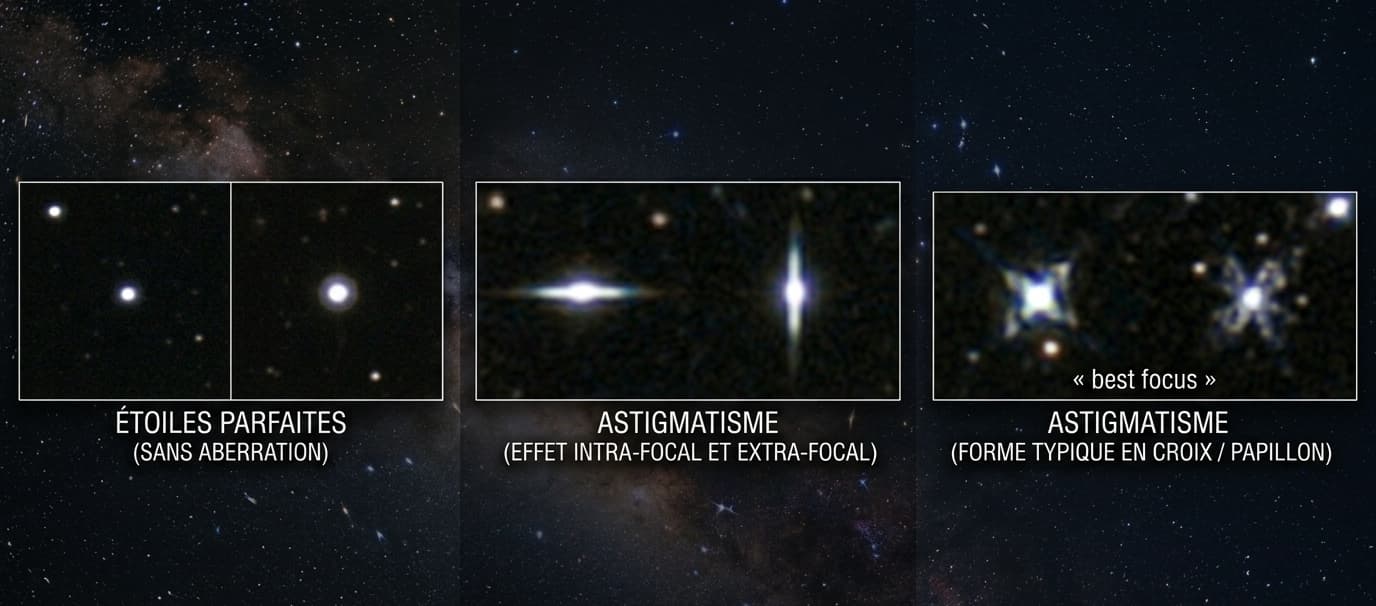
The one structural point is the measured tilt. It shows in the single-axis asymmetry: the bottom-left diagonal keeps FWHM values of 5.07/4.45 while the top-right and bottom-right rise to 6.08 and 5.74 with rounder but larger stars. The amplitude stays low (corner/centre ratio 1.175, horizontal asymmetry 0.103), so this is a mechanical adjustment to refine, not a problem that spoils the image. It is the kind of residual you only see on inspection, not when viewing the picture.
On background and processing there is nothing to criticise: 1% radial profile, 1% plane, no dark clipping, no global saturation. The gradient removal did its job and the noise stays discreet with no trace of oversmoothing. A few bright star cores are clipped with no residual gradient, which is marginal on a mono luminance.
Priority actions
- Check the flatness of the imaging train (camera, corrector and filter drawer tightening) to clear the tilt measured on the horizontal axis
- Lengthen individual subs beyond 60s to better overcome read noise, since the background to black point margin of 2.51 shows you are not sky-limited
- Capitalise on these moonless nights to increase total integration and bring out the outer halo of NGC 253