Astrophotography diagnosis of NGC 6888: Sensor tilt, clipped stars and 1 other
Raw300s05 oct. 2026
The Doc examined this image of NGC 6888 (raw, 300s). Estimated overall technical quality: 6/10. 3 defects found: Sensor tilt (severity 3/5), Clipped stars (severity 2/5), Bad seeing (severity 2/5).

Info
- Cible
- NGC 6888
- Date
- 05 oct. 2026, 19:29
- Lune
- Gibbeuse croissante 74.6% (sous l'horizon)
- Site
- Bortle 4 · transition rural/banlieue (VIIRS)
- Position
- 20h12m16s · +38°22'36"
Favourable conditions: the Moon is below the horizon, so no lunar contribution to the sky background, and Bortle 4 is comfortable for an emission target like NGC 6888. The measured background gradient (22% amplitude, 30.9 deg orientation) stays modest and will be removed by a standard gradient extraction. The background to black point margin of 2.36 shows a background sitting low, but in broadband under Bortle 4 with a 300s sub that is expected rather than alarming. For this Wolf-Rayet nebula, rich in Ha and OIII, a dual-band filter would clearly boost contrast even under this dark sky by cutting the very dense Cygnus stellar continuum.
Setup
- Type d'image
- Brut
- Télescope
- ZWO AM5N
- Caméra
- ZWO ASI676MC
- Exposition
- 300s
- Phase de lune
- Dernier croissant (30 %)
- FOV
- 32.6'
Framing is sound: 0.54 deg of field for a roughly 18 arcmin nebula, the target fits comfortably with margin. However, 0.55"/px at 750mm is heavy oversampling, well beyond what typical seeing can use; the central FWHM of 4.66 px confirms it. A 2x2 bin in processing would return SNR without losing real detail. The AM5N mount handles 300s without trouble. Two settings to watch: sensor temperature at 26°C is too high and generates avoidable dark current, while an offset of 11 remains acceptable since no dark clipping is measured.
The diagnosis in detail
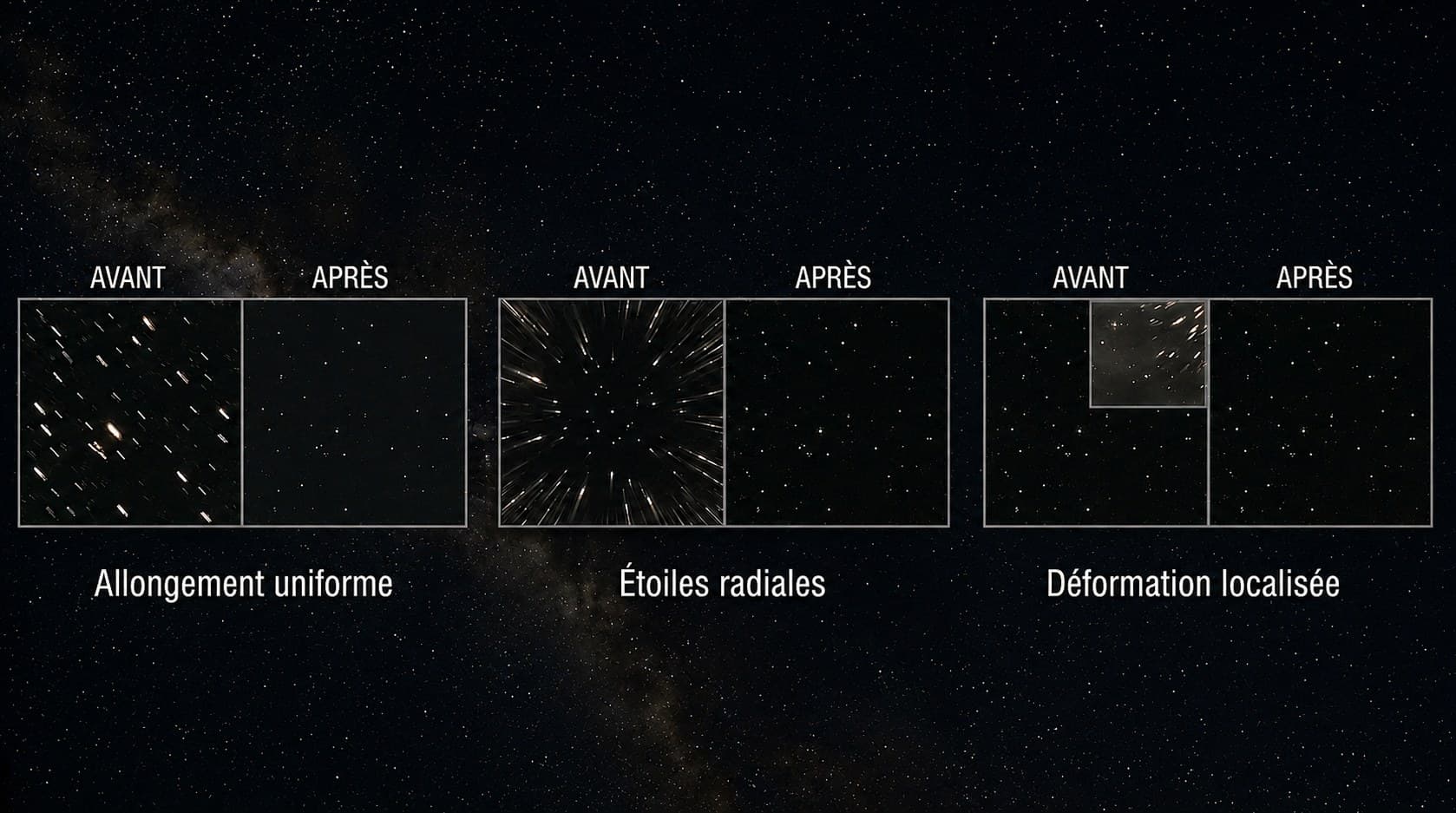
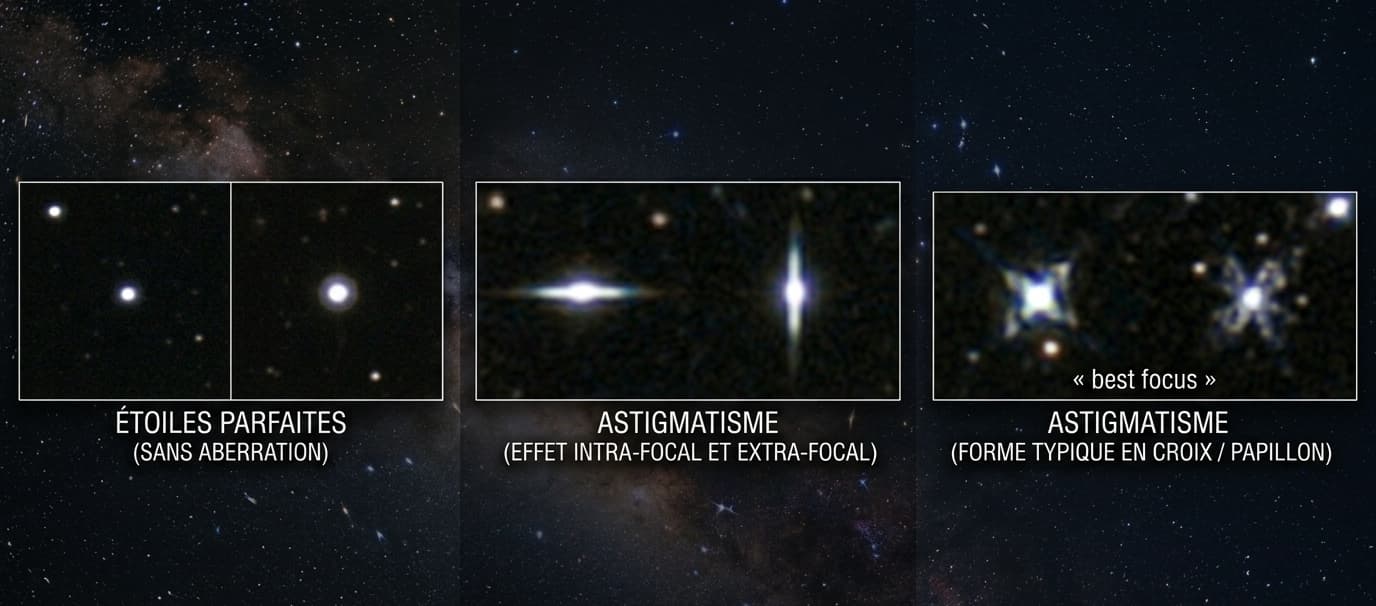
The main finding is instrumental. The Moffat metrics show a sharp centre (FWHM 4.66 px, elong 1.13 against a field floor of 1.07) and a degradation that does not affect the four corners equally: the right side of the field is clearly more bloated (TR elong 1.24, BR elong 1.27 at PA53 deg) than the left (L 1.08, BL 1.09). This single-axis asymmetry, confirmed by a vertical asymmetry of 0.114 versus 0.047 horizontally and a corner/centre ratio of 1.575, points to a tilted focal plane rather than a backfocus error, which would degrade all four corners symmetrically.
The rest is secondary and largely normal for a sub. Tracking is not a concern: at 300s unbinned, round stars at centre validate the mount and guiding. The PSF width comes mostly from this setup's extreme oversampling, likely compounded by a sensor still warm at 26°C and average turbulence. Finally, a few bright star cores are clipped, which stays cosmetic if you blend a short set into the stack.
Comparison with the DSS confirms that the filamentary structures visible around NGC 6888 are genuine nebulosity, not background artefacts.
Priority actions
- Fix the imaging train tilt: crosswise retightening, then an adjustable tilt plate tuned until the corner/centre ratio drops below 1.2
- Enable or check cooling, 26°C at the sensor is too warm for 300s exposures
- Consider 2x2 binning in processing to convert the 0.55"/px oversampling into SNR
- Add a short 30-60s set to the acquisition plan to recover bright star cores
- Try a dual-band filter on this Wolf-Rayet target to strengthen filament contrast