Astrophotography diagnosis of NGC 6888: Tracking drift and sensor tilt
Master28×300s21 juin 2026
The Doc examined this image of NGC 6888 (master, 28×300s). Estimated overall technical quality: 6/10. 2 defects found: Tracking drift (severity 3/5), Sensor tilt (severity 2/5).
&w=1920&q=75)
Info
- Cible
- NGC 6888
- Date
- 21 juin 2026, 00:50
- Lune
- Gibbeuse décroissante 59.3% (sous l'horizon)
- Site
- Bortle 2 · rural typique (VIIRS)
- Position
- 20h13m14s · +38°32'36"
Excellent conditions: Bortle 2 and Moon below the horizon (so no lunar pollution possible, moon gradient excluded). The dark background and the IFN visible in the corners confirm a very transparent sky. For Hα on an emission nebula these conditions are ideal and would even allow pushing total time or adding OIII/SII without sky-background concerns. The low measured background level is not a defect here: in narrowband at 300s under a dark sky, a histogram barely lifted off the black point is expected, not a sign of underexposure.
Setup
- Type d'image
- Master
- Télescope
- EQMod Mount
- Caméra
- ZWO ASI585MM Pro
- Exposition
- 28×300s
- Phase de lune
- Premier croissant (34 %)
- FOV
- 1.70°
Coherent setup: 375mm focal length and a 3840×2160 sensor give a 1.70° field, NGC 6888 (about 20') sits comfortably at center with room for the surrounding nebulosity, a good framing choice. The 1.595"/px sampling suits typical seeing and is not the limiting factor here (central FWHM 2.96 px). Gain 220 on the ASI585MM and offset 15 with 0% saturation and no hard dark clipping are healthy, and the -14.5°C temperature is perfect. 28×300s in Hα is a solid base; the gains to be had are on tracking, not on configuration.
The diagnosis in detail
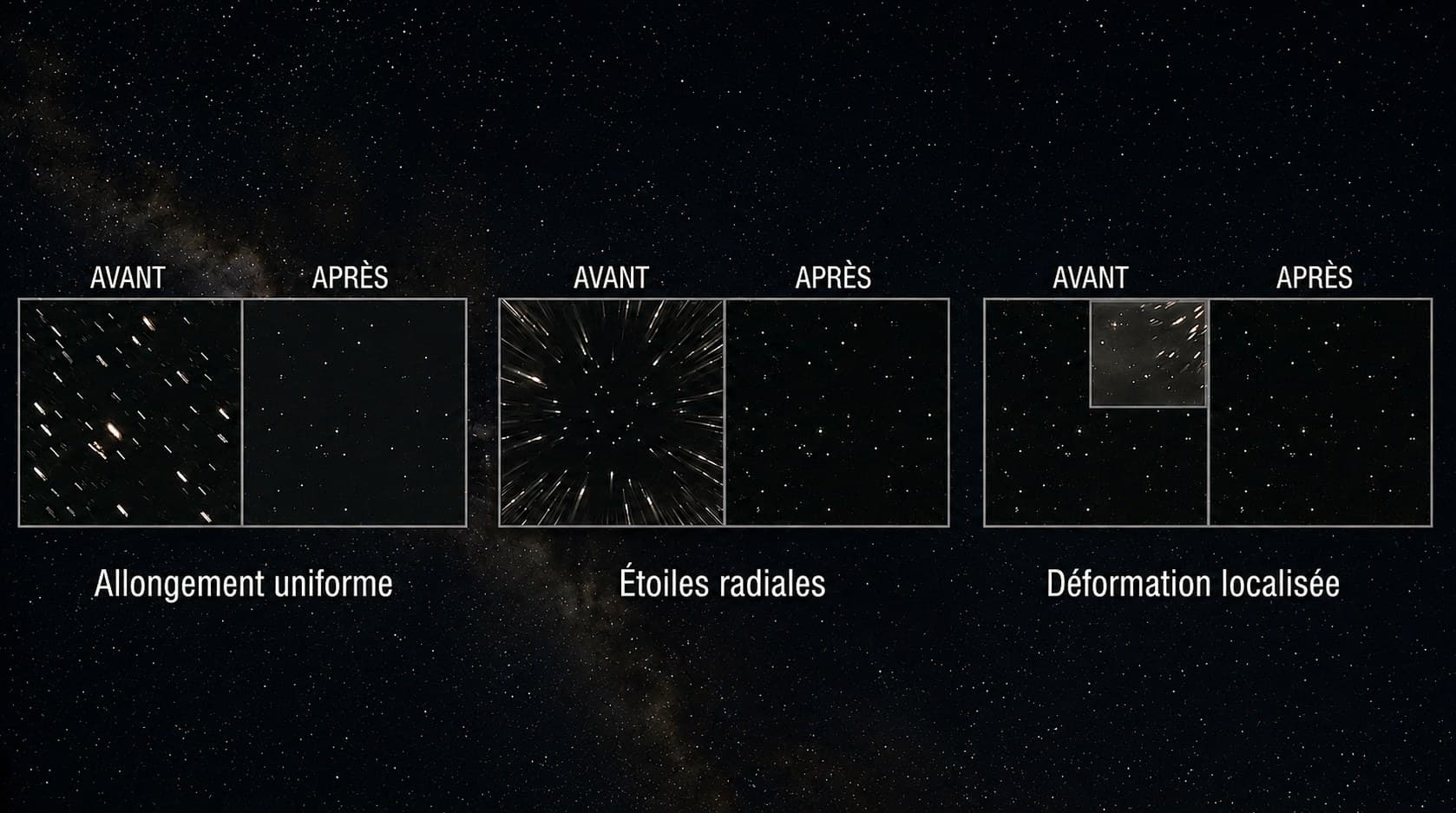
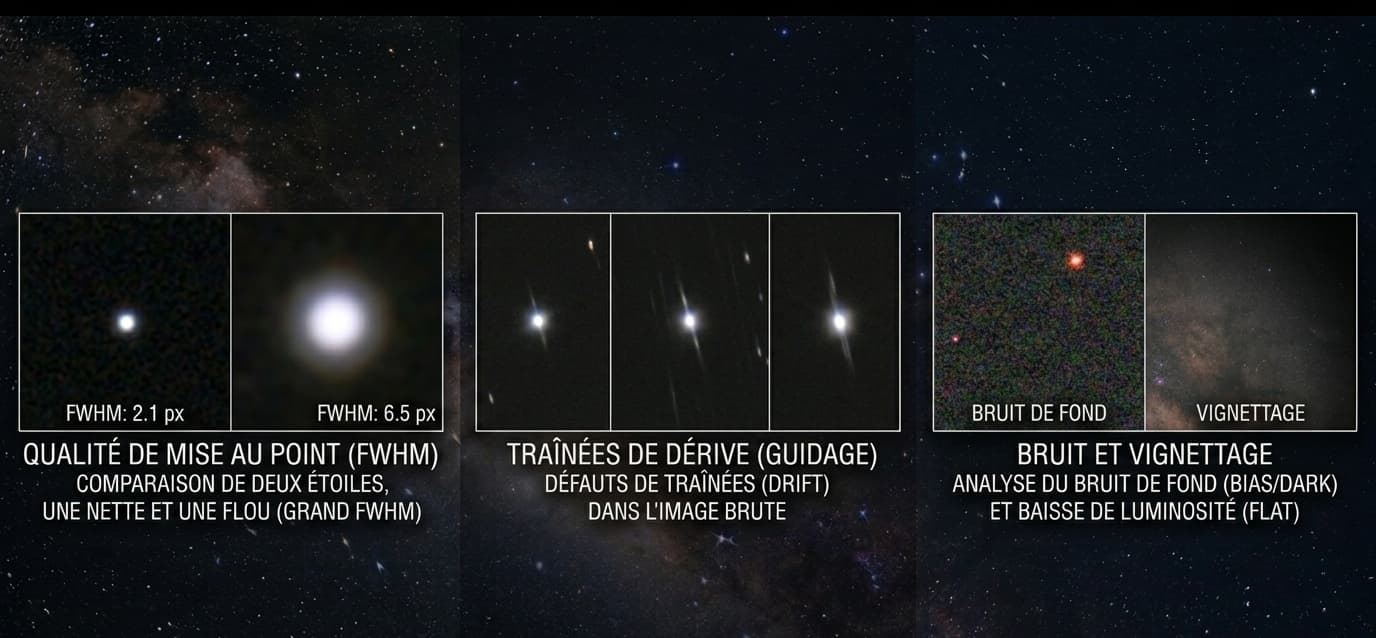
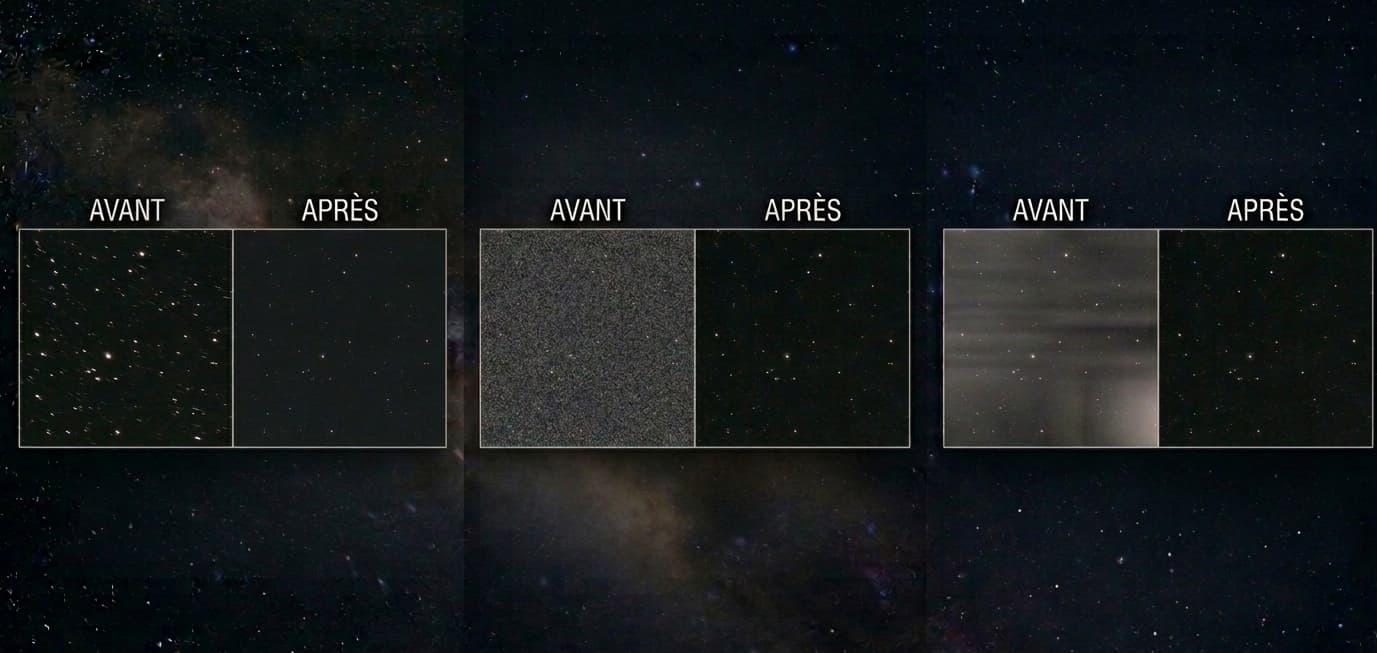
The image is strong on background and calibration: no instrumental gradient to report (the plane measurement correlates with the genuine IFN visible on the DSS, so it is not an artifact), no residual vignetting or calibration pattern. The diagnosis focuses on the PSF. The Moffat metric is unambiguous: elongation is present from the center (center elong 1.4 versus a field floor of 1.32) and the direction is very coherent zone to zone (PA scatter of only 12.5°). This is the signature of a uniform tracking/guiding drift, not an optical field-edge aberration.
A lighter tilt component is superimposed: reading the panel, the left side degrades clearly more (L 1.77, BL 2.03, FWHM up to 4.4 px) than the right side which stays tight (R, TR, BR around 1.32-1.37). The corner/center ratio stays moderate (1.219) and the asymmetry is mostly horizontal (0.15 versus 0.069 vertical), which caps the tilt severity at a mechanical point of attention.
In practice, addressing the tracking first will bring the most visible gain in star sharpness; the mild tilt is then corrected by a mechanical adjustment of the imaging train.
Priority actions
- Fix the tracking drift: refine polar alignment and guiding to make stars pinpoint all the way to the center
- Measure then compensate the mild tilt (left side more stretched) via a tilt plate or even retightening of the imaging train
- Take advantage of the Bortle 2 moonless sky to gather more exposure time or add OIII/SII