Astrophotography diagnosis of NGC 6960_080926: Astigmatism
Raw300s08 sept. 2026
The Doc examined this image of NGC 6960_080926 (raw, 300s). Estimated overall technical quality: 7/10. 1 defect found: Astigmatism (severity 2/5).
&w=1920&q=75)
Info
- Cible
- NGC 6960_080926
- Date
- 08 sept. 2026, 20:59
- Lune
- Gibbeuse croissante 93.6% (sous l'horizon)
- Site
- Bortle 2 · rural typique (VIIRS)
- Position
- 20h49m48s · +30°25'47"
Near ideal conditions. Bortle 2 with the Moon below the horizon (so no lunar contribution despite the 93.6% gibbous phase, and 132.9° of separation anyway): the sky background is limited only by natural airglow. This shows directly in the background map, with a 2% plane gradient amplitude and zero anisotropy, which is excellent. On a supernova remnant like the Veil, this sky lets you chase the faint OIII filaments without fighting light pollution. The only consequence of such a dark sky is that the 300s exposure stays close to the black point (e_margin 2.02), which is normal behaviour in narrowband under Bortle 2.
Setup
- Type d'image
- Brut
- Télescope
- EQMod Mount
- Caméra
- ZWO ASI585MM Pro
- Exposition
- 300s
- Phase de lune
- Dernier croissant (9 %)
- FOV
- 3.36°
Coherent setup for framing, debatable for sampling. The 3.36° field at 190mm focal length frames the NGC 6960 arc perfectly and lets the filaments breathe out to the edges, the right focal choice for this target. On the other hand 3.148"/px with the 2.9µm pixels of the ASI585MM is heavily undersampled: stars drop to 1.4 px FWHM, right at the limit where stellar shape is no longer truly resolved, which explains the fragility of the astigmatism measurement. On the settings side, gain 160, offset 15 and -19.5°C are healthy: no dark clipping, no saturation, and the low background margin is expected in narrowband under a dark sky.
The diagnosis in detail
This sub is clean. The DSS comparison validates every structure: the main arc at the top, the filament complex on the left (Pickering's Triangle), the diffuse extensions toward the bottom of the field are all present in the reference, so no nebulosity visible here is a gradient or reflection artefact. The measured background confirms the impression: 2% plane amplitude, zero azimuthal anisotropy, a nearly flat radial profile at +1%. Nothing to fix on the illumination side.
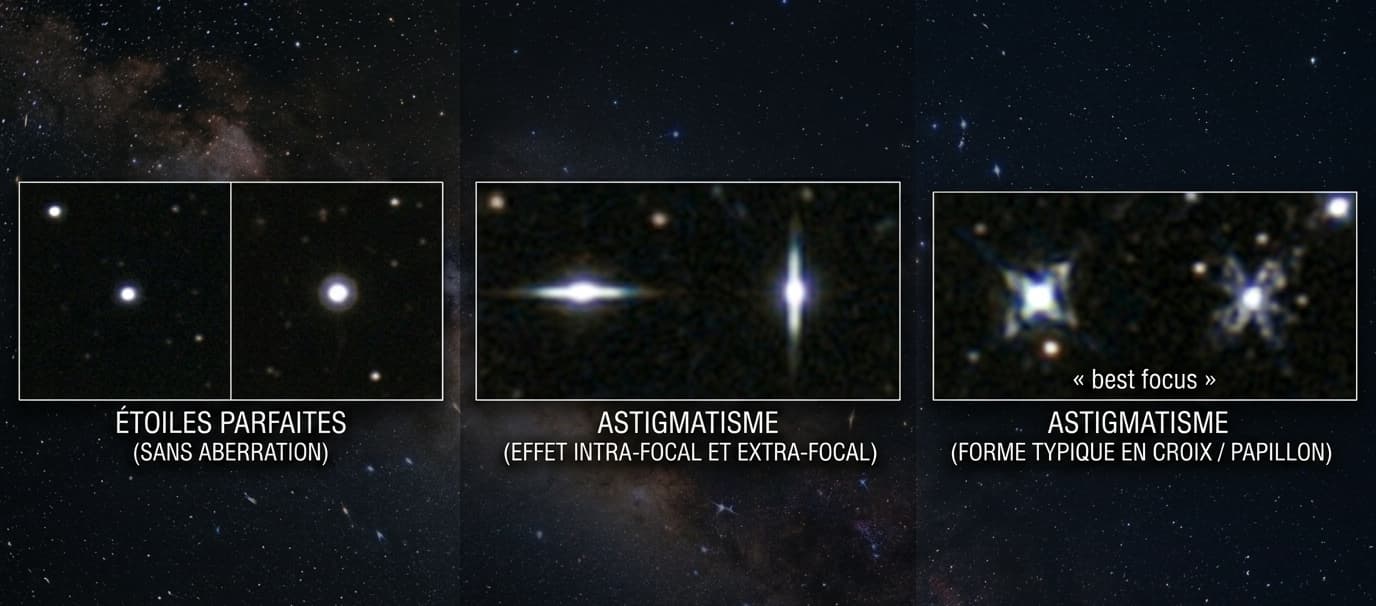
The only technical point is star shape. The Moffat measurement gives an elongation rising to 1.31 on the bottom edge and 1.28 at centre against a field floor of 1.06, with no FWHM increase at the periphery (corner/centre ratio 1.055). That combination, stretching without bloating, is the signature of field astigmatism rather than tilt or a backfocus error. But with an FWHM of only 1.4 px we are below Nyquist and the ellipse fit becomes very sensitive to single-sub noise; the 26.7° PA scatter points the same way, toward an unstable measurement. Verdict: a minor point of attention, not a defect to act on right away.
No trace of tracking drift, focus miss or pervasive hot pixels on this sub. The 300s exposure is appropriate, cooling is adequate, and the nebula signal already sits well above the noise: this sub is a good candidate for stacking as is.
Priority actions
- Stack ten or so subs and rerun the aberration inspector on the master: at this sampling that is the only reliable elongation measurement
- Check the corrector backfocus and rule out mechanical pinching if the elongation is confirmed on the master
- Keep shooting at 300s: the current sub is usable as is and the moonless Bortle 2 sky should be exploited to the fullest