Astrophotography diagnosis of NGC 6960: Astigmatism
Raw240s19 sept. 2026
The Doc examined this image of NGC 6960 (raw, 240s). Estimated overall technical quality: 6/10. 1 defect found: Astigmatism (severity 2/5).

Info
- Cible
- NGC 6960
- Date
- 19 sept. 2026, 22:56
- Lune
- Croissant décroissant 40.3% (sous l'horizon)
- Site
- Bortle 3 · rural peu pollué (VIIRS)
- Position
- 20h49m56s · +30°51'51"
Excellent conditions: Bortle 3, Moon below the horizon at 40% illumination and 67 degrees from the target, so no lunar contribution is possible. This matches the measured background map, which shows only an insignificant planar gradient (1% amplitude, R2=0.03) and near perfect radial symmetry. Under such a sky, the Veil in broadband is perfectly reachable without a light pollution filter, which would only cut useful signal here. The lever is therefore not sky quality but exposure time: take advantage of such a dark sky to lengthen subs and stack long, which is exactly what the grainy background is missing.
Setup
- Type d'image
- Brut
- Télescope
- ZWO AM5
- Caméra
- Nikon DSC D5600
- Exposition
- 240s
- Phase de lune
- Premier quartier (58 %)
- FOV
- 3.21°
A coherent setup for the target. At 418mm, the 3.21 degree field covers the entire Veil remnant, with both main arcs in frame and margin around them: exactly the expected framing for NGC 6960 plus NGC 6992. Sampling at 3.84 arcsec per pixel is clearly undersampled though, with stars fitting within 2 px of FWHM at center, which limits filament detail and makes star shape measurements fragile. On exposure, 240s under Bortle 3 leaves a background to black point margin of only 2.67, below the sky limited regime: there is room to go longer, 300 to 420s depending on guiding stability.
The diagnosis in detail
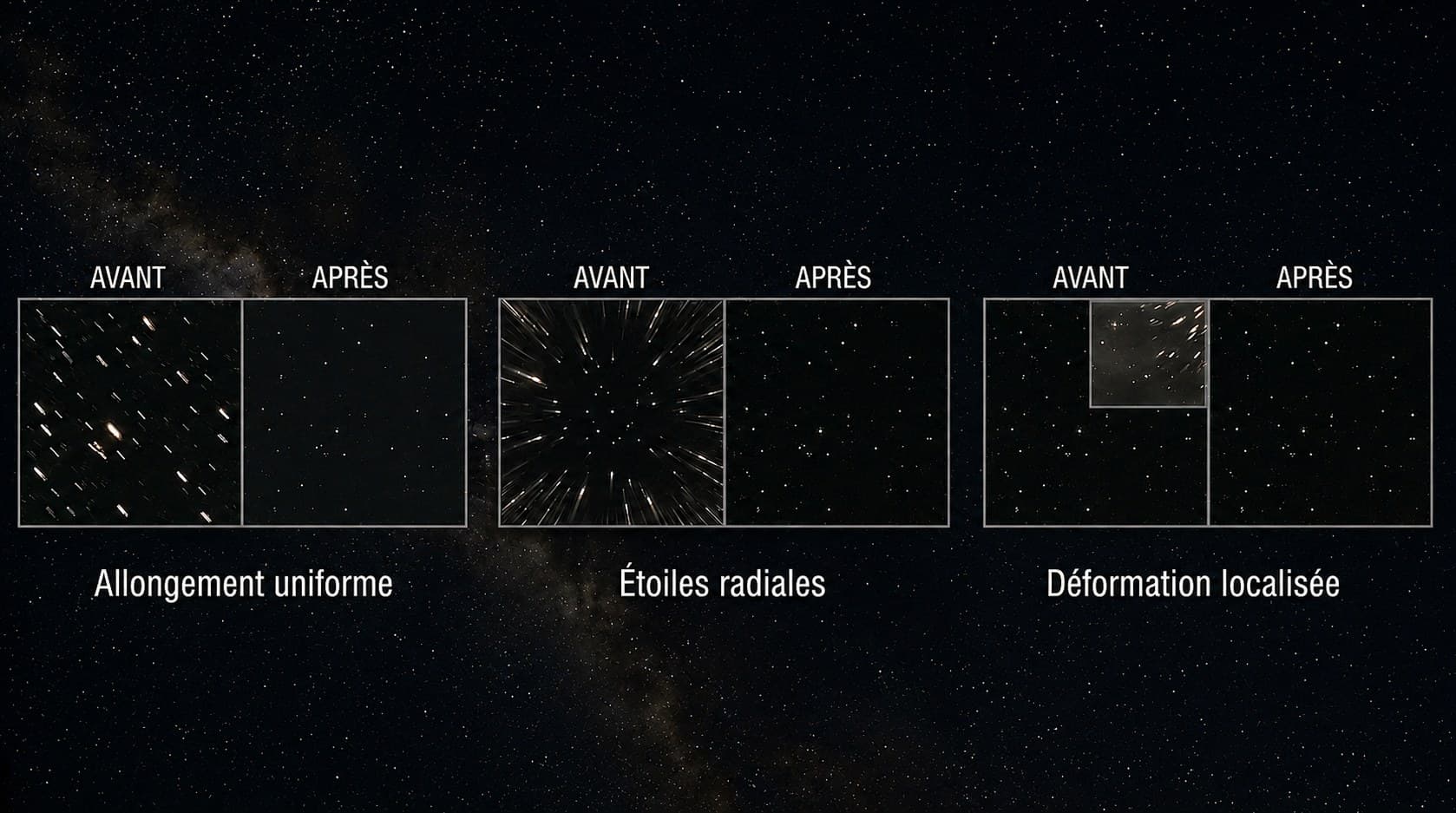
The sub is fundamentally healthy. The central PSF sits at the field floor (elong 1.18) and the position angle scatter between zones is high (36.6 degrees), which rules out any tracking component: no drift, no periodic error, no guiding oscillation. The AM5 does its job properly over 240s.
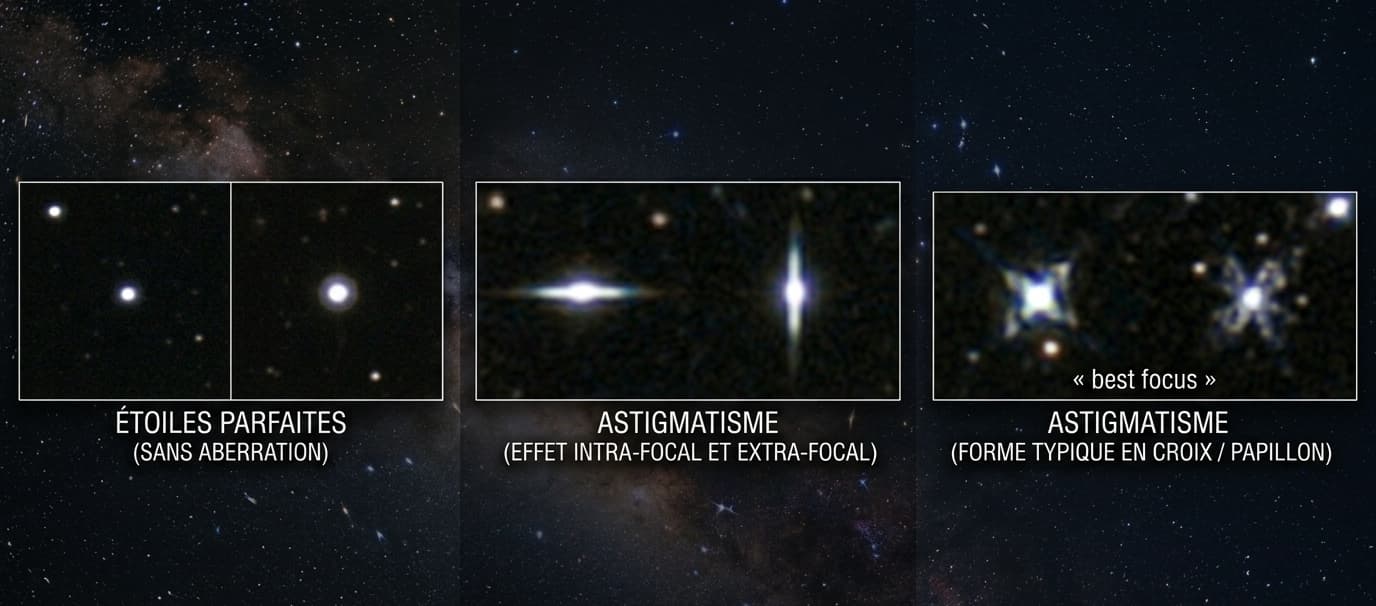
The only real shape defect is peripheral: elongation rises to 1.35-1.70 in the corners and edges while FWHM does not increase at all (corner/center ratio 0.792). Stars staying tight yet stretched off axis is the signature of field astigmatism, not field curvature nor a backfocus error. The automatic pre verdict leaned toward tilt, but the tilt measurement is weak (15%) and the PSF panel does not show the clear diagonal asymmetry required. At 3.84 arcsec per pixel on a noisy single sub the Moffat fit is fragile anyway: treat this elongation as a point to confirm on a stack, not as a final verdict.
The rest comes down to signal: comparison with the DSS shows the filaments are genuine and correctly positioned, but drowned in grain for lack of integration. The sky background is otherwise remarkably flat, as confirmed by the measured background map.
Priority actions
- Lengthen sub exposure toward 300-420s to escape the read noise limited regime and lift the background off the black point
- Stack several hours on the target with dithering enabled, this is the main quality lever here
- Rerun the Aberration Inspector on a calibrated stack to confirm or rule out field astigmatism before any mechanical intervention
- Check the flatness and tightness of the imaging train, then fine tune backfocus if a corrector is in use