Astrophotography diagnosis of NGC 6960: Astigmatism
Raw240s19 sept. 2026
The Doc examined this image of NGC 6960 (raw, 240s). Estimated overall technical quality: 6/10. 1 defect found: Astigmatism (severity 2/5).

Info
- Cible
- NGC 6960
- Date
- 19 sept. 2026, 22:56
- Lune
- Croissant décroissant 40.3% (sous l'horizon)
- Site
- Bortle 3 · rural peu pollué (VIIRS)
- Position
- 20h49m56s · +30°51'51"
Favorable conditions. The Moon is below the horizon and 66.9 deg from the target, so it has no impact on this field: no lunar veil to expect. Bortle 3 is a real asset for NGC 6960, whose OIII is very sensitive to light pollution; that is why the filaments already come out cleanly in a single 240s sub. The background, however, sits close to the black point (e_margin 2.33, 0.59% dark clipping), meaning you are not yet fully sky-limited: under a sky this dark, longer subs or a large number of frames is the right lever to bury read noise.
Setup
- Type d'image
- Brut
- Télescope
- ZWO AM5
- Caméra
- Nikon DSC D5600
- Exposition
- 240s
- Phase de lune
- First quarter (58 %)
- FOV
- 3.21°
A coherent setup for the target, with one sampling caveat. At 418mm and a 3.21 deg field, the full Veil loop fits comfortably in frame, with NGC 6960 on the left and NGC 6992/6995 on the right: the framing is well thought out. On the other hand, 3.84 arcsec/px is clearly undersampled, and it shows: measured FWHM sit around 2 to 2.8 px only, meaning stars are defined by a handful of pixels. That is what makes shape defects (edge elongation) proportionally more visible. The 240s subs are reasonable; under Bortle 3 on an emission target you can push to 300s without risk of blowing out the background.
The diagnosis in detail
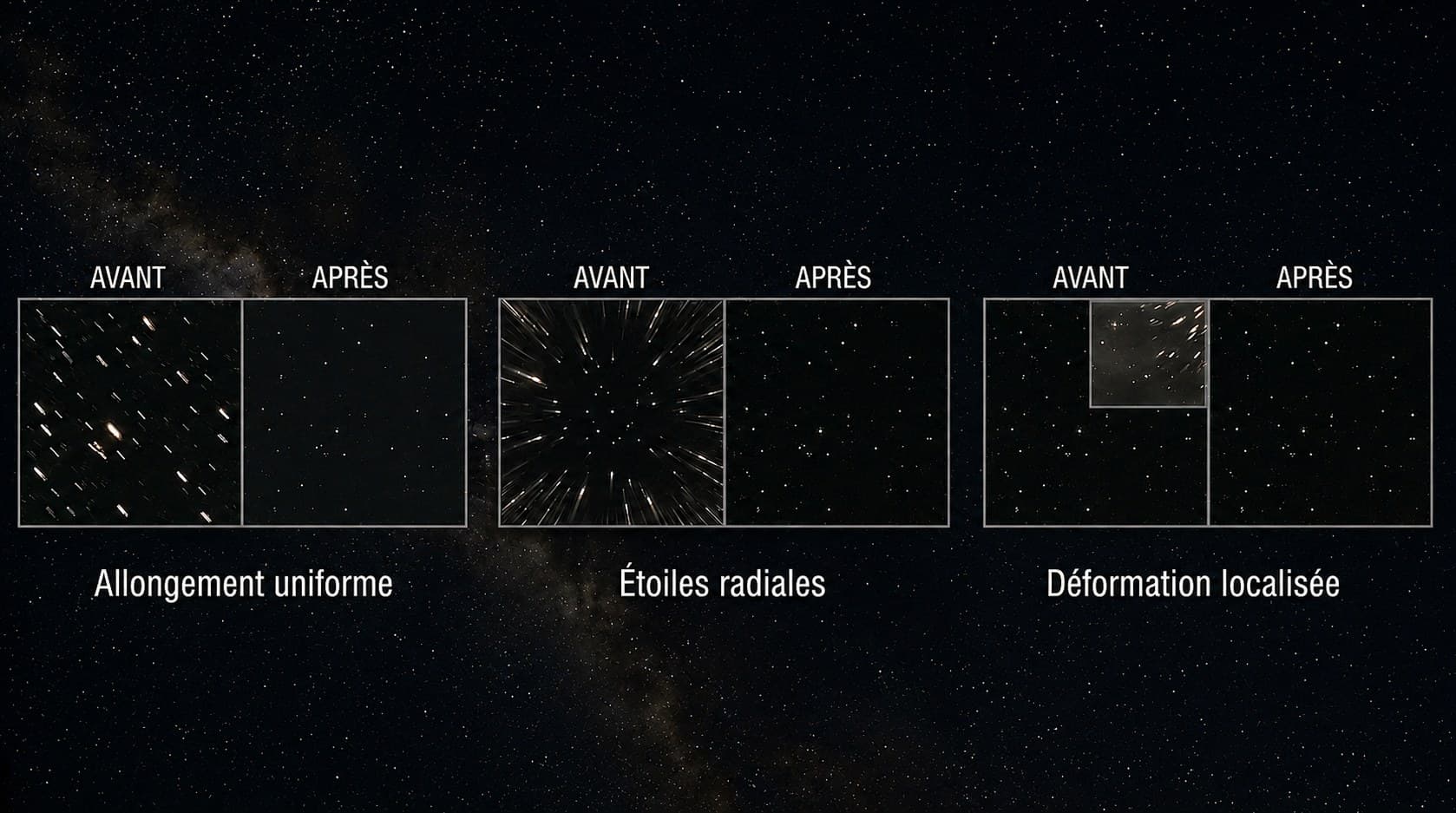
The diagnosis is simple and fairly reassuring: this 240s frame is sound on the essentials, and the only measurable instrumental issue is a degradation of star shape at the periphery. The discriminant is the center: at 1.12 elongation it sits exactly at the field floor, so it is perfectly round. That immediately rules out any global cause, tracking, guiding, wind or focus. The AM5 tracking over 240s leaves no trace of drift or oscillation.
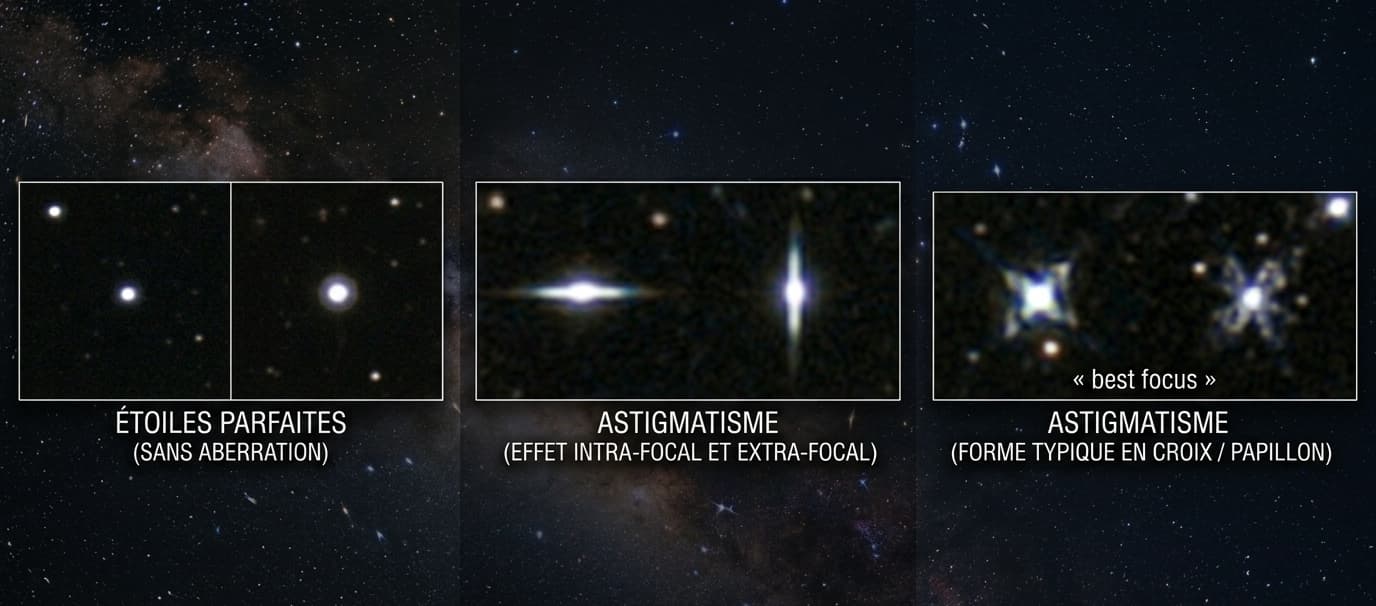
The degradation is therefore purely optical and purely field related. Its signature is characteristic: elongation rises to 1.68 in the bottom right corner while the corner/center FWHM ratio is 0.739, meaning the corners are in fact thinner than the center. Stars that are stretched but not broadened point to astigmatism, not tilt or field curvature. The tilt candidate at 9% confidence is ruled out for that reason: there is no sharpness asymmetry between opposite corners, TL and BR are both stretched.
The sky background shows a 29% radial falloff toward the edges with clear rotational symmetry (plane/radial dominance 0.13, anisotropy 0.04): that is raw optical vignetting, perfectly normal before flats are applied, and therefore not a defect at this stage. Properly made flats will remove it entirely.
Priority actions
- Check the coplanarity and tightness of the optical train, then verify the corrector backfocus distance to reduce edge astigmatism
- Shoot a proper flat series matched to the optical train to correct the measured 29% radial falloff
- Push subs toward 300s to lift the background further off the black point (e_margin currently 2.33)
- Accumulate a large number of subs with dithering enabled to fully exploit the Bortle 3 sky quality