Astrophotography diagnosis of NGC 6960: Astigmatism, background chroma noise and 1 other
Processed
The Doc examined this image of NGC 6960 (processed). Estimated overall technical quality: 7/10. 3 defects found: Astigmatism (severity 2/5), Background chroma noise (severity 2/5), Backfocus error (severity 1/5).

Info
- Cible
- NGC 6960
- Position
- 20h51m11s · +31°17'09"
Waxing gibbous Moon at 91 percent is the worst possible context for broadband, but the target is an emission nebula and the Ha/OIII rendering points to a narrowband acquisition, which is why the background stays dark and the gradient is nearly nil (only 5 percent amplitude). You played it right: on this kind of supernova remnant a narrow filter neutralises most of the scattered moonlight. If you want to push broadband layers or recover faithful star colours, save them for a moonless night, otherwise the stars will stay signal-poor and background chroma noise will keep dominating.
Setup
- Type d'image
- Traitée
- Phase de lune
- Gibbeuse croissante (91 %)
- FOV
- 3.11°
The 3.11 degree wide framing is the right call: the entire Veil loop fits in frame with comfortable margins, impossible on a tighter field. Sampling at 3.834 arcsec/px is clearly undersampled though: with 4 px FWHM at centre you are measuring roughly 15 arcsec of apparent width, so filament detail is limited by the pixel grid rather than by the sky. That is acceptable for a wide-field shot, but detailing Pickering's Triangle filaments would need a longer focal length or finer native sampling. The histogram shows a background barely lifted off the black point (e_margin 1.33), normal in narrowband.
The diagnosis in detail
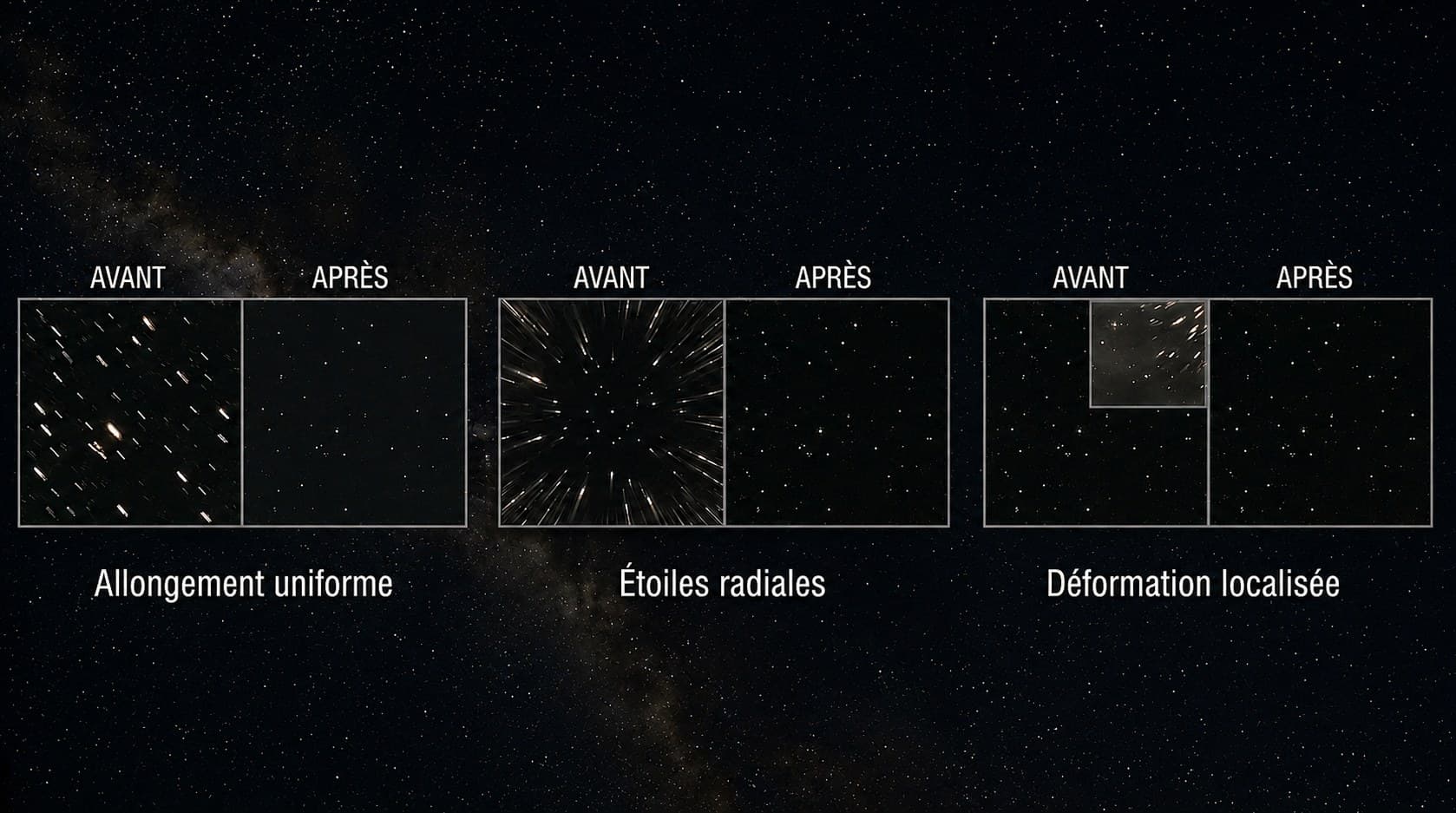
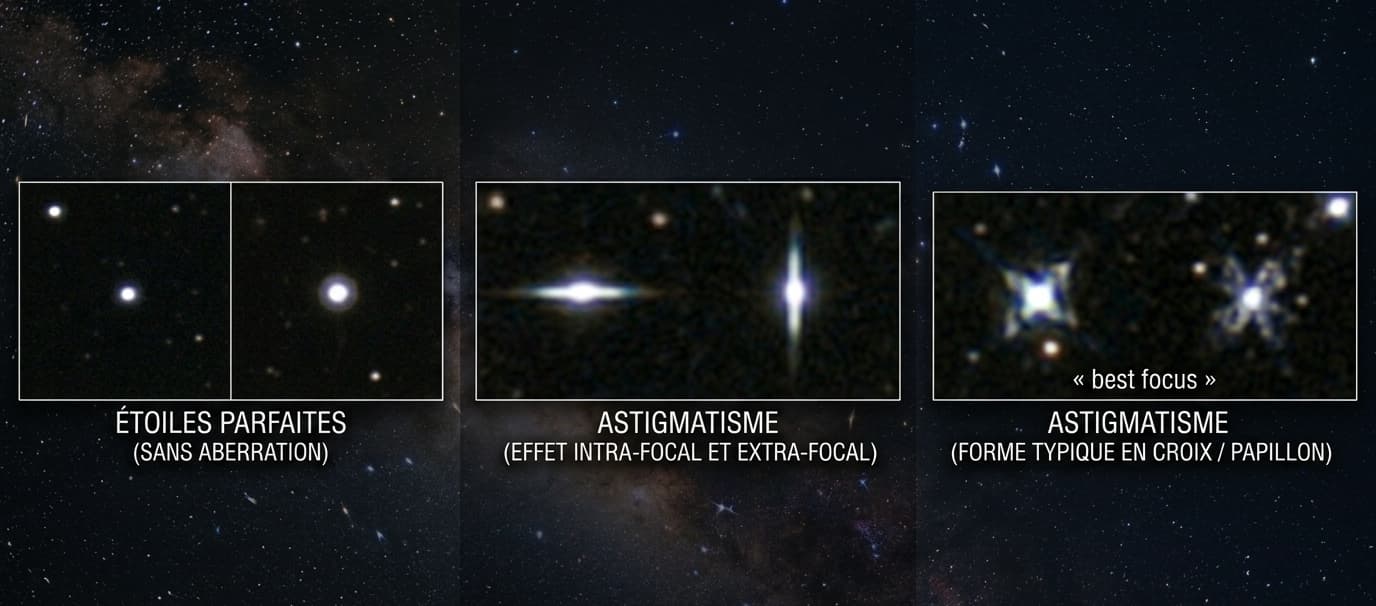
The image is broadly healthy and the diagnosis comes down to two points. Optically, the Moffat measurement shows a perfectly round centre (elong 1.06 against a field floor of 1.01) while the right edges and bottom edge climb to 1.24-1.34 with no rise in FWHM (corner/centre ratio 0.881). That dissociation is characteristic: it is not field curvature, it is not tracking (PA scatter is 41.8 degrees, so no common direction), it is field astigmatism, likely tied to the corrector or a slight stress in the optical train.
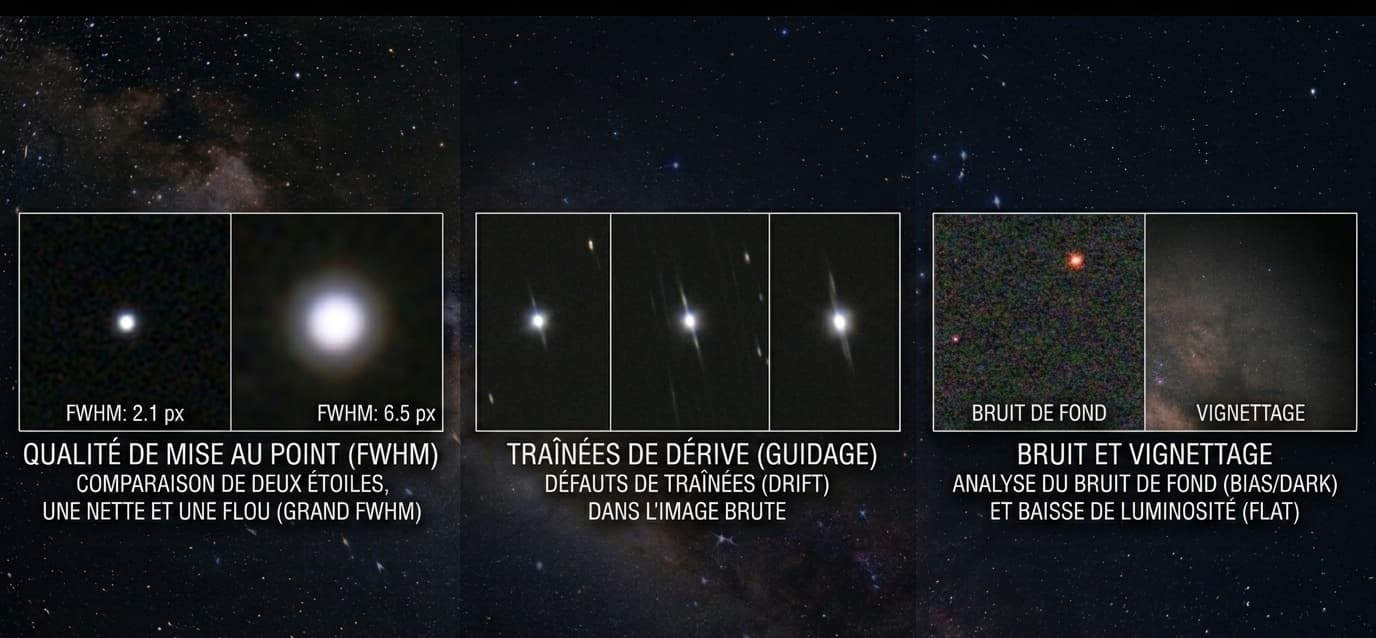
On the processing side, the sky background carries measurable chroma noise (chroma sigma 0.064) visible as red and bluish patches between the filaments, absent from the DSS reference. It is amplified by a stretch applied to a background barely lifted off the black point, which is expected in narrowband under a 91 percent Moon.
Everything else is clean: no significant gradient (5 percent amplitude), no satellite trail, no calibration artefact, and the Veil structure matches the DSS filament for filament. This image has real potential, and astigmatism is the only hardware limitation.
Priority actions
- Rerun an aberration inspector test after checking the optical train to isolate the source of the field astigmatism
- Apply targeted chroma noise reduction on the background with a mask protecting the filaments
- Increase colour channel integration to strengthen background SNR
- Verify backfocus spacing in 0.5 mm steps including filter thickness