Astrophotography diagnosis of NGC 6960: Noise / underexposure, astigmatism and 2 others
Mastermixed30×240s19 sept. 2026
The Doc examined this image of NGC 6960 (master, mixed, 30×240s). Estimated overall technical quality: 6/10. 4 defects found: Noise / underexposure (severity 3/5), Astigmatism (severity 2/5), Background chroma noise (severity 2/5), Sensor tilt (severity 1/5).

Info
- Cible
- NGC 6960
- Date
- 19 sept. 2026, 22:56
- Lune
- Croissant décroissant 40.3% (sous l'horizon)
- Site
- Bortle 3 · rural peu pollué (VIIRS)
- Position
- 20h51m12s · +31°14'56"
Conditions were favourable: Bortle 3 with the Moon below the horizon at 40% phase, so neither strong light pollution nor lunar veiling to compensate. That is exactly the sky a low surface brightness supernova remnant like NGC 6960 needs, since its filaments demand a dark, stable background. Yet the measured background sits very close to the black point (e_margin 1.74), which is not the sky's fault but the exposure budget's: under a sky this good you can afford longer subs or higher gain without any risk of saturating the background. In other words the site limits nothing here, the integration time does.
Setup
- Type d'image
- Master
- Télescope
- ZWO AM5
- Caméra
- Nikon DSC D5600
- Filtre
- mixed
- Exposition
- 30×240s
- Phase de lune
- Premier quartier (58 %)
- FOV
- 3.03°
The framing is sound: 3.03 degrees of field take in the whole Veil complex, eastern arc and Broom, the right call at this 417mm focal length. Sampling at 3.84 arcsec per pixel is clearly undersampled with 7.78 micron photosites, though: the fine filaments are limited by the pixel grid as much as by seeing, which explains FWHM values of only 3 to 4 pixels. The uncooled Nikon body is the weak link on such a faint target, weighing on background chroma noise. With 240s subs under a Bortle 3 sky, a dual-band filter on this emission target would clearly lift filament contrast.
The diagnosis in detail
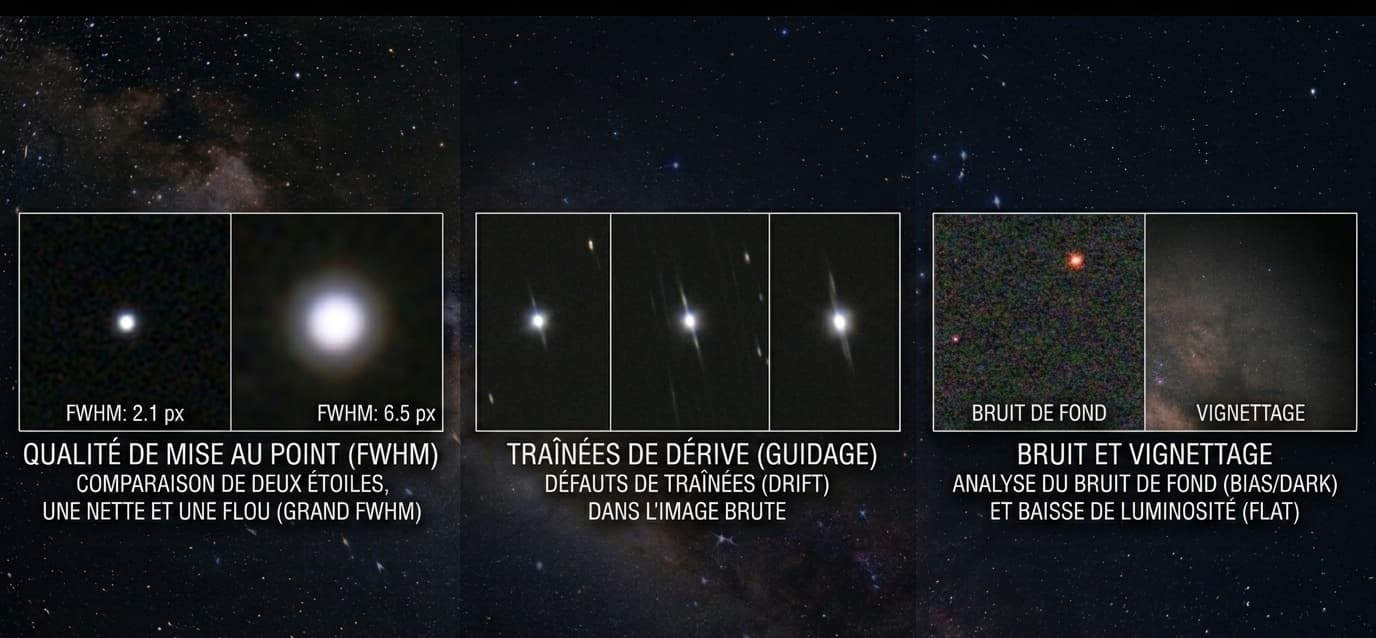
Tracking and focus are not the issue: the field centre measures 1.08 elongation, exactly the field floor, and FWHM never exceeds 4.2 pixels. The AM5 is doing its job, and no drift or oscillation is readable on the panel.
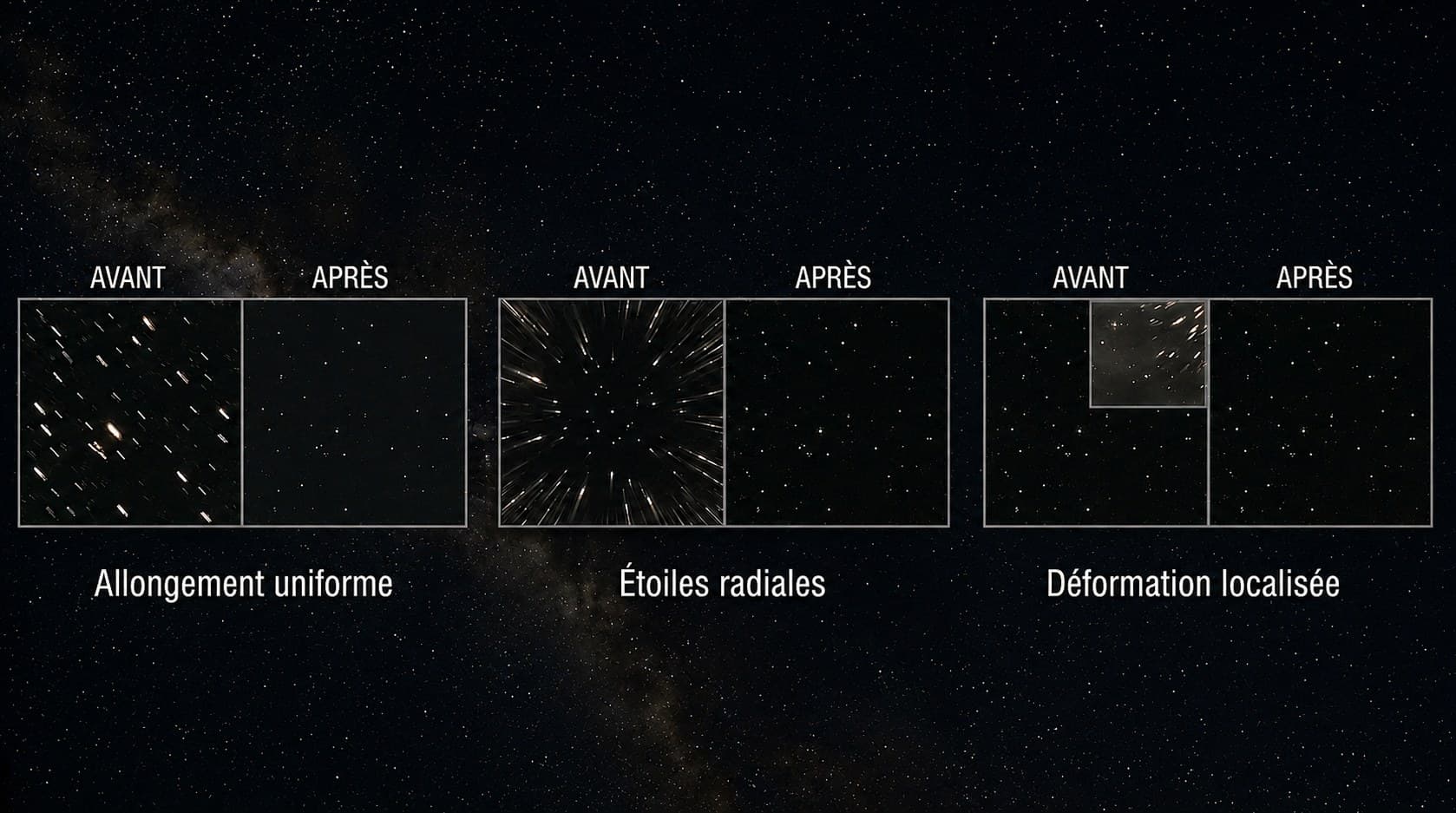
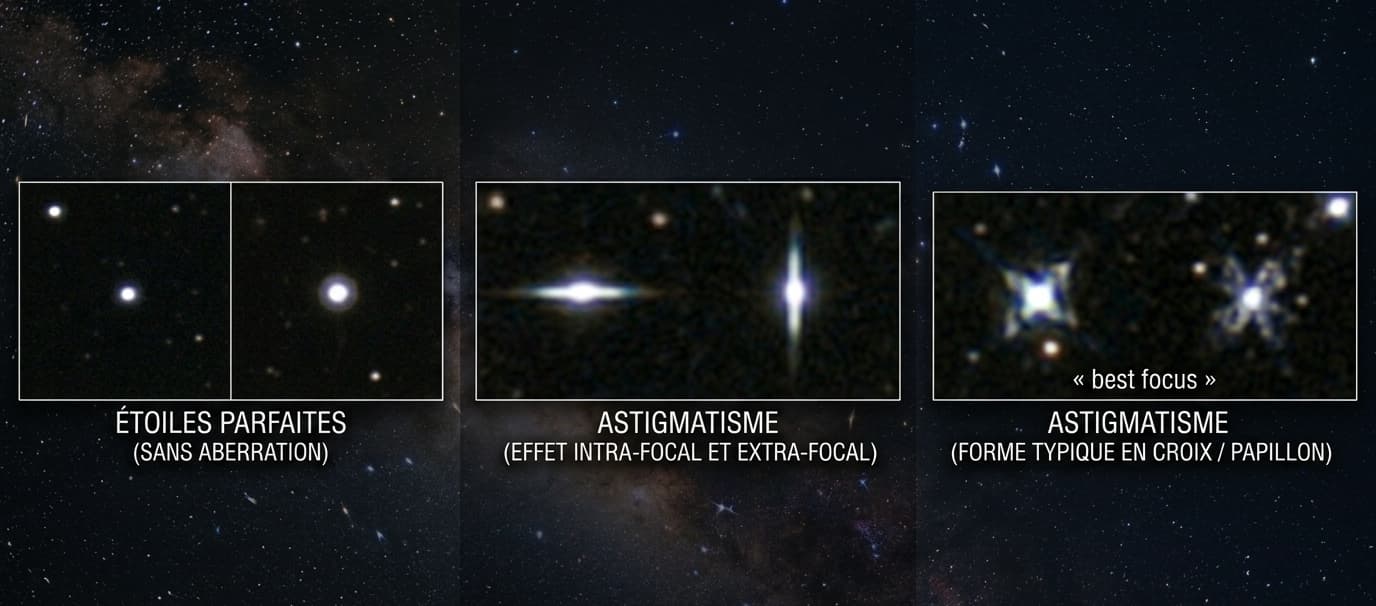
The shape defect is localised and small. The left edge and bottom-left corner rise to 1.25 and 1.35 elongation while FWHM does not increase toward the corners (corner/centre ratio 0.891): tight but stretched stars, which points to field astigmatism rather than a backfocus error. The left/right asymmetry adds a minor tilt component, but it is too weak to address separately while astigmatism dominates. Rotating the camera 90 degrees and reshooting a panel would settle sensor versus optics for good.
The real brake is the signal budget. Thirty 240s subs leave the background barely lifted off the black point, with visible chroma mottling in the upper-left quadrant and central filaments buried that the DSS renders clearly. Under a Bortle 3 sky, that is exposure time you can gain without effort.
Priority actions
- Triple the total integration on NGC 6960, aiming for 6 to 10 hours to pull the fine filaments out of the noise
- Lengthen subs or raise gain until e_margin reaches 5-10; the Bortle 3 sky allows it
- Add a dual-band filter to boost contrast on this emission remnant
- Check the tightness and flatness of the imaging train, then reshoot an aberration panel after rotating the camera 90 degrees
- Dither between subs and use temperature-matched darks to cut background chroma noise