Astrophotography diagnosis of NGC 6960: Noise / underexposure, astigmatism and 1 other
Master30×240s19 sept. 2026
The Doc examined this image of NGC 6960 (master, 30×240s). Estimated overall technical quality: 6/10. 3 defects found: Noise / underexposure (severity 3/5), Astigmatism (severity 2/5), Background chroma noise (severity 2/5).

Info
- Cible
- NGC 6960
- Date
- 19 sept. 2026, 22:56
- Lune
- Croissant décroissant 40.3% (sous l'horizon)
- Site
- Bortle 3 · rural peu pollué (VIIRS)
- Position
- 20h51m13s · +31°16'48"
Very favorable conditions, well used. Bortle 3 gives a naturally dark background, ideal for an extended emission target like the Veil, and the 40% Moon was below the horizon during the session, so no lunar contribution is possible: the background map confirms it with a near-flat plane (4% amplitude, R2 0.08). In that context there is no external excuse for a noisy background, which points straight back to integration time. With a sky like that, a filter is optional in broadband; the effort should go into stacking more subs rather than into spectral selectivity.
Setup
- Type d'image
- Master
- Télescope
- ZWO AM5
- Caméra
- Nikon DSC D5600
- Exposition
- 30×240s
- Phase de lune
- Premier quartier (58 %)
- FOV
- 3.19°
A setup that is coherent for framing, less so for fine detail. At 418mm, the 3.19 degree field takes in the whole Veil complex, which is exactly the right choice for this target: both arcs and Pickering fit with room to spare. On the other hand, the 3.84 arcsec/px sampling is clearly undersampled, which explains a measured FWHM of only 2.2-2.7 px: you lose stellar resolution, but on an extended filamentary nebula that is an acceptable trade. The 240s subs are well suited under Bortle 3; it is their count (30) that limits the result, not their length.
The diagnosis in detail
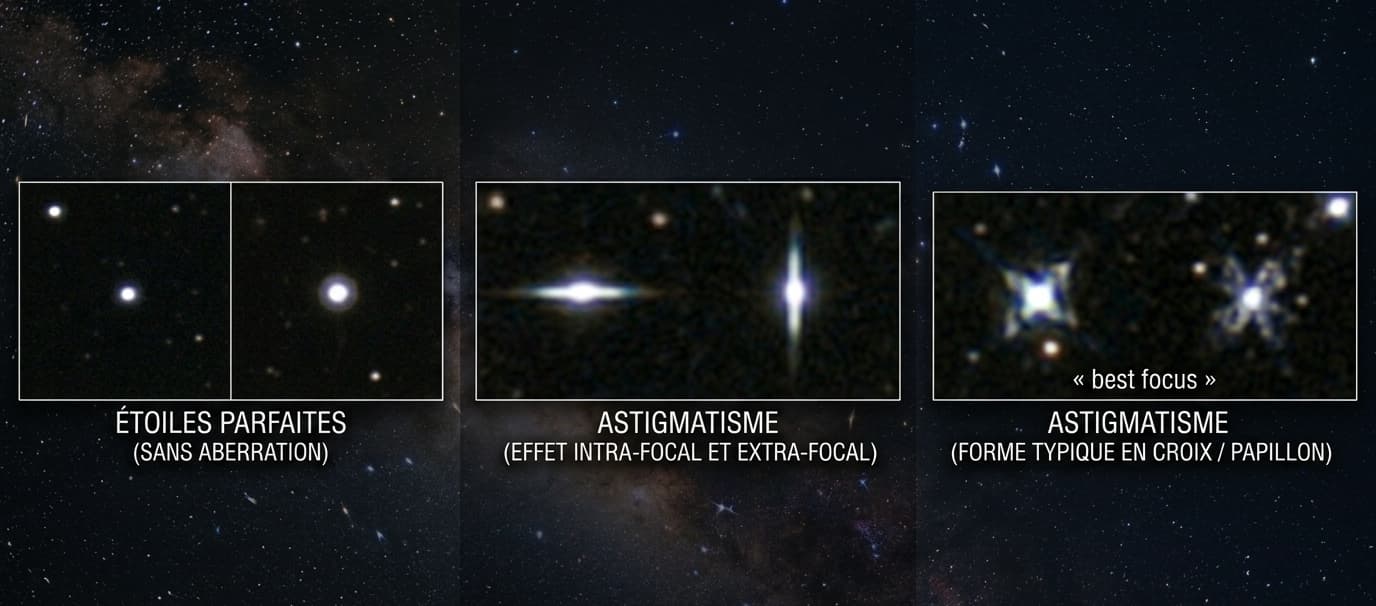
Two distinct findings, of unequal weight. Optically, the aberration inspector is clear: the center is clean (elong 1.09 against a field floor of 1.02) and the corner/center FWHM ratio is 0.96, so there is no field curvature or backfocus to correct. What rises is only the peripheral elongation, up to 1.28 in the bottom-right corner and 1.21 on the right edge, with no bloating of the spot: that is the clean signature of residual field astigmatism. The effect is mild and confined to the edges, and does not compromise the image.
On the signal side is where final quality is decided. Thirty 240s subs make 2h of integration on one of the most extended and faintest objects of the summer sky. The consequence shows everywhere: the background is grainy, chroma mottling appears in the dark zones between the arcs, and above all the intermediate filaments that the DSS shows clearly between NGC 6960 and Pickering barely emerge. The background-to-black-point margin of 2.45 confirms a background that is barely lifted.
The two points are unrelated: astigmatism is mechanical and fixed at the clamping stage, noise is fixed with exposure time. The second has far more impact on the result.
Priority actions
- Triple the integration time at minimum, aim for 5 to 8h on the Veil to extract the faint filaments
- Enable dithering between subs to decorrelate noise and improve stacking rejection
- Check optical train tightness and sensor perpendicularity to reduce corner astigmatism
- Raise the offset or black point slightly at integration to remove the 0.11% dark clipping
- Process the background chrominance separately to soften the color mottling