Astrophotography diagnosis of NGC 6992: Astigmatism
Master5×300s03 juil. 2026
The Doc examined this image of NGC 6992 (master, 5×300s). Estimated overall technical quality: 7/10. 1 defect found: Astigmatism (severity 2/5).
&w=1920&q=75)
Info
- Cible
- NGC 6992
- Date
- 03 juil. 2026, 22:23
- Lune
- Croissant croissant 14.1% (3.1° d'alt., 47.5° de la cible)
- Site
- Bortle 2 · rural typique (VIIRS)
- Position
- 20h57m37s · +31°23'02"
Verdict: excellent acquisition conditions for this target. The Bortle 2 sky gives a very low luminance background, ideal for capturing the faint Ha filaments of the Veil. The Moon, a 14.1% crescent only 3.1 deg above the horizon and 47.5 deg from the target, brings no usable pollution: its influence is negligible here. No lunar gradient is expected or observed. Nothing to fault on conditions, you picked the right window.
Setup
- Type d'image
- Master
- Télescope
- EQMod Mount
- Caméra
- ZWO ASI585MM Pro
- Exposition
- 5×300s
- Phase de lune
- Gibbeuse décroissante (83 %)
- FOV
- 1.65°
Verdict: setup consistent with the target. At 375mm focal length the 1.65 deg field frames the eastern wing of the Veil well, which fills the frame nicely without being cut off. The 1.595 arcsec/px sampling is comfortable under typical seeing and makes good use of the ASI585MM Pro (2.9um pixels). Gain 220 on this sensor stays healthy without massively saturating stars, offset 15 is sufficient (dark clipping 0%), and -17C keeps dark current well controlled. In Ha the low background margin (e_margin 1.41) is normal at 300s and not penalizing. The real lever is total duration: 25 min cumulative is short to extract the full potential of this sky.
The diagnosis in detail
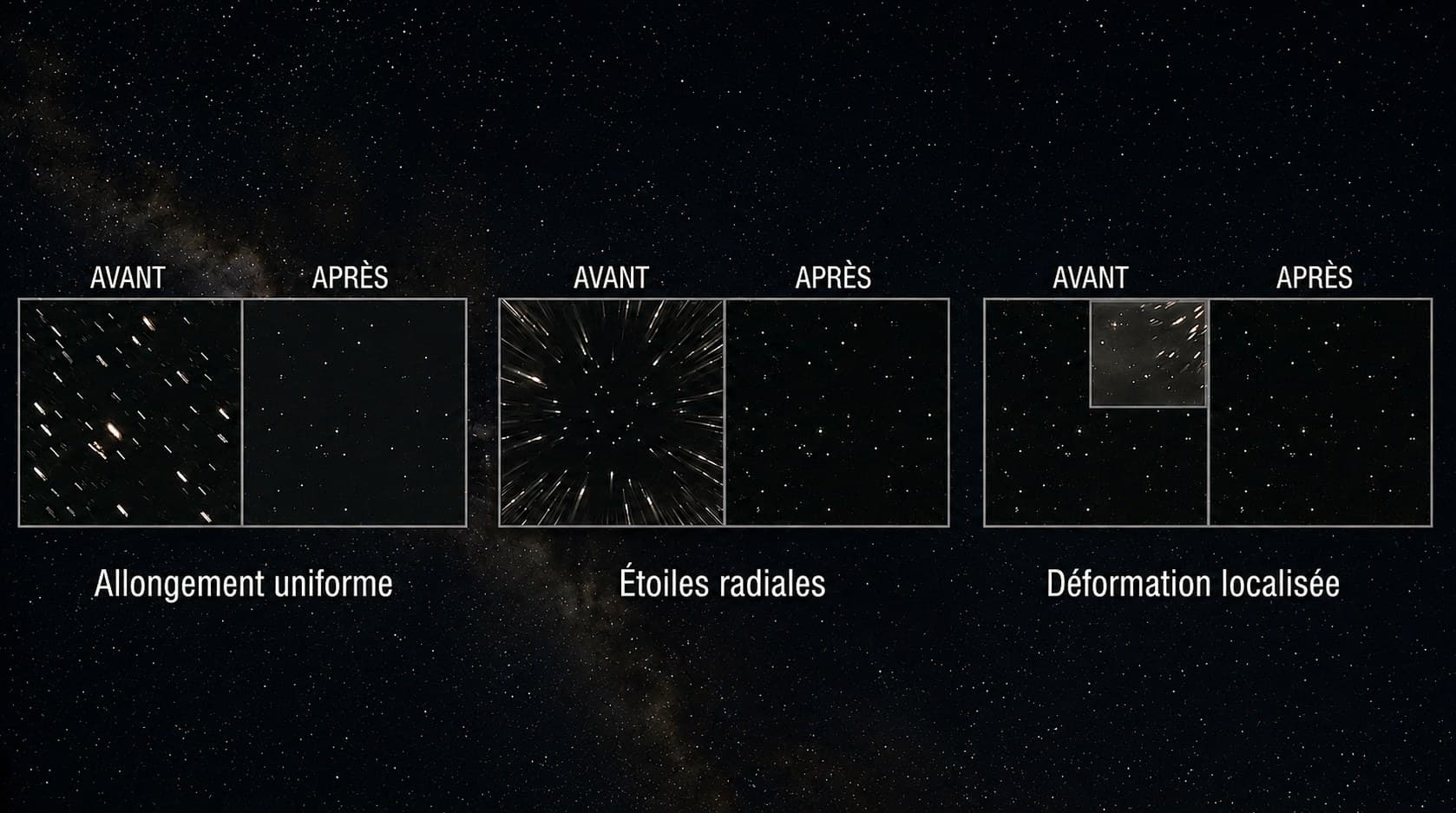
The acquisition is of very good quality. The PSF panel confirms healthy tracking and focus: center C is round (elong 1.06, barely above the field floor of 1.02) and FWHM is homogeneous around 4.2-4.4px, i.e. ~1.6-2.3 arcsec, consistent with the sampling. No drift or guiding signature: PAs are scattered (41.3 deg), proof there is no global directional elongation.
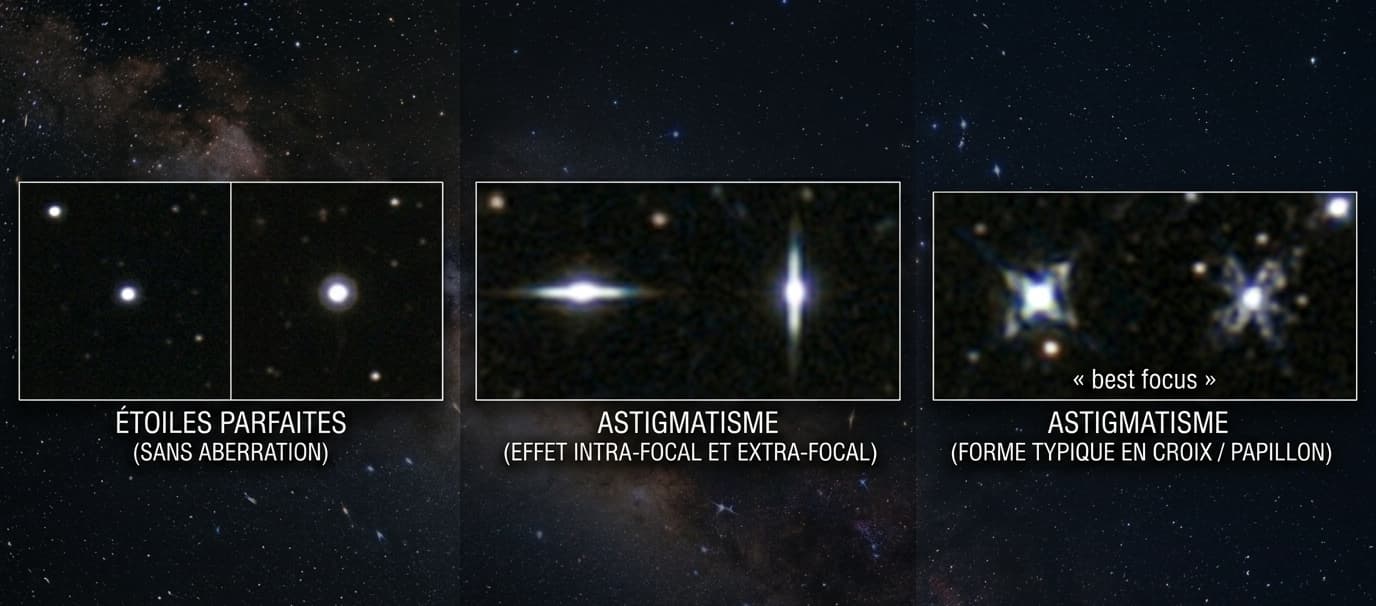
The only optical defect is moderate field astigmatism: elongation rises gradually toward the edges and corners (BL 1.22, BR 1.19, R/B 1.15) without FWHM increasing, which rules out field curvature or clear backfocus error. It is a stretching of peripheral stars, correctable by checking the optical train and backfocus. The background map is excellent (only 3% plane gradient, radial symmetry, no residual vignetting), showing the Bortle 2 sky and calibration are clean.
The truly limiting point is not a defect but integration: 5x300s = 25 min. The background is still slightly grainy and a few satellite trails were not rejected for lack of enough subs. Adding more exposures will smooth the noise and remove these residuals.
Priority actions
- Accumulate many more subs (aim for 3-5h total) to smooth the background and enable effective sigma rejection
- Check the flatness of the optical train and fine-tune backfocus to reduce corner astigmatism, then re-verify with an aberration panel
- Enable/strengthen outlier pixel rejection (Winsorized/Linear Fit) at integration to remove satellite trails