Astrophotography diagnosis of NGC 6992: Astigmatism
RawHOO 1 composite0s
The Doc examined this image of NGC 6992 (raw, HOO 1 composite, 0s). Estimated overall technical quality: 6/10. 1 defect found: Astigmatism (severity 3/5).
&w=1920&q=75)
Info
- Cible
- NGC 6992
- Position
- 20h56m20s · +31°34'09"
Last-quarter crescent Moon at 7% illumination: negligible light contribution, so the sky can be treated as essentially Moon-free for this target. With no light-pollution (Bortle) data provided I can't quantify the background, but the measured background map is flat (0% gradient, radial symmetry), so conditions were favorable. NGC 6992 is an emission target (Ha/OIII) ideal for narrowband and tolerant of a faint Moon like here.
Setup
- Type d'image
- Brut
- Télescope
- Skywatcher 200/800
- Caméra
- FUJIFILM XT-3
- Filtre
- HOO 1 composite
- Monture
- EQ6R
- Exposition
- 0s
- Phase de lune
- Dernier croissant (7 %)
- Seeing
- 1,6°
- FOV
- 1.68°
Setup/target match is good: with a 1.68-degree wide field the Eastern Veil sits comfortably in frame with balanced placement. The 200/800 (f/4) Newtonian on an EQ6-R offers a fast ratio and fine sampling, consistent with the stated seeing around 1.6. The weak link is field correction: at f/4 a properly spaced coma corrector is essential to keep stars tight into the corners, which the measured astigmatism confirms. The stated 0s sub prevents any exposure judgment; in narrowband a background sitting close to the black point (e_margin 2.18) is normal, not a sign of under-exposure.
The diagnosis in detail
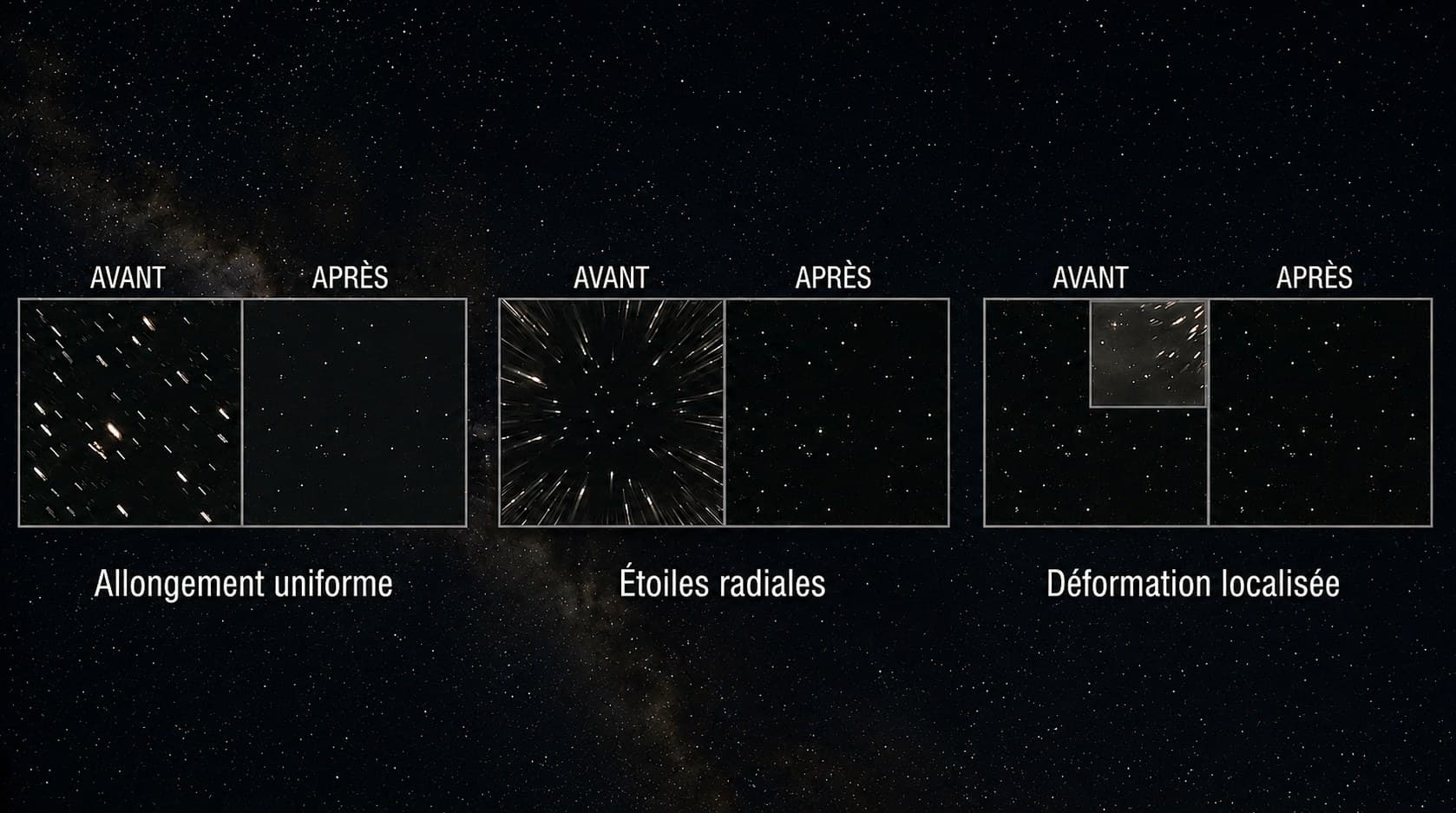
On this monochrome sub the essentials are healthy. The field core is sharp (center elong 1.11, barely above the 1.07 floor) and the elongation direction is inconsistent from zone to zone: we therefore rule out tracking drift or periodic error, which would produce uniform parallel streaks everywhere. The EQ6-R tracking is fine here.
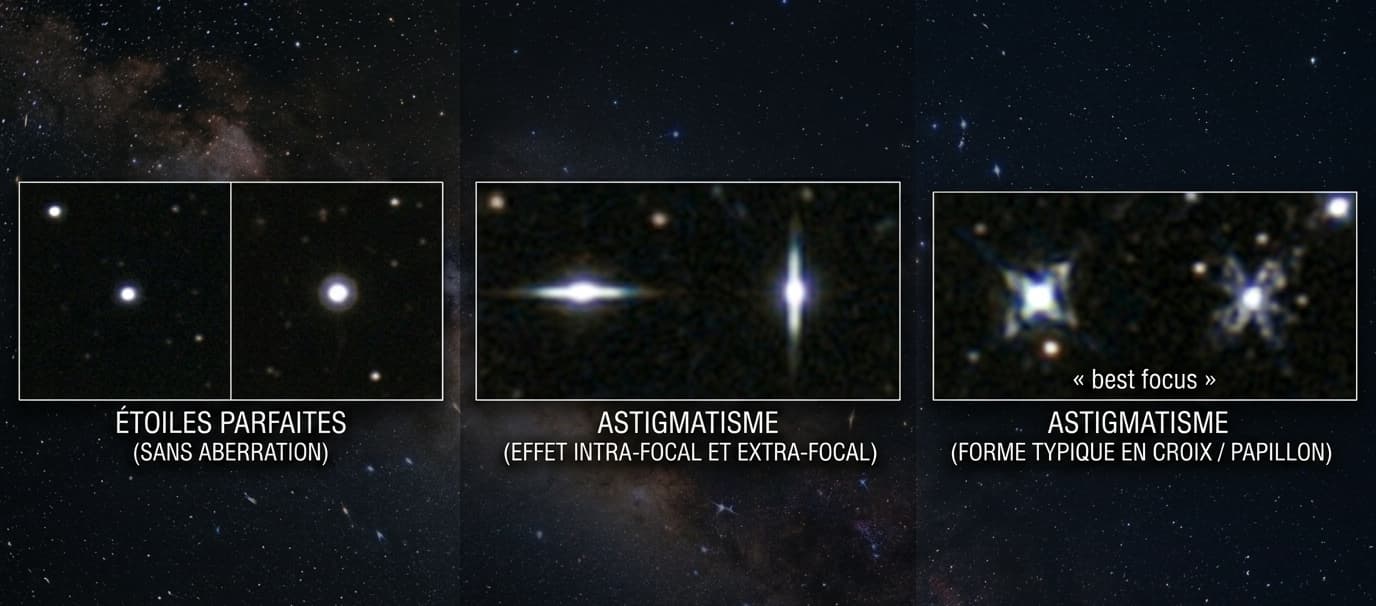
The real defect is optical and confined to the edges: elongation rises radially (BR 1.64, TL/R 1.50) while FWHM barely degrades (corner/center ratio 1.135). This elongation/FWHM dissociation is the signature of field astigmatism, expected on an f/4 Newtonian whose coma corrector is missing or mis-spaced, with a possible collimation contribution given the scattered angles. The fix is a suitable corrector, precise backfocus and careful collimation.
On calibration and sky, the background map is flat and radially symmetric, with no gradient or residual vignetting to report, and the DSS confirms the red/cyan filaments are the real nebula, not artifacts. This is a clean basis for stacking.
Priority actions
- Add a coma/field corrector suited to the f/4 Newtonian to tighten edge stars
- Set backfocus (sensor-to-corrector spacing) precisely to spec
- Redo a careful collimation before the next session