Astrophotography diagnosis of V398 Cephei: Astigmatism
Raw300s17 août 2026
The Doc examined this image of V398 Cephei (raw, 300s). Estimated overall technical quality: 7/10. 1 defect found: Astigmatism (severity 2/5).
&w=1920&q=75)
Info
- Cible
- V398 Cephei
- Date
- 17 août 2026, 22:37
- Lune
- Gibbeuse décroissante 71% (sous l'horizon)
- Site
- Bortle 2 · rural typique (VIIRS)
- Position
- 0h03m11s · +66°50'13"
Excellent conditions: Bortle 2, and a 71% waning gibbous Moon that is below the horizon, so no lunar contribution is possible on this sub. The background stays very low (median 0.02, background to black point margin of 1.85), which is normal for a filtered exposure under such a dark sky and not in itself a sign of underexposure to fix. On an emission region like this one, that kind of night lets you reach the faint extensions without fighting a gradient. Capitalize by extending total integration rather than raising the sub length.
Setup
- Type d'image
- Brut
- Télescope
- EQMod Mount
- Caméra
- ZWO ASI585MM Pro
- Exposition
- 300s
- Phase de lune
- Premier croissant (23 %)
- FOV
- 3.36°
The setup is well matched to the target. At 190 mm focal length you get a 3.36 degree field, ample to frame the nebulosity and its surroundings, so the composition is comfortable. Sampling at 3.15 arcsec/px is clearly undersampled though: stars are 1.3 to 1.5 px FWHM, so a star sits on one or two pixels and you lose all fine detail, which also explains why the astigmatism stays visually discreet. Gain 180 on the ASI585MM with 300s and the sensor at -15.5C: healthy settings, no shadow clipping, sufficient offset. Nothing to change on the acquisition side.
The diagnosis in detail
This sub is mechanically and thermally clean. The field center measures 1.14 elongation, exactly the floor measured across the image: stars are round there, which rules out any tracking component (drift, periodic error, guiding oscillation). On an untouched 300 second exposure, that is a strong indicator of how well the mount behaved that night.
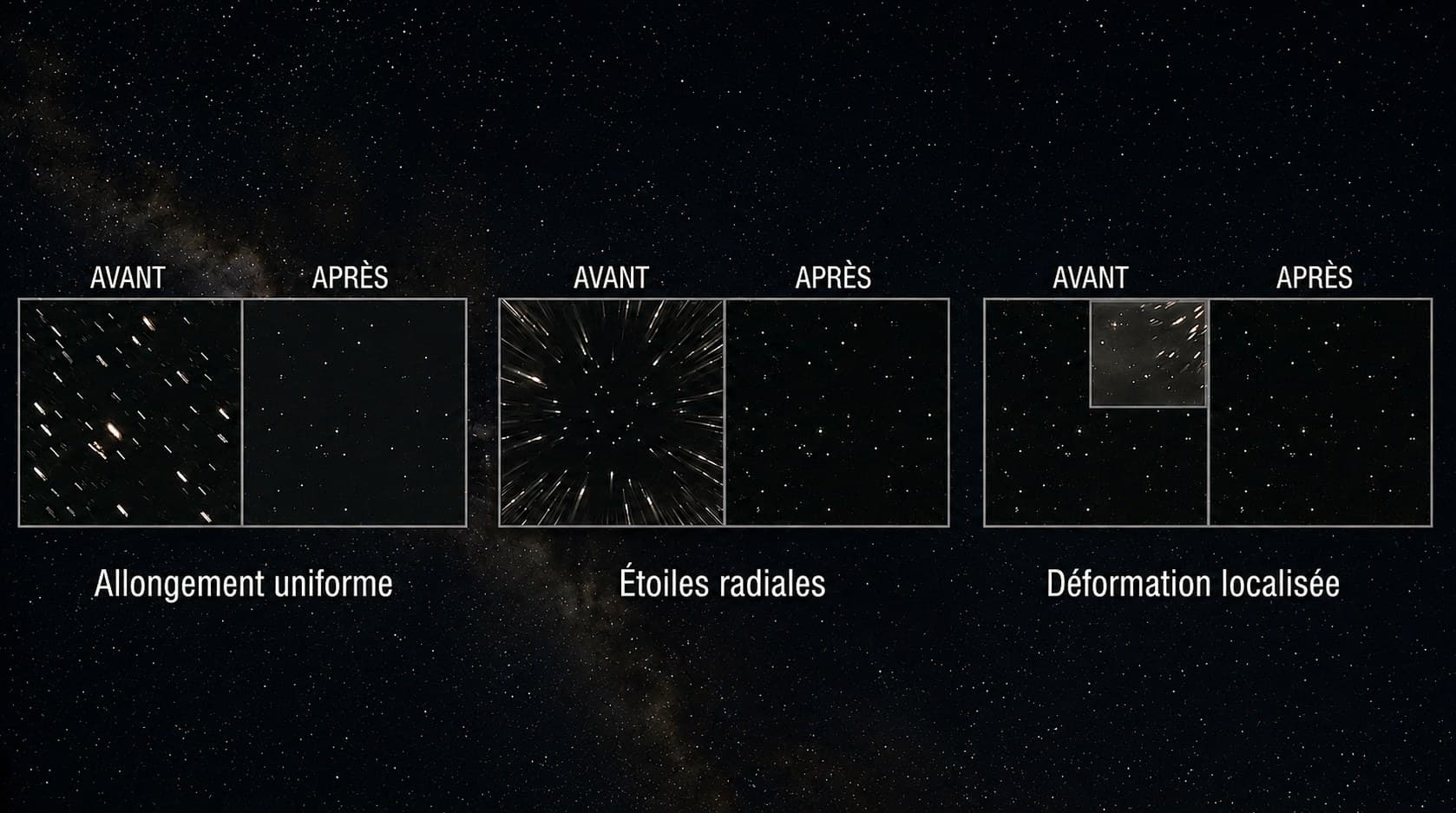
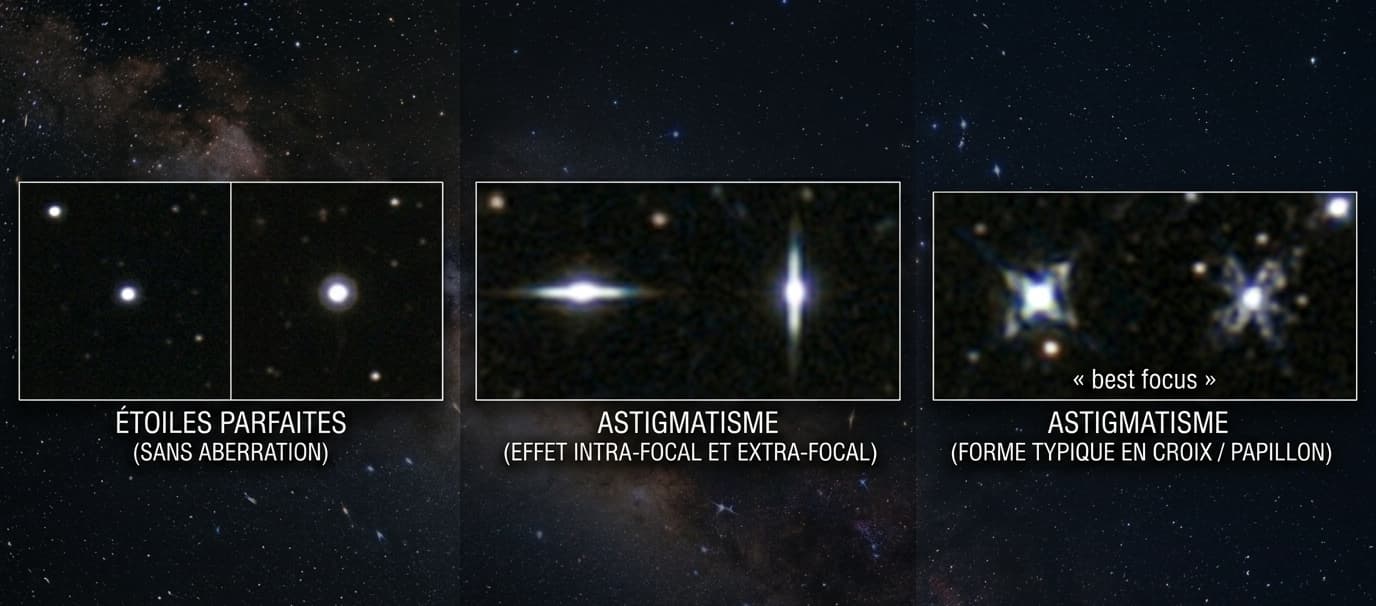
The degradation is purely optical and peripheral. Elongation climbs to 1.33 on the top right, 1.34 on the right edge and 1.39 in the bottom right corner, while FWHM does not move at all (corner/center ratio 0.985). That split between rising elongation and stable FWHM is the signature of field astigmatism: stars stay tight but stretch. Field curvature or a backfocus error would have inflated the FWHM, which is not the case here.
The background is healthy: a very weak radial profile, a 3% gradient with an R squared of 0.2, so no clear background model to correct, and the nebular structures in the image land in the same place on the DSS. Undersampled at 3.15 arcsec/px, the visual impact of this astigmatism stays limited, but it is worth checking the spacing before a long run.
Priority actions
- Check and fine tune the optical backfocus, then verify corner elongation on a test sub
- Check for mechanical stress on the camera holder and the optical cell
- Capitalize on this Bortle 2 sky by extending total integration rather than the sub length