Astrophotography diagnosis of NGC 7380: Noise / underexposure and tracking drift
MasterO180s23 sept. 2026
The Doc examined this image of NGC 7380 (master, O, 180s). Estimated overall technical quality: 6/10. 2 defects found: Noise / underexposure (severity 3/5), Tracking drift (severity 2/5).

Info
- Cible
- NGC 7380
- Date
- 23 sept. 2026, 19:38
- Lune
- Croissant décroissant 9% (27.3° d'alt., 73° de la cible)
- Site
- Bortle 2 · rural typique (VIIRS)
- Position
- 22h47m34s · +58°05'27"
Very favourable conditions. A Bortle 2 sky is as good as it gets for narrowband, and the measured background confirms it: no instrumental or light pollution gradient was detected, the only measured variation corresponds to the extended structure itself. The Moon is reported 27.3 degrees above the horizon but 73 degrees from the target, with contradictory illumination values between the moon field (92 percent) and the context string (9 percent): either way, at 73 degrees separation and through a narrow OIII filter its impact stays negligible and no lunar gradient is visible. In short, nothing in the sky limits this image: the limiting factor is integration time, not conditions.
Setup
- Type d'image
- Master
- Télescope
- EQMod Mount
- Caméra
- ZWO ASI2600MM Air
- Filtre
- O
- Exposition
- 180s
- Phase de lune
- Gibbeuse croissante (92 %)
- FOV
- 1.48°
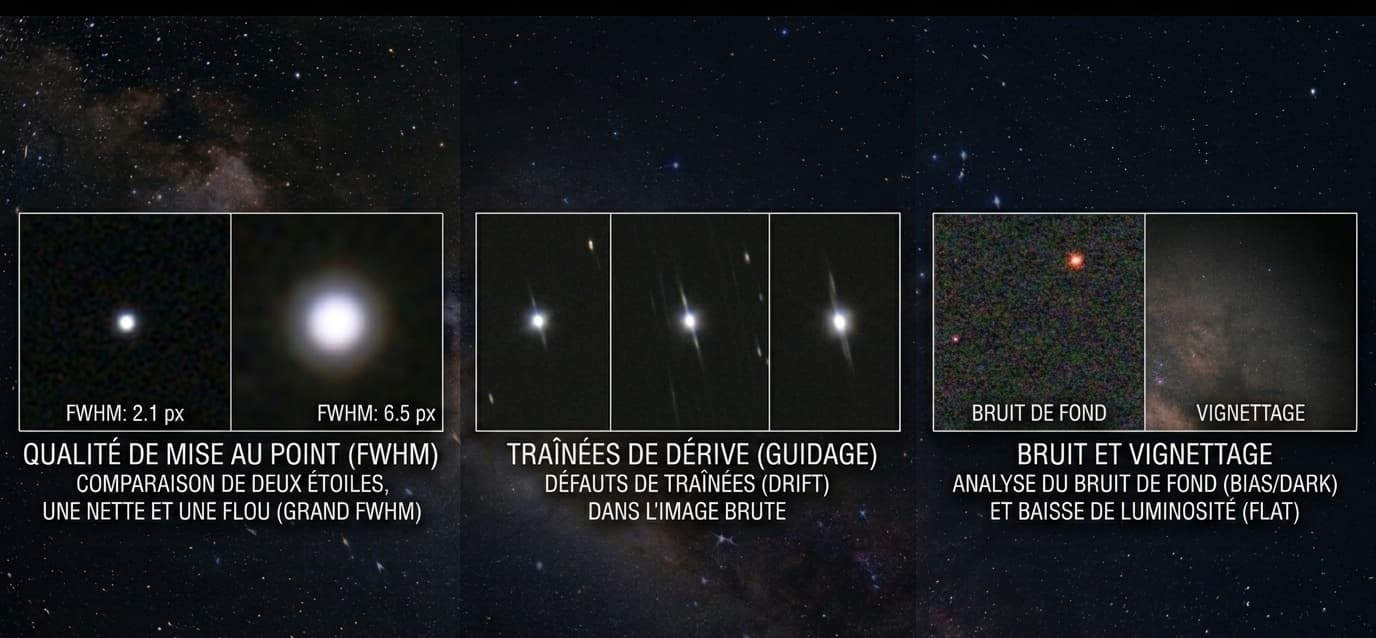
A coherent but under-exploited setup. At 835mm and 0.464 arcsec/px you are clearly oversampled: the measured 8.7px FWHM corresponds to roughly 4 arcsec, which is seeing or tracking, not useful resolution. Software binning 2 would give you 0.93 arcsec/px, cleaner stars and a welcome signal gain in OIII. The 1.48 degree field frames NGC 7380 comfortably with room to spare, so framing is not an issue. On settings, 180s in OIII under Bortle 2 is too short: the background stays glued to the black point (e_margin 1.39). Move to 300 to 600s, the sky allows it with no risk of background saturation.
The diagnosis in detail
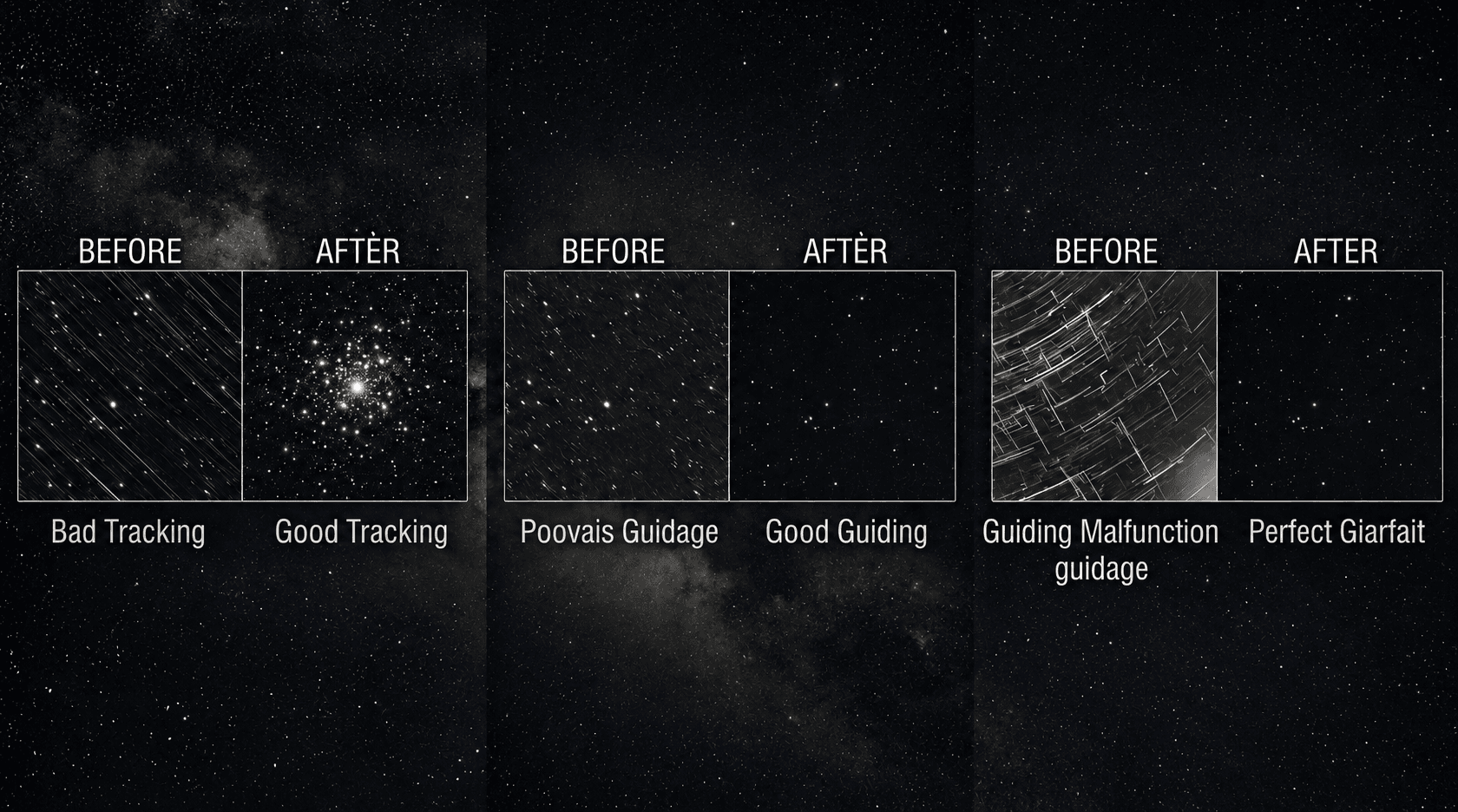
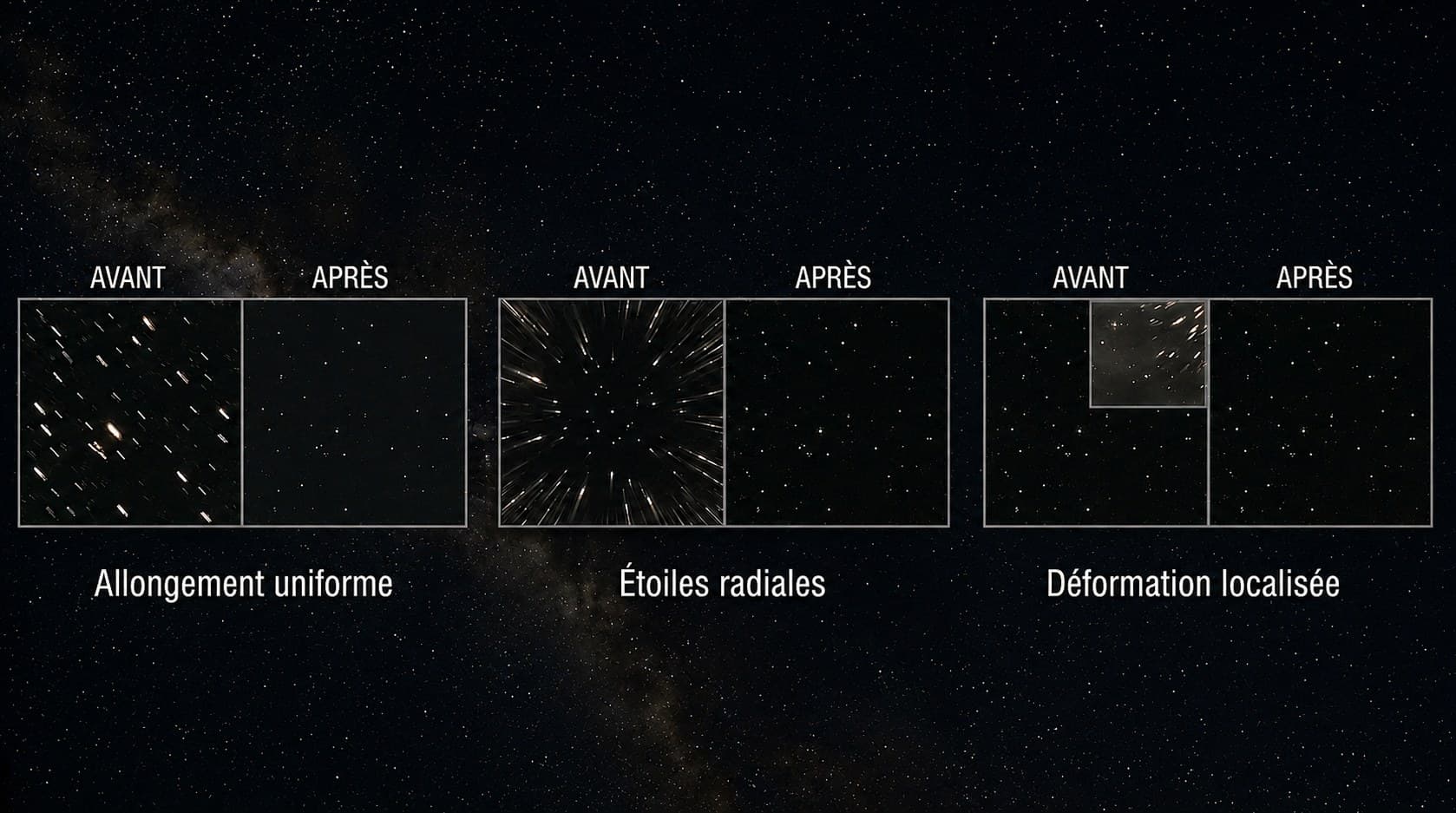
The aberration inspector is unambiguous: the field centre already shows 1.21 elongation where a monochrome camera floor sits around 1.12, and that elongation is identical across all nine zones (1.19 to 1.24) with tightly grouped angles (6.1 degrees of scatter). The corner to centre FWHM ratio of 1.032 is remarkably low: optics and backfocus are well set and the sensor is properly flat. Everything deforming the stars therefore comes from the mount, not the optical train. The slightly higher elongation on the bottom row (1.24 against 1.19 at the top) suggests a drift whose amplitude varied through the session rather than a fixed fault.
The second topic is signal. With a background to black point margin of 1.39, this master is not sky limited, which is partly normal in narrow OIII, but the consequence is visible: NGC 7380's nebulosity shows only as very faint traces while the star field is rich. Under a Bortle 2 sky you have enormous headroom to lengthen the subs without the background taking over.
The two issues are treated independently: guiding for star shape, exposure and integration for signal. Neither compromises this master, which remains a sound base.
Priority actions
- Increase the OIII sub exposure from 180s to 300 or 600s to exploit the Bortle 2 sky and lift the background off the black point
- Stack several more hours of OIII so that the NGC 7380 nebulosity emerges
- Review the PHD2 guiding log to identify the drift axis (RA or DEC) and correct polar alignment and aggressiveness
- Consider binning 2 during processing: at 0.464 arcsec/px for a 4 arcsec FWHM you gain signal without losing real detail