Astrophotography diagnosis of NGC 7380: Tracking drift
MasterH180s23 sept. 2026
The Doc examined this image of NGC 7380 (master, H, 180s). Estimated overall technical quality: 7/10. 1 defect found: Tracking drift (severity 2/5).

Info
- Cible
- NGC 7380
- Date
- 23 sept. 2026, 22:00
- Lune
- Croissant décroissant 8.6% (33.5° d'alt., 72.4° de la cible)
- Site
- Bortle 2 · rural typique (VIIRS)
- Position
- 22h47m36s · +58°05'24"
Near ideal conditions. Bortle 2 gives a very dark sky background, and the given lunar context (8.6% crescent, 33.5 degrees altitude, 72.4 degrees from target) is negligible, especially since a Ha filter rejects most lunar scatter anyway. On an HII region like NGC 7380 you could even shoot under a far more intrusive moon. In this sky the limiting factor is no longer the background but total integration time and tracking quality. Make the most of that Bortle 2 by adding OIII and SII layers, which would genuinely benefit from such a dark sky.
Setup
- Type d'image
- Master
- Télescope
- EQMod Mount
- Caméra
- ZWO ASI2600MM Air
- Filtre
- H
- Exposition
- 180s
- Phase de lune
- Gibbeuse croissante (92 %)
- FOV
- 1.48°
Setup is well matched to the target. At 835mm focal length with 3.76 micron pixels you sample at 0.93 arcsec/px, which is slightly oversampled for typical seeing and explains part of the measured FWHM near 5px (about 4.7 arcsec). Software bin 2 at integration would give you a better signal to noise ratio without losing any real detail. The 1.48 degree field frames NGC 7380 comfortably, with room for the faint extensions of Sh2-142. The Ha filter on an HII region is the right call. The 180s exposure explains the low measured histogram margin, but that is normal in narrowband under a Bortle 2 sky: nothing to fix on the exposure side.
The diagnosis in detail
This Ha master is well executed. The background map shows no usable instrumental anomaly: the slight measured radial falloff is weak and its model poorly constrained (R2=0.51), and the DSS confirms the extended nebulosity around the Wizard Nebula is genuinely real, not a flat artifact. No dust donuts, no banding, no residual fixed pattern: the calibration chain is doing its job.
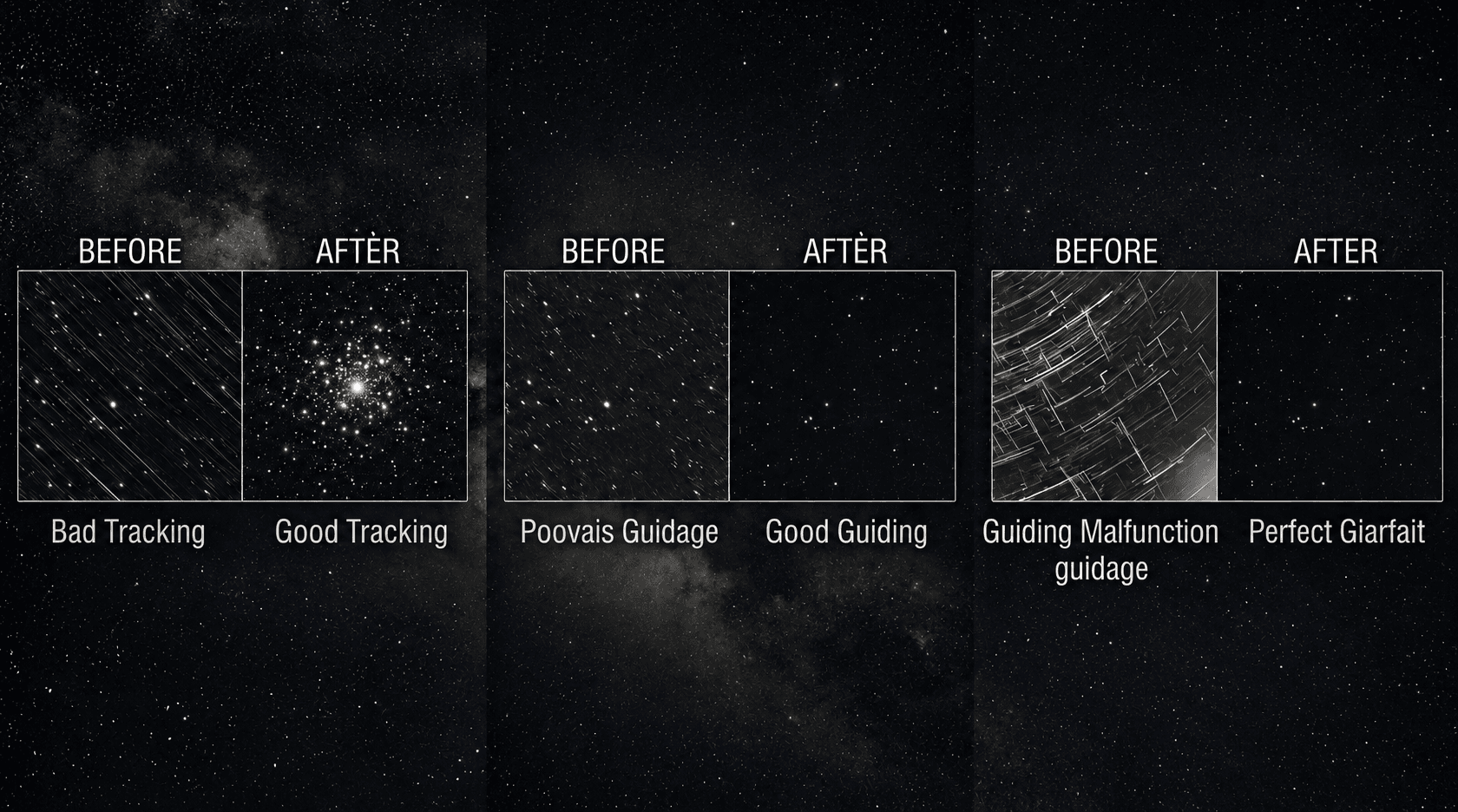
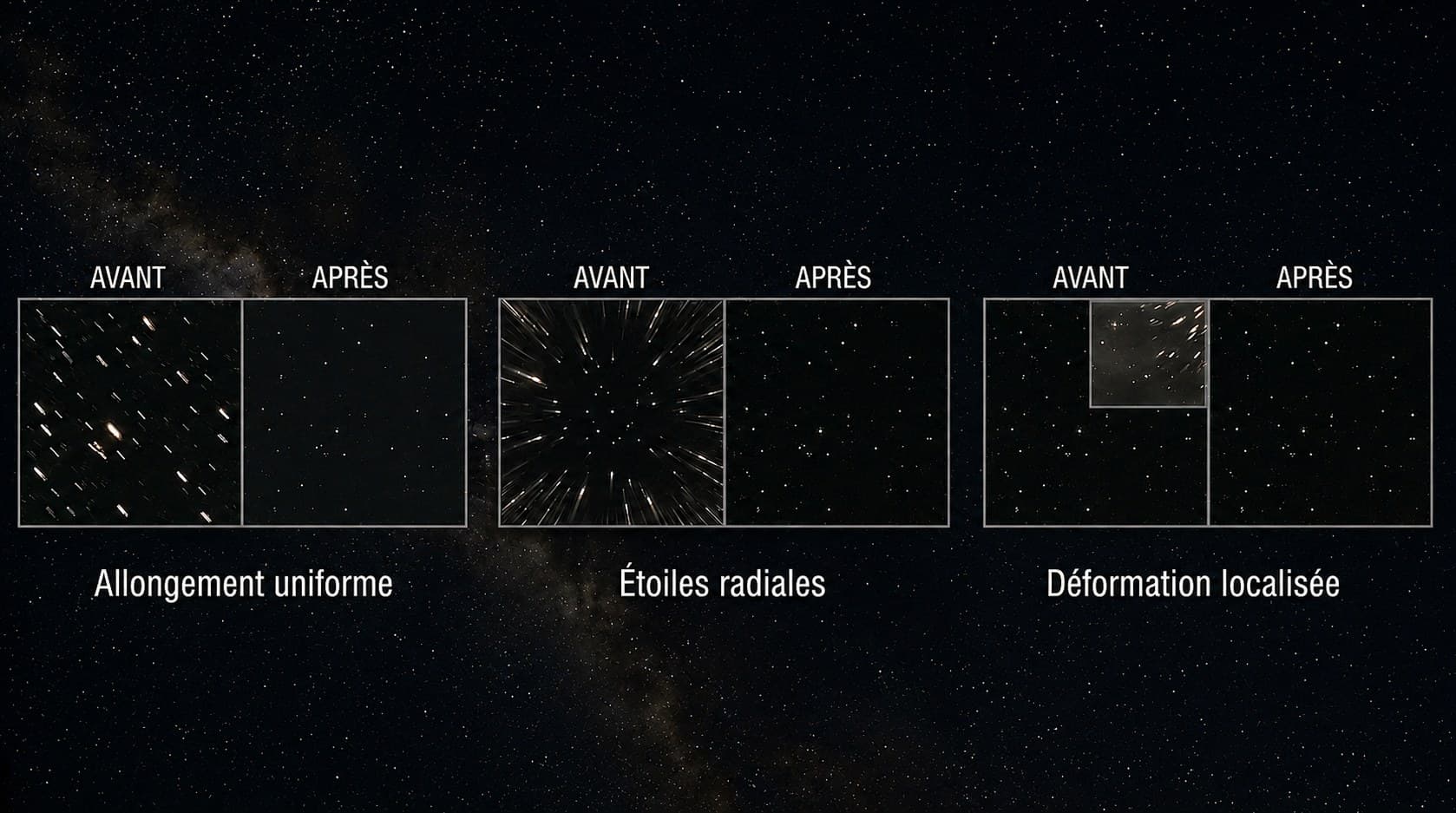
The only measured issue concerns star shape. The aberration inspector gives 1.24 elongation at the centre while the field floor sits at 1.21, with a near identical orientation across all nine zones (PA spread of 7.7 degrees). This signature is characteristic: an optical aberration spares the centre, a tracking drift does not. The 1.072 corner/centre FWHM ratio confirms there is no tilt, no backfocus error and no residual coma. On the panel the cyan ellipses fit well and show slightly oval stars everywhere, with no radial commas.
The amplitude stays modest, hence the low severity. But at 0.93 arcsec/px you are oversampled, so the slightest tracking imprecision shows up immediately. That is where your clearest room for improvement lies.
Priority actions
- Analyse the session PHD2 logs to identify which axis is drifting (RA or Dec) and tighten guiding below 0.5 arcsec RMS
- Redo a precise polar alignment before each session, a drift consistent across the whole field often points there
- Check for differential flexure by tightening the imaging train and the guide scope mount
- Consider bin 2 at integration to offset the oversampling and gain signal to noise ratio