Astrophotography diagnosis of NGC 7380: Light pollution gradient and sensor tilt
MasterH180s23 sept. 2026
The Doc examined this image of NGC 7380 (master, H, 180s). Estimated overall technical quality: 6/10. 2 defects found: Light pollution gradient (severity 3/5), Sensor tilt (severity 2/5).

Info
- Cible
- NGC 7380
- Date
- 23 sept. 2026, 19:38
- Lune
- Croissant décroissant 9% (27.3° d'alt., 73° de la cible)
- Site
- Bortle 2 · rural typique (VIIRS)
- Position
- 22h47m22s · +58°02'31"
Excellent conditions on paper: Bortle 2 and a waning crescent Moon at 9% illumination, 73 deg from the target, so its contribution to the background is negligible. Under these conditions the measured 65% vertical gradient is almost certainly not lunar: look instead at local stray light, NGC 7380 being low early in the session, or mismatched flats. A Bortle 2 sky in Ha is a gift for this target: you can extend integration without worrying about sky background, useful signal builds while background noise stays low. Use this site to stack hours rather than to push gain.
Setup
- Type d'image
- Master
- Télescope
- EQMod Mount
- Caméra
- ZWO ASI2600MM Air
- Filtre
- H
- Exposition
- 180s
- Phase de lune
- Gibbeuse croissante (92 %)
- FOV
- 1.61°
Setup well matched to the target. At 835.8 mm focal length on a 6248x4176 sensor, the 1.61 deg field frames NGC 7380 comfortably, the nebula sits centered with margin: nothing is cut off, this is a safe framing. Sampling at 0.93 arcsec/px is slightly oversampled for typical seeing, confirmed by the 3.7 px center FWHM (about 3.4 arcsec), so software 2x binning could gain signal-to-noise with no real resolution loss. On settings, 180s in Ha on a cooled mono sensor is sound: the very low measured background (e_margin 1.77) is NORMAL in narrowband and does not indicate underexposure, do not lengthen the sub for that reason.
The diagnosis in detail
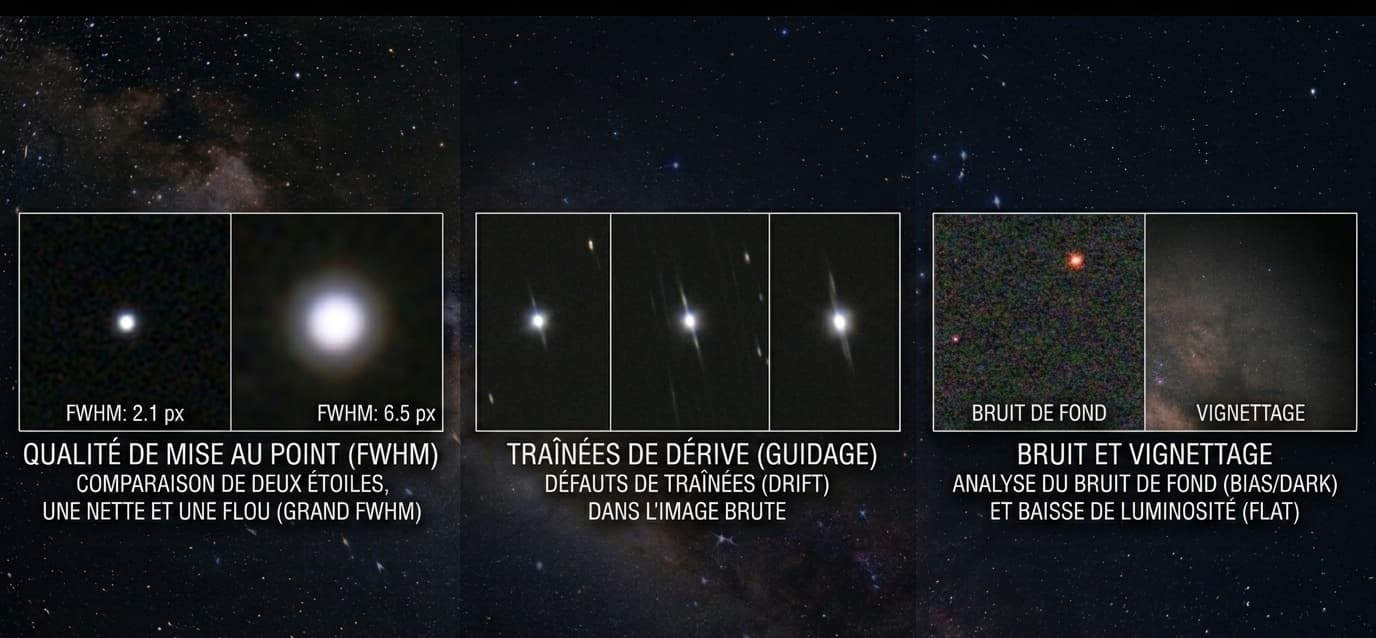
The PSF analysis validates the acquisition mechanics. The center shows 3.68/3.30 px Moffat axes for an elongation of 1.11, barely above the field floor measured at 1.07, and PA dispersion between zones is only 10 deg. In other words: no global directional elongation, so no tracking drift, no periodic error, no guiding oscillation. Focus is clean too, no zone shows a uniformly blurred disk.
A discreet field signature remains. The corner/center FWHM ratio is 1.12, low in itself, but the asymmetry concentrates on a single axis (horizontal 0.112 against vertical 0.044) and clearly opposes the top-left corner (4.14 px) to the bottom-right (3.55 px). That is the signature of mild tilt, not field curvature, which would be symmetric across all four corners. At this level the image stays perfectly usable, but a mechanical check of the imaging train would keep it from drifting by the next session.
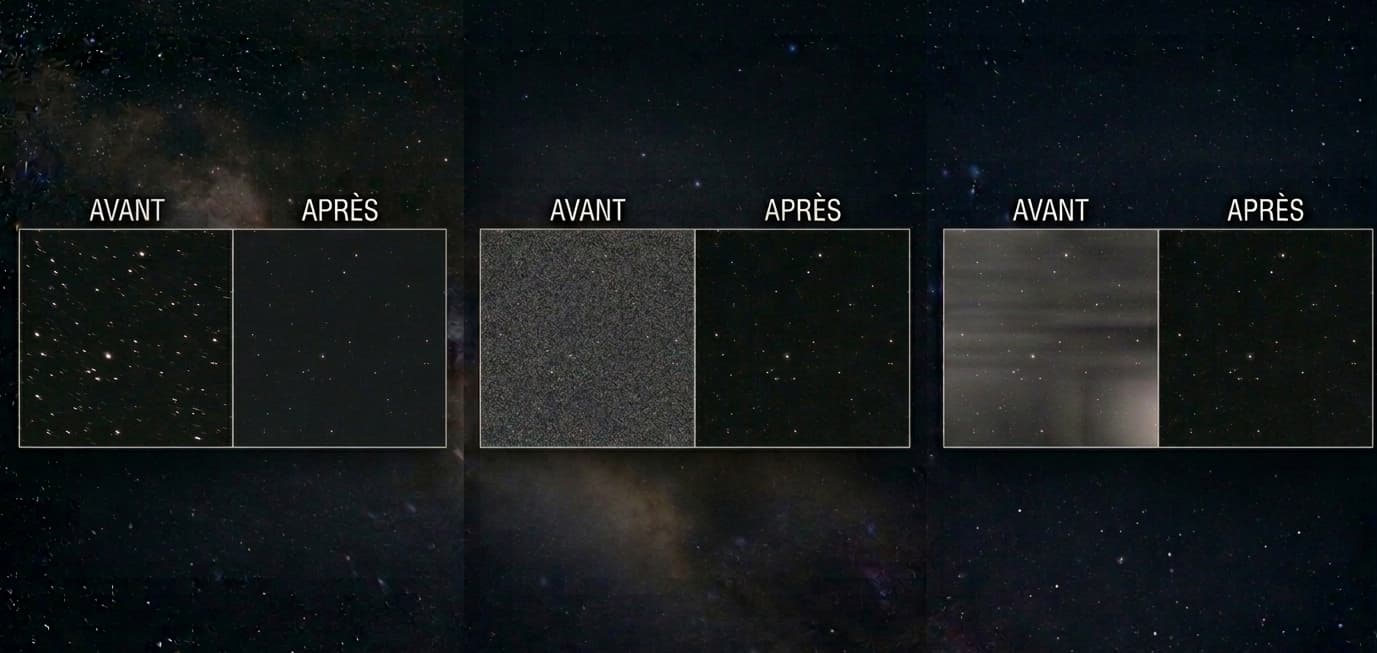
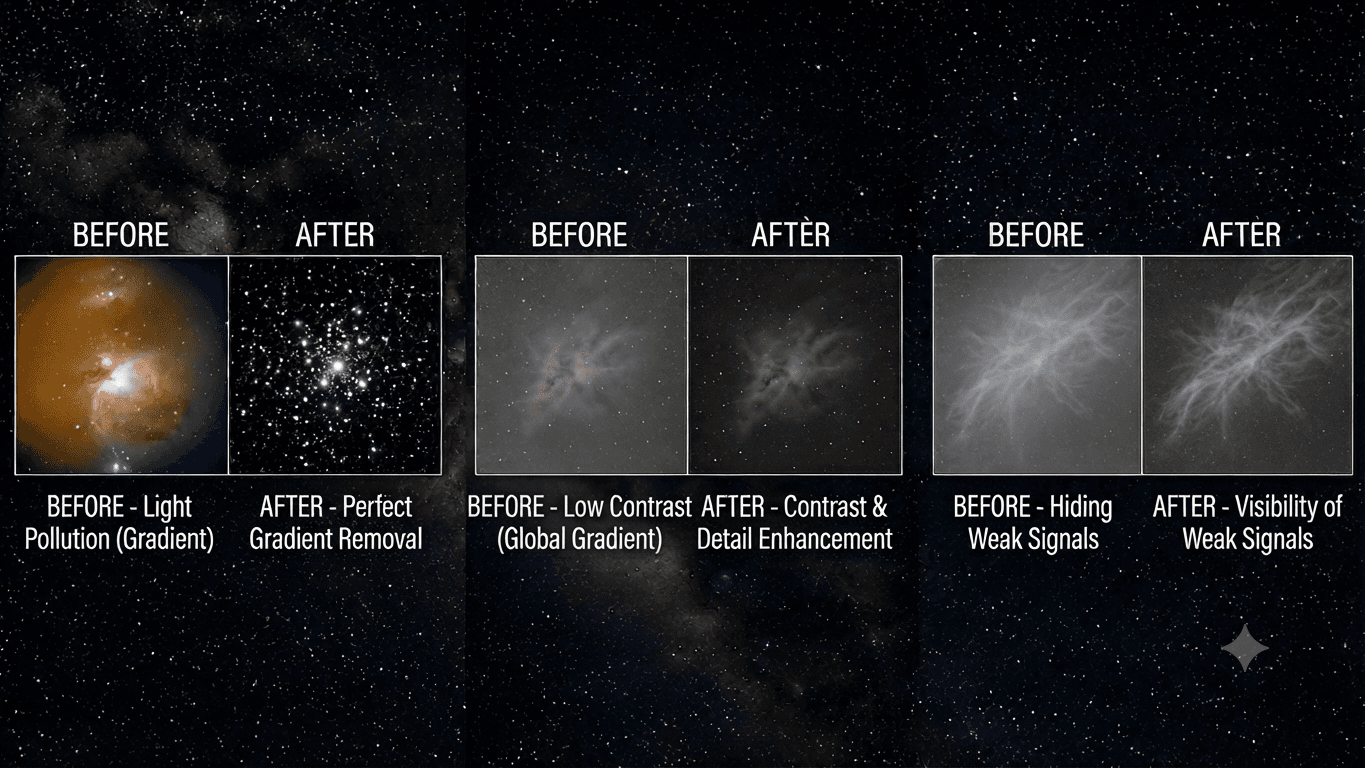
The real sticking point is the background. The 65% amplitude plane gradient oriented at 88 deg dominates the radial component by a factor of 425: this is not vignetting, it is a genuine oriented gradient. It is measured, not guessed, and there is no extended nebulosity in the lower area that could explain it. It must be removed before any stretch, otherwise it will eat the nebula's contrast.
Priority actions
- Extract the background gradient with GraXpert or DBE before any non-linear stretch
- Reshoot a flat set under the exact session conditions to check whether they are the cause
- Check and evenly retighten the optical train, then rerun an aberration inspector test to confirm the tilt
- Stack more hours at this Bortle 2 site rather than pushing gain
- Test software 2x binning, since 0.93 arcsec/px sampling is oversampled for the observed FWHM