Astrophotography diagnosis of NGC 7635: Astigmatism
Raw600s14 sept. 2026
The Doc examined this image of NGC 7635 (raw, 600s). Estimated overall technical quality: 8/10. 1 defect found: Astigmatism (severity 2/5).
&w=1920&q=75)
Info
- Cible
- NGC 7635
- Date
- 14 sept. 2026, 21:01
- Lune
- Gibbeuse décroissante 85.1% (sous l'horizon)
- Site
- Bortle 2 · rural typique (VIIRS)
- Position
- 23h20m39s · +61°33'05"
Excellent conditions. Bortle 2 with an 85% gibbous moon but below the horizon, so no lunar contribution is possible, consistent with the measured background: very dark and free of any oriented gradient (plane amplitude 4%, R2 0.14, no usable structure). The slight 6% radial falloff toward the edges is normal optical vignetting before flats, not a defect. On an emission target like NGC 7635, this sky lets you pull out the faint outer shells of the bubble and the Sh2-157 arc at lower right without fighting the background. This is the kind of night to reserve for the faint channels, OIII and SII in particular.
Setup
- Type d'image
- Brut
- Télescope
- EQMod Mount
- Caméra
- ZWO ASI585MM Pro
- Exposition
- 600s
- Phase de lune
- Premier croissant (10 %)
- FOV
- 3.36°
Coherent setup, with one sampling caveat. At 190mm focal length and 2.9um pixels you sample at 3.15"/px, which is clearly undersampled: stars measure barely 1.3 px FWHM, which partly explains the instability of the edge elongation measurements. The 3.36deg field, on the other hand, is ideal for this region: the Bubble, M52, NGC 7538 and the Sh2-157 wisps all fit together in frame, as the DSS confirms. On settings, gain 160 and -17.5C are healthy, offset 15 produces no dark clipping (0%). The background-to-black-point margin of 2.02 is low, but that is normal in narrowband at this Bortle level: do not lengthen the exposure because of it, 600s is already generous.
The diagnosis in detail
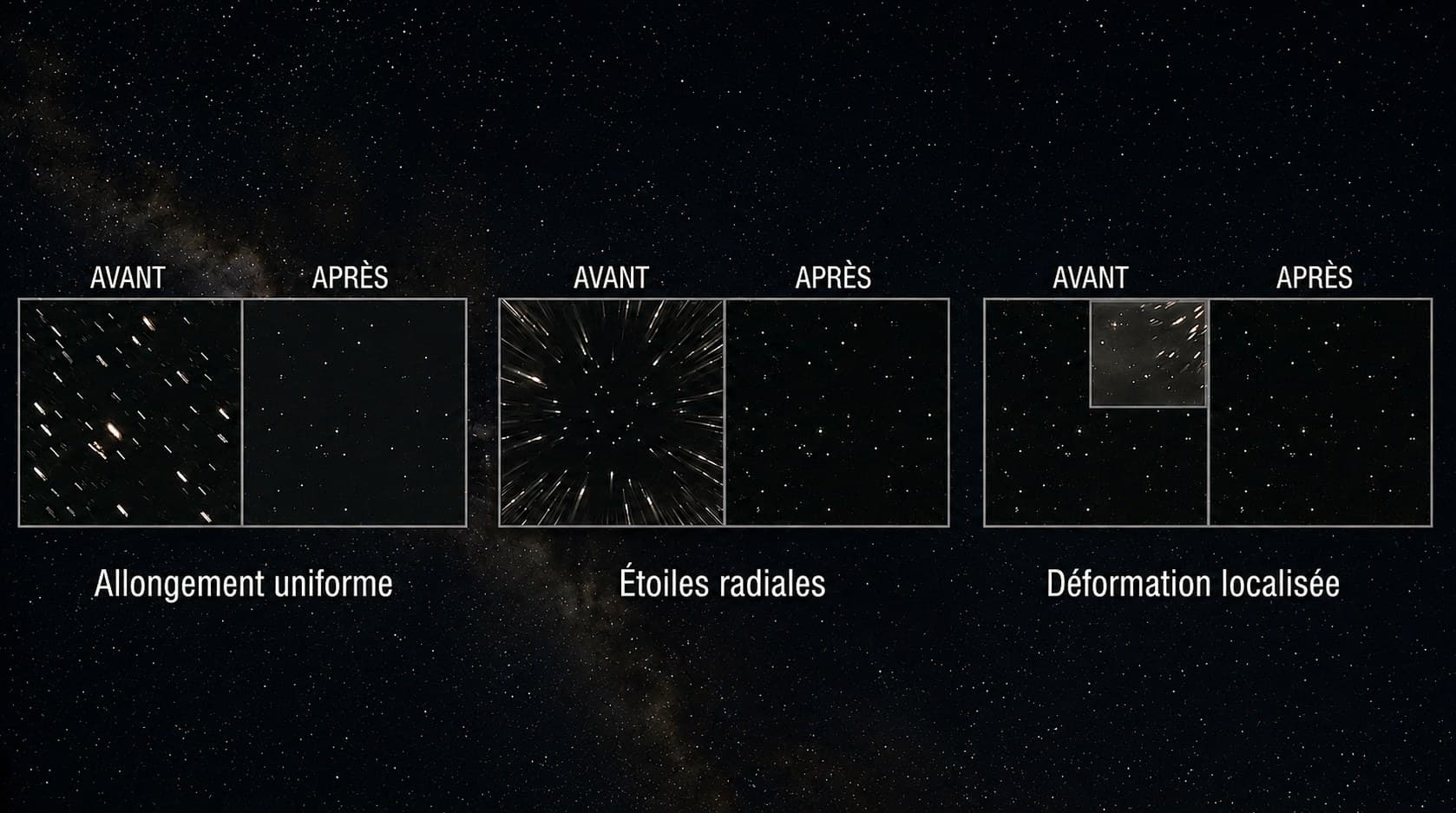
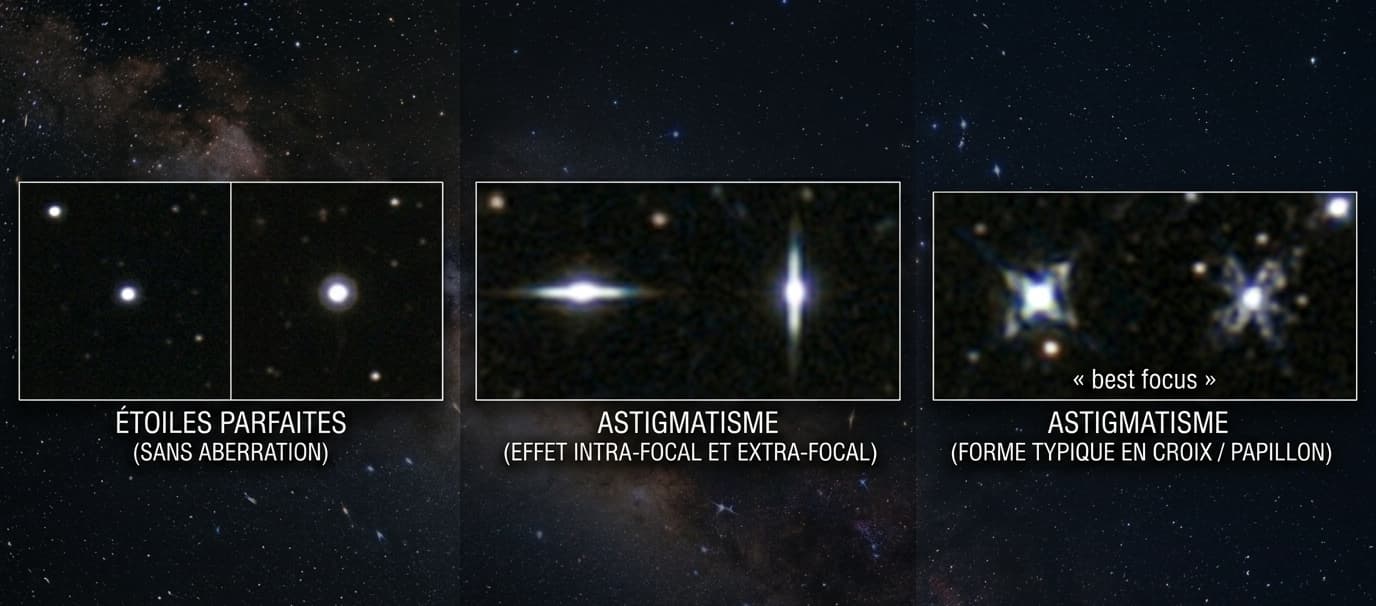
The diagnosis comes down to one point: star shape at the edge of field. The center is faultless, elong 1.06 exactly at the field floor, so no tracking failure, no missed focus, no vibration. Degradation appears only at the periphery, and its signature is clear: elongation climbs to 1.70 at the top and 1.47 on the right while major-axis FWHM stays flat (corner/center ratio 1.062). Field curvature or a backfocus error would inflate the spot in both directions; here it stretches along one axis only, which points to field astigmatism.
Two honest caveats. First, PA scatter between zones stays low (17.2deg) whereas pure astigmatism usually produces variable tangential orientations: the pattern is not perfectly canonical, and some mechanical stress in the imaging train is plausible. Second, at 3.15"/px with 1.3 px stars, every ellipse fit rests on very few pixels, and on a single sub noise mechanically inflates those ratios. The severity of 2 reflects that caution.
Otherwise the sub is healthy. The background is flat and radially symmetric (azimuthal anisotropy 0.01), with no trace of light pollution gradient or amp glow despite 600s. Comparison with the DSS validates every diffuse structure in the field as real nebulosity. You can stack without reservation.
Priority actions
- Check the corrector backfocus distance to within a tenth of a millimetre before the next session
- Slightly loosen the sensor clamp rings to remove any mechanical stress, then re-run an aberration test
- Consider a longer focal length or smaller pixels if you want to exploit the seeing at this Bortle 2 site, 3.15"/px caps your resolution