Astrophotography diagnosis of NGC 7635: Tracking drift and backfocus error
RawIRUV60s24 sept. 2026
The Doc examined this image of NGC 7635 (raw, IRUV, 60s). Estimated overall technical quality: 6/10. 2 defects found: Tracking drift (severity 2/5), Backfocus error (severity 2/5).

Info
- Cible
- NGC 7635
- Date
- 24 sept. 2026, 21:05
- Lune
- Croissant décroissant 3.8% (29.4° d'alt., 69.9° de la cible)
- Site
- Bortle 3 · rural peu pollué (VIIRS)
- Position
- 23h20m08s · +61°22'45"
Very favourable conditions. Bortle 3 and a moon at 3.8% illumination, even at 29 degrees altitude and 70 degrees from the target, produce no meaningful pollution: the background map confirms it with only 2% gradient amplitude and an R squared of 0.29, meaning nothing structured. You are in the ideal case to pull NGC 7635 in broadband IRUV without a dual-band. The only real sky-side lever left is integration time: a 60s sub with e_margin at 2.8 stays short, the background is not truly sky-limited.
Setup
- Type d'image
- Brut
- Télescope
- EQMod Mount
- Caméra
- ZWO ASI2600MC Pro
- Filtre
- IRUV
- Monture
- EQ6 pro
- Exposition
- 60s
- Phase de lune
- Gibbeuse croissante (97 %)
- Notes
- DOF correction
- FOV
- 54.5'
Coherent but demanding setup. At 1482mm on an ASI2600MC, the 0.91 degree field frames NGC 7635 somewhat loosely, the Bubble itself filling only a small fraction of the sensor: you have room to crop or frame tighter. Sampling at 0.523 arcsec/px is clearly oversampled for typical seeing, which explains FWHM around 5px and makes every tracking error visible. Gain 120 and offset 50 are healthy, no shadow clipping, sensor at -10C is fine. On the other hand, 60s at this focal length under Bortle 3 leaves the background fairly close to the black point (e_margin 2.8): moving to 120 or 180s once guiding is reliable would be the most direct gain.
The diagnosis in detail
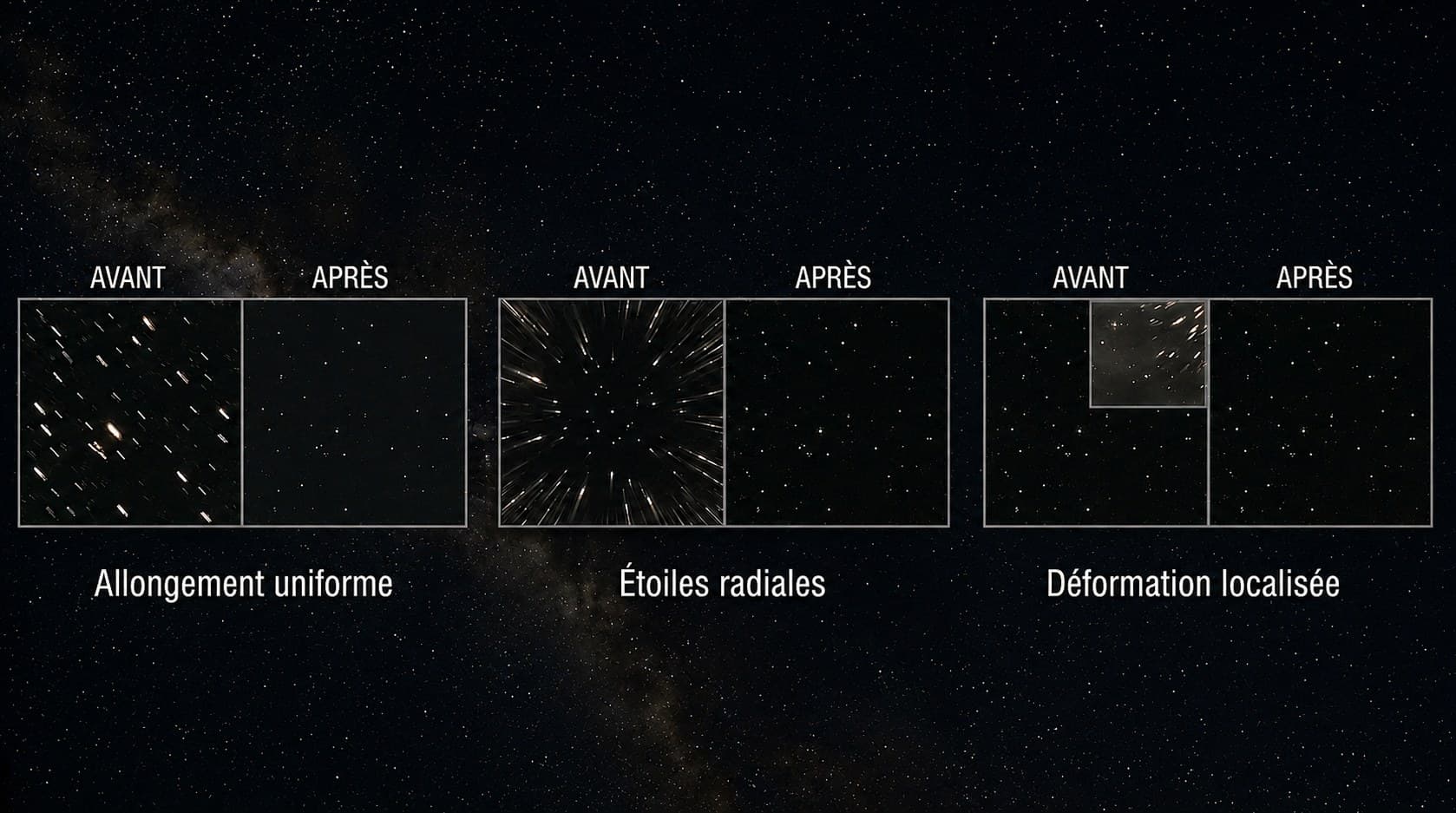
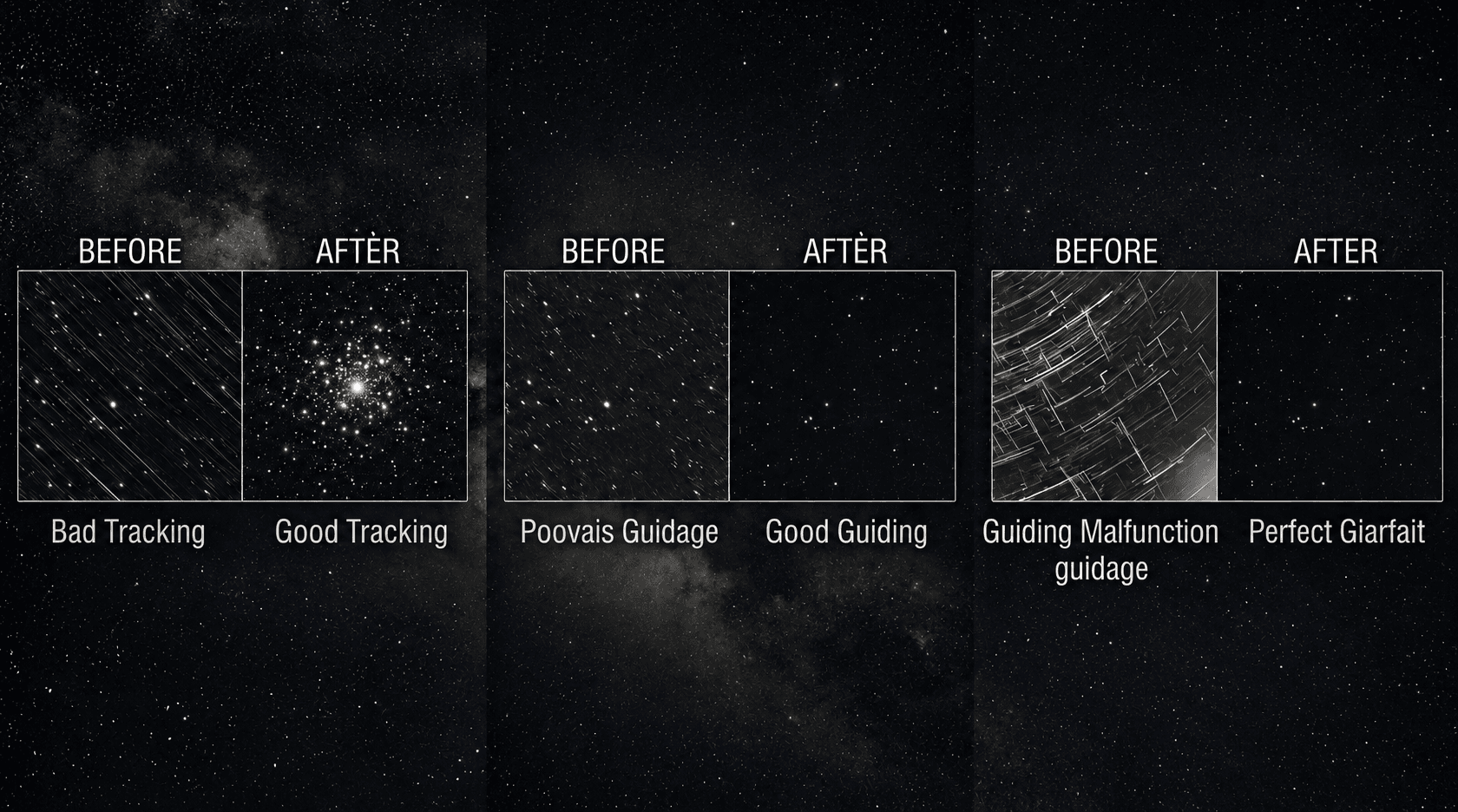
The two retained defects read clearly in the PSF panel and do not overlap in cause. The first is global: centre stars already show an elongation of 1.15 while the field floor sits at 1.08, and position angles stay grouped between 56 and 72 degrees from zone to zone. An optical aberration never deforms the centre that way, so the cause is mechanical, on the mount or guiding side, over a 60s sub only.
The second sits on top of the first but follows a different logic: FWHM starts at 4.85px at centre and climbs toward the four corners, up to 6.88px at top left, with stars staying oval rather than comatic. That is the signature of residual field curvature, consistent with your note about back spacing correction in progress. The slight asymmetry between TL and TR suggests a tilt component may also hide behind it, worth watching once backfocus is set.
The rest is healthy: radially symmetric background with only 2% variation, no invasive hot pixels, no satellite trail, and the nebula already stands out in the same place as on the DSS. Once these two points are fixed, this setup should deliver noticeably tighter stars.
Priority actions
- Make tracking reliable first: careful polar alignment then PHD2 guiding targeting an RMS under 0.5 arcsec
- Adjust backfocus in 0.5mm steps accounting for the IRUV filter, then revalidate with an aberration panel
- Extend the sub exposure to 120-180s once guiding is stable, to lift the background off the black point
- Crop or accept the wide field: NGC 7635 covers little area at 1482mm on this sensor