Astrophotography diagnosis of NGC 7635: Tracking drift
RawIRUV60s24 sept. 2026
The Doc examined this image of NGC 7635 (raw, IRUV, 60s). Estimated overall technical quality: 6/10. 1 defect found: Tracking drift (severity 3/5).

Info
- Cible
- NGC 7635
- Date
- 24 sept. 2026, 20:25
- Lune
- Croissant décroissant 3.9% (25.7° d'alt., 70.1° de la cible)
- Site
- Bortle 3 · rural peu pollué (VIIRS)
- Position
- 23h20m08s · +61°22'45"
Favorable conditions. The declared Bortle 3 sky matches the measured background map: no significant gradient (1% amplitude, R2 0.28), very dark background. On the moon side, the detailed context gives a waning crescent at 3.9% illumination, 25.7 degrees high and 70 degrees from the target, so its light contribution is negligible, even though the setup sheet separately says 97% (contradictory data, the detailed context takes precedence here). Under these conditions NGC 7635 in broadband IRUV is entirely workable: nothing in the sky background limits the image. The background-to-black-point margin stays low (e_margin 2.79), so you are not sky-limited: that is explained by the dark sky, not by a fault.
Setup
- Type d'image
- Brut
- Télescope
- EQMod Mount
- Caméra
- ZWO ASI2600MC Pro
- Filtre
- IRUV
- Monture
- EQR 6 pro
- Exposition
- 60s
- Phase de lune
- Gibbeuse croissante (97 %)
- Notes
- DOF correction
- FOV
- 54.5'
Coherent but demanding setup. At 1482mm on an ASI2600MC the field is 0.91 degrees wide: NGC 7635 and its bubble fit comfortably, and framing stays fine with the object slightly below center. The 0.52"/px sampling is heavily oversampled for typical seeing: the measured FWHM (about 6 px, roughly 3") confirms you are not exploiting that resolution, and binning 2 at integration would pay off in both SNR and apparent sharpness. Gain 120 and offset 50 are healthy (no dark clipping, 0% saturation), sensor temperature at -10C is fine. On 60s subs the background margin is low, but that is logical under a Bortle 3 sky in broadband: you can extend to 120-180s once tracking is reliable, which will lift the background further above read noise.
The diagnosis in detail
The frame is a broadly healthy 60s sub. The background map shows neither marked vignetting nor a usable gradient (1% amplitude, plane/radial dominance 0.47, zero anisotropy): the background is clean and the dark sky delivers. The diffuse reddish nebulosity around the bubble is confirmed by the DSS reference, so it is real signal and not a background artifact.
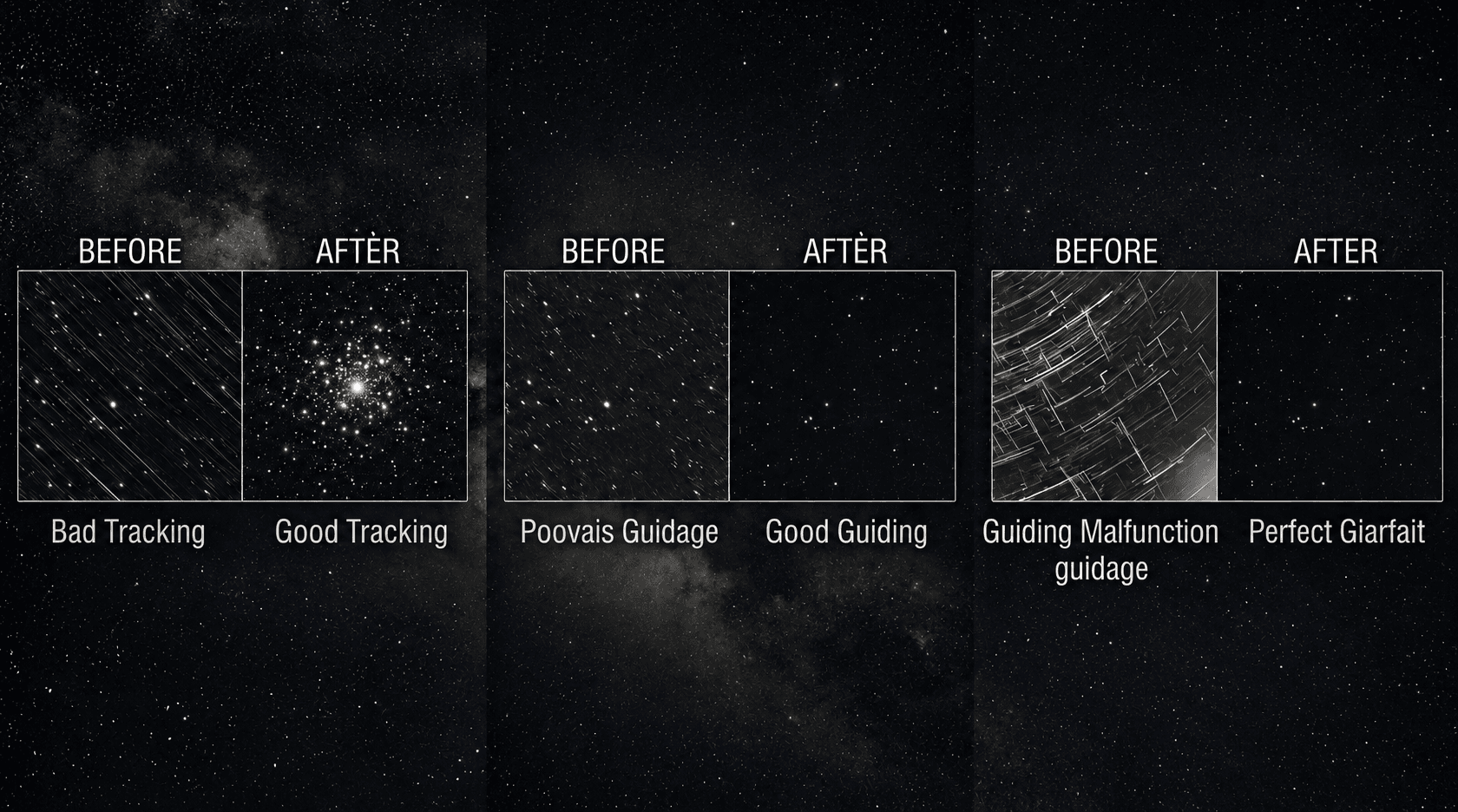
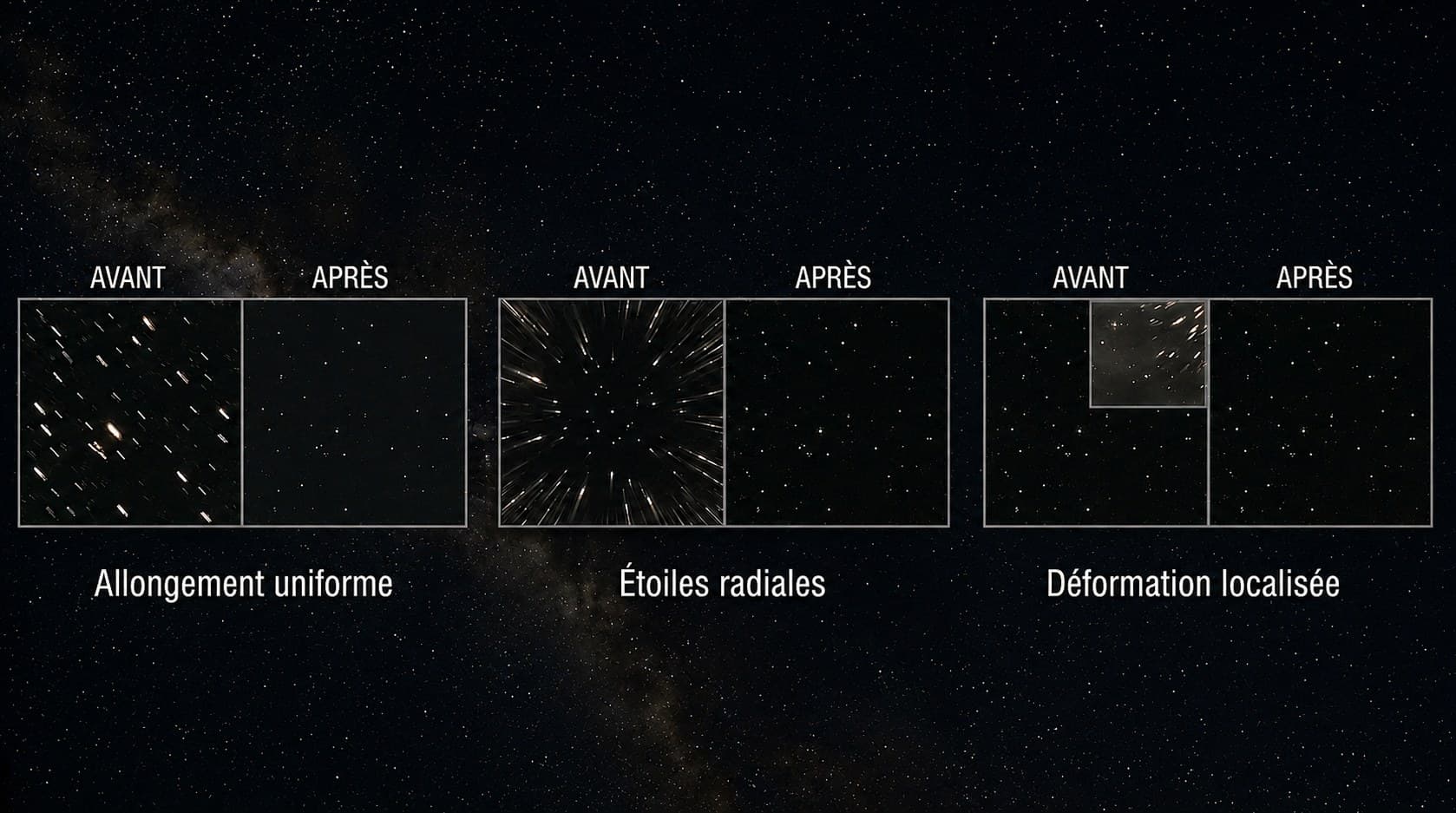
The weakness is single and clear: star shape. The aberration inspector shows elongation already present at the center (1.21 against a field floor of 1.06), with tightly grouped position angles (17.4 degree spread, around 55-65 degrees) and a low corner/center ratio (1.18). This signature rules out a field optical problem (tilt, backfocus or coma would leave a round center and degrade radially) and points to tracking. The bottom-right corner, somewhat worse (elong 1.42), suggests a small field component on top, but it stays secondary.
At 0.52"/px, a drift of one or two pixels is enough to produce this: the demand is high, and every gain in polar alignment and guiding precision will translate directly into tighter stars. The rest (calibration, background, framing) needs nothing particular at this stage.
Priority actions
- Redo polar alignment and check autoguiding, targeting total RMS below 0.5" for 0.52"/px sampling
- Check balance and optical train flexure before the next session
- Consider binning 2 at integration, 0.52"/px sampling is far beyond the measured seeing (FWHM about 3")
- Extend subs to 120-180s once tracking is reliable, to lift the background further above read noise