Astrophotography diagnosis of NGC 7635: Tracking drift
Raw200s10 sept. 2026
The Doc examined this image of NGC 7635 (raw, 200s). Estimated overall technical quality: 7/10. 1 defect found: Tracking drift (severity 2/5).
&w=1920&q=75)
Info
- Cible
- NGC 7635
- Date
- 10 sept. 2026, 00:23
- Lune
- Pleine lune 98.5% (sous l'horizon)
- Site
- Bortle 2 · rural typique (VIIRS)
- Position
- 23h21m10s · +60°52'28"
Excellent conditions: Bortle 2 with the Moon below the horizon, so no lunar contribution is possible and the sky background is naturally low, which the measurement confirms (only a 2% gradient with no clear orientation). For an emission target like NGC 7635 this context is ideal: you can afford long exposures without worrying about light pollution gradients, and you could even consider OIII or SII, which are far more demanding on SNR. This is exactly the kind of night to chase faint signal, such as the tenuous extensions around the Bubble or the diffuse nebulosity on the left of the field.
Setup
- Type d'image
- Brut
- Télescope
- EQMod Mount
- Caméra
- ZWO ASI585MM Pro
- Exposition
- 200s
- Phase de lune
- Dernier croissant (3 %)
- FOV
- 3.36°
A coherent but heavily undersampled setup: 3.15"/px at 190mm focal length on an ASI585MM, which explains FWHM values around 1.5px, at the low limit of what can be measured. You are in a regime where seeing is no longer the limiting factor, but where spatial detail is capped by the pixel. It is a good trade for covering the 3.36° field and taking in the Bubble, M52 and the neighbouring nebular complex, less so for resolving NGC 7635 on its own. On the settings side, gain 160, offset 15 and -25°C are healthy; the 2.36 e_margin is low but perfectly normal in narrowband, where the background stays dark even at 200s.
The diagnosis in detail
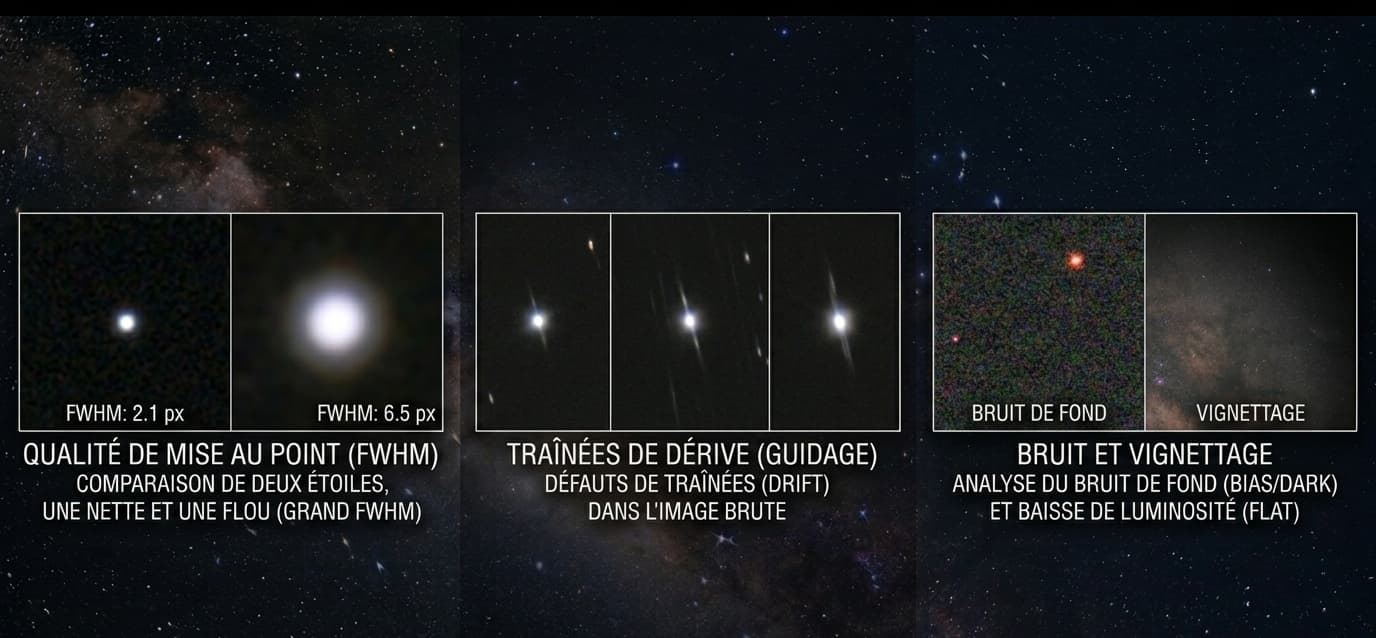
This is a well made Ha sub. The Moffat measurements give FWHM values between 1.25 and 1.64px across zones, with a corner/centre ratio of 0.986: in other words the corners are no softer than the centre, which rules out significant field curvature or a backfocus error. The backfocus-error candidate at 38% confidence is not confirmed by the panel, where the corners show no symmetric radial bloating.
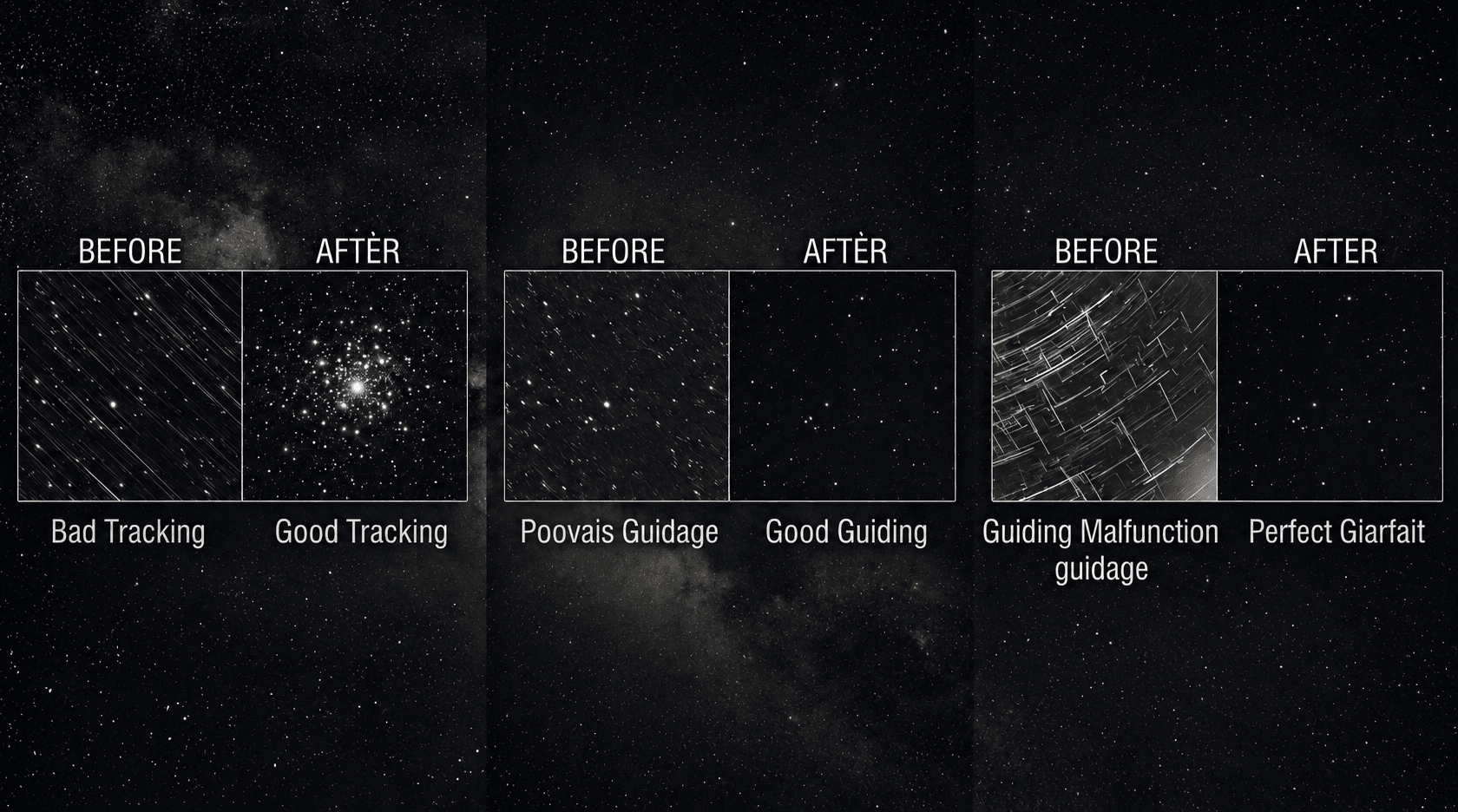
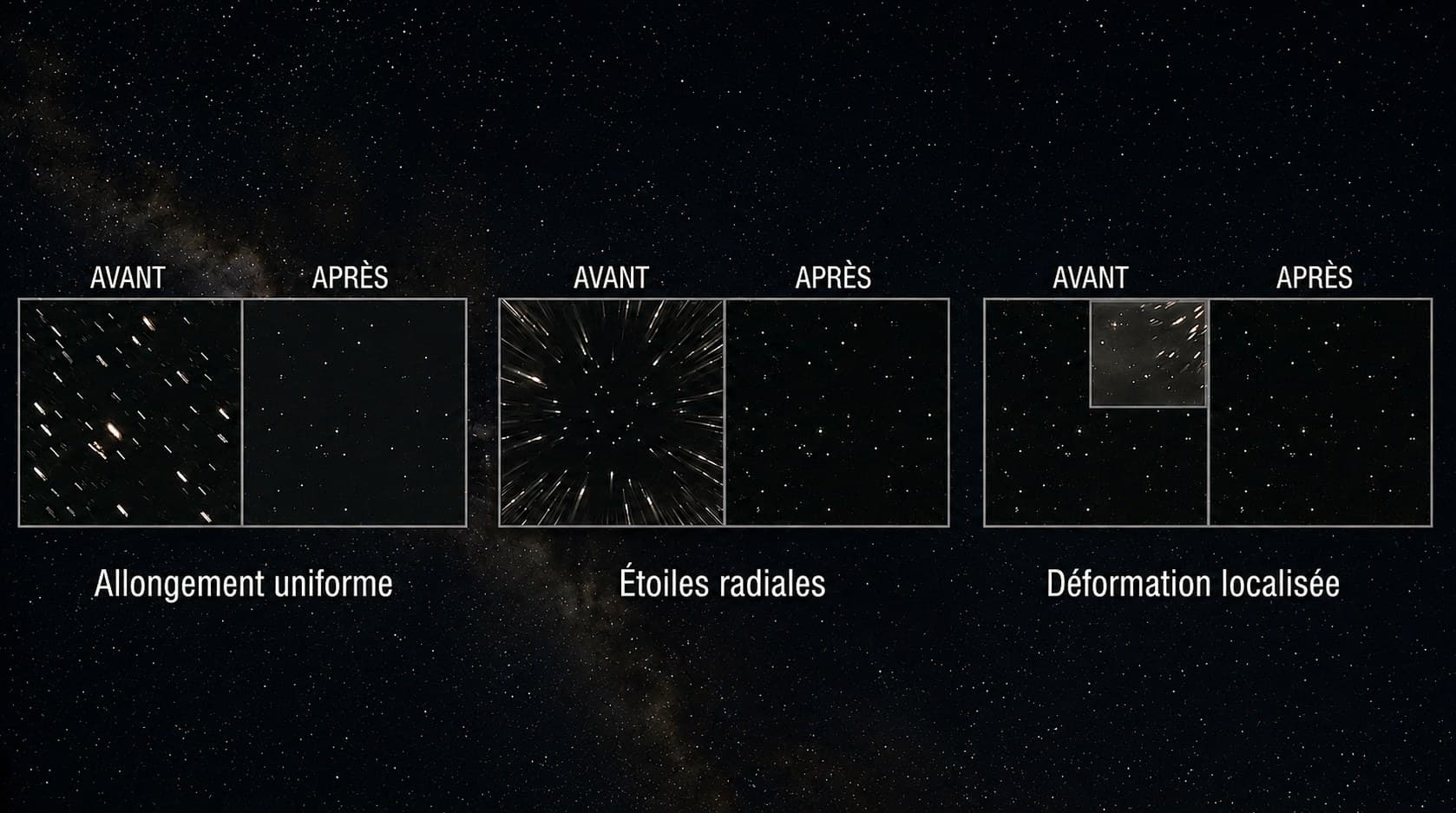
The only real defect is the central elongation. The centre shows elong 1.15 while the field floor drops to 1.02 (BL zone), proving that round stars are achievable on this frame: the stretch is therefore not a measurement artefact. The consistency of the position angles points to a common mechanical cause rather than an optical one. On a 200s exposure this is the classic signature of slow drift, polar alignment or guiding.
Keep it in perspective: at 3.15"/px a 15% elongation amounts to a fraction of a pixel of error. The impact on the stacked image will be modest, and stacking with dithering will smooth part of it out. This is an optimisation point, not a blocker.
Priority actions
- Redo the polar alignment before the next session to remove the residual drift
- Check the guiding curve and aim for total RMS under 1 arcsecond
- Test a 120-150s exposure to confirm the elongation is tied to integration length
- Take advantage of the Bortle 2 sky and absent Moon to gather OIII on this target