Astrophotography diagnosis of Ngc281: Residual vignetting, backfocus error and 1 other
ProcessedSHO3x30x600
The Doc examined this image of Ngc281 (processed, SHO, 3x30x600). Estimated overall technical quality: 7/10. 3 defects found: Residual vignetting (severity 3/5), Backfocus error (severity 3/5), Clipped stars (severity 2/5).

Info
- Cible
- Ngc281
- Site
- Bortle 5 · banlieue résidentielle (VIIRS)
Thoroughly favorable conditions for this target. A last crescent at 24% illumination adds almost no background pollution, and in SHO on an emission nebula like NGC 281 the moon is not a limiting factor anyway as long as it is not close to the field. Bortle 5 is likewise neutralized by the narrowband filters: the measured background is indeed clean, with no oriented gradient (plane amplitude 10% with an R2 of 0.02, so not significant). Nothing to change in your planning: you can push SHO sessions under this moon without hesitation, and save moonless nights for possible RGB star data.
Setup
- Type d'image
- Traitée
- Télescope
- CDK 12,5" planeWave
- Caméra
- Moravian C4 monochrome
- Filtre
- SHO
- Monture
- Paramont MX+
- Exposition
- 3x30x600
- Phase de lune
- Dernier croissant (24 %)
High-end setup, perfectly matched to the target. The CDK 12.5 paired with the Moravian C4 gives a field that lets NGC 281 breathe without cramping it, and the Paramount MX+ is clearly holding tracking: center elongation is 1.07, meaning round stars over 600 s, no complaint on the mount side. SHO is the right call under Bortle 5. The 3x30x600 s, 15 hours total, matches the weakness of the OIII signal on this target. The real weak link is mechanical: this large sensor demands backfocus set to a tenth of a millimeter and flats reshot after every optical train reassembly, which clearly was not done here. On exposure, an e_margin of 1.33 is normal in narrowband at 600 s, nothing to worry about.
The diagnosis in detail
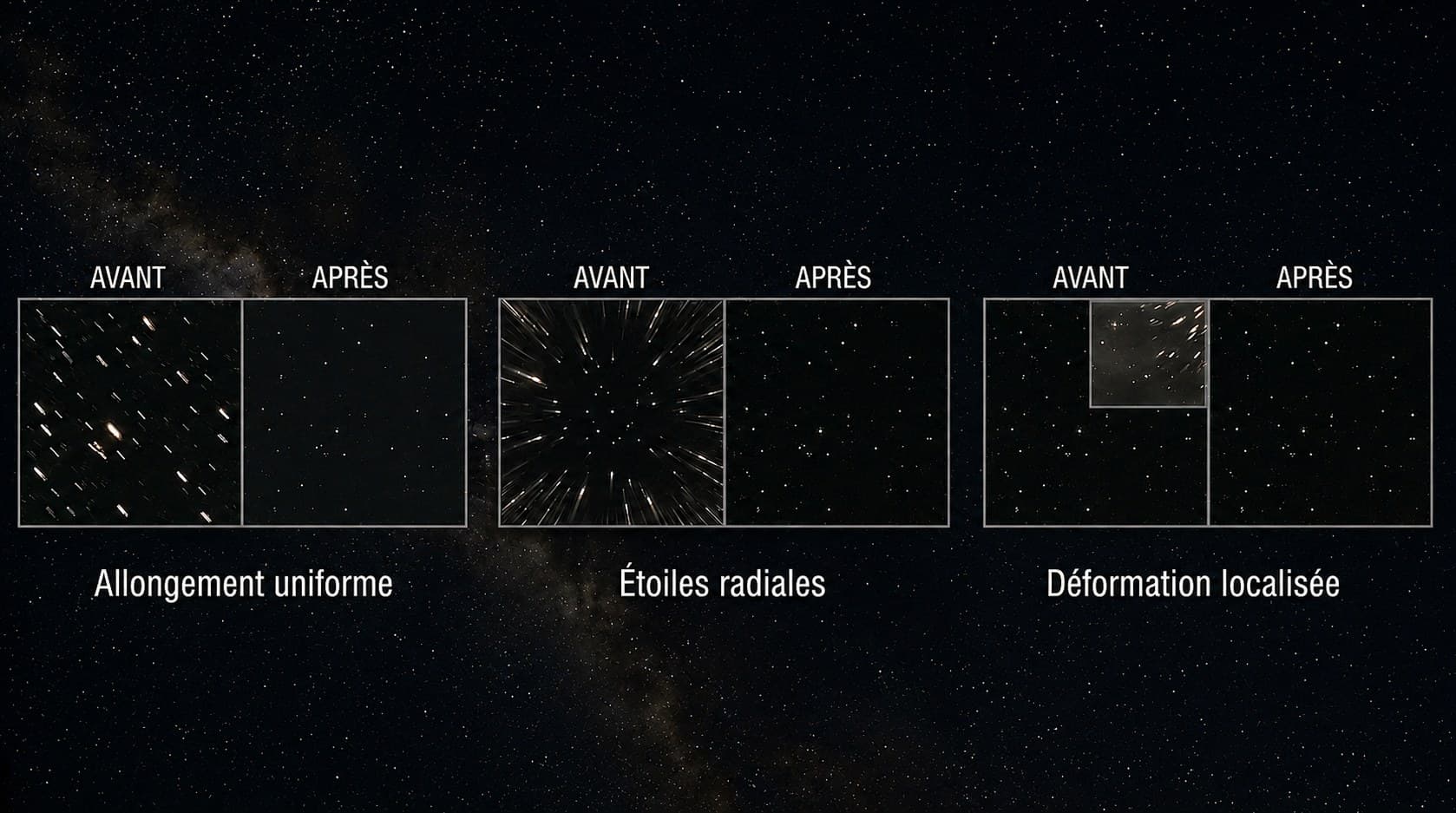
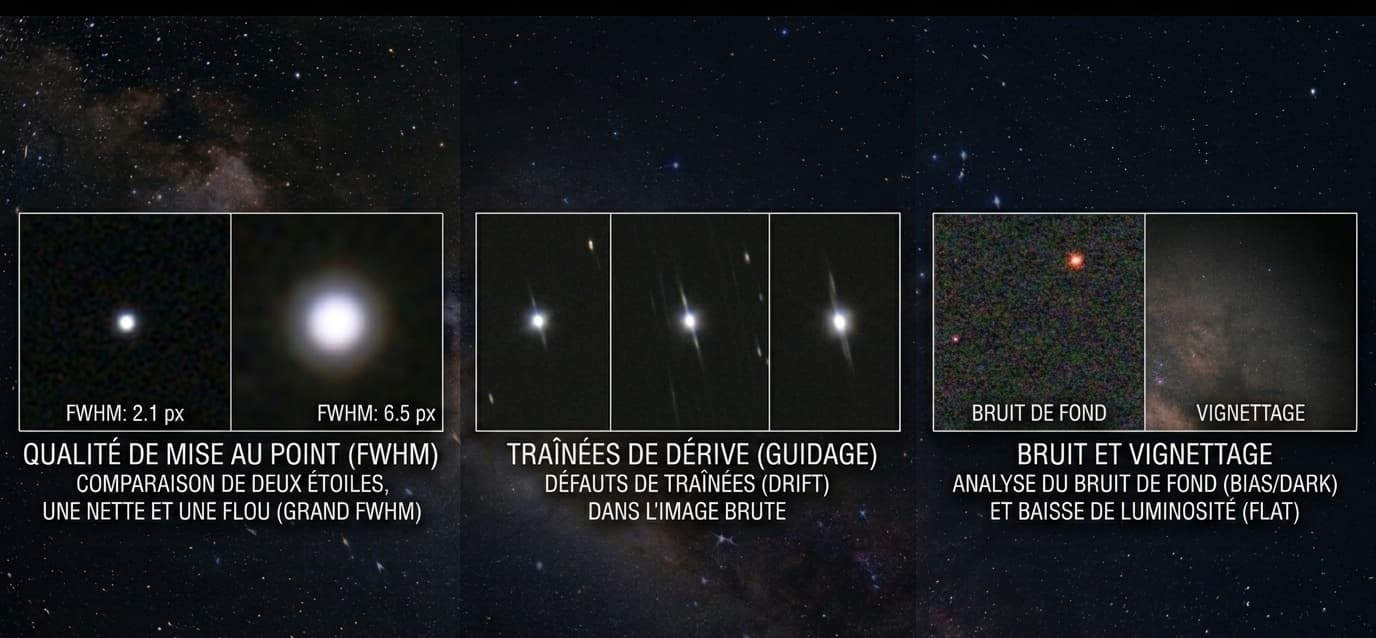
The diagnosis is clearly instrumental, neither atmospheric nor processing related. The PSF panel is unambiguous: the field center is excellent at 3.75/3.50 px FWHM with 1.07 elongation, which means seeing, focus and 600 s tracking are all three good. But as soon as you move off axis, FWHM climbs to 11.87 px on the right edge, 10.57 px bottom-left and 8.41 px bottom-right, while the top-right corner stays at 4.03 px. This degradation is dominated by bloated disks, not by radial coma tails, which signs a focal plane problem.
The signature combines two components. A symmetric field defocus component, typical of mis-set backfocus, affecting the whole periphery. And a residual asymmetric component, since top-right stays fine while the bottom and right side are the worst, suggesting slight non-coplanarity in the optical train. The logical order of attack is therefore: set the spacing first, then measure residual tilt once backfocus is optimal, not the other way round.
The second axis is illumination calibration. A 43% radial falloff with an R2 of 0.97 and azimuthal anisotropy of 0.03 is a pure vignetting signature, perfectly correctable with proper flats. The fact that it survives into a finished image means either missing or mismatched flats, or a partial correction. Good news: unlike the backfocus, this one is recoverable in post on the existing master.
Priority actions
- Set the optical train backfocus in 0.5 mm steps, checking corner FWHM with the aberration inspector at each step
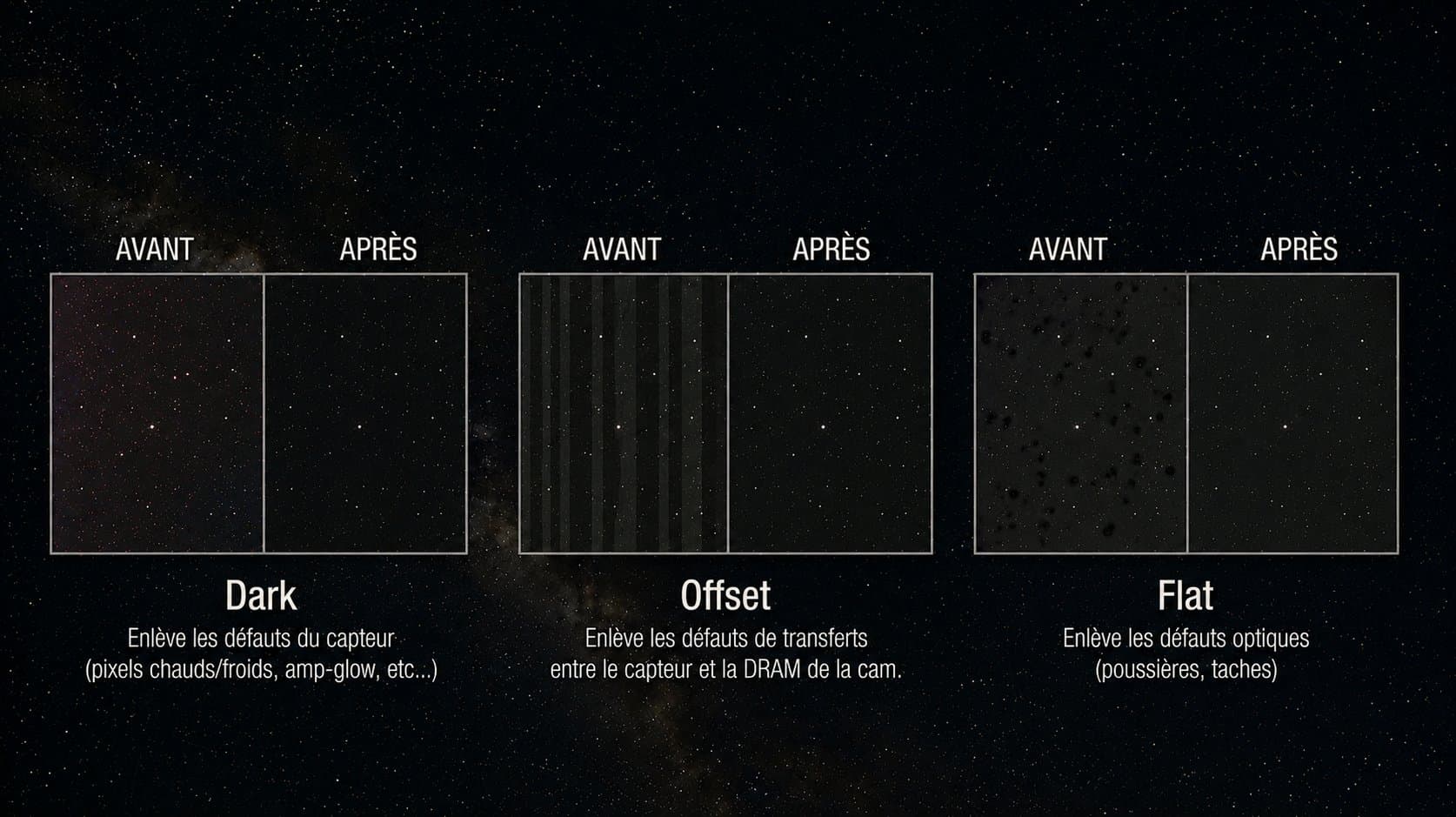
- Reshoot a full set of flats and flat-darks per filter, with the optical train in exactly the state used for the lights, to remove the 43% radial falloff
- Measure and correct the residual tilt once backfocus is optimal, using the top-right corner as the healthy reference of the field
- Apply a residual illumination correction (GraXpert or DBE in division mode) to the current master to rescue this version without reacquiring
- Add a short exposure set per filter to rebuild the clipped star cores in HDR