Astrophotography diagnosis of ngc6946 + ngc6939: Tracking drift, light pollution gradient and 1 other
ProcessedL185×60s07 sept. 2023
The Doc examined this image of ngc6946 + ngc6939 (processed, L, 185×60s). Estimated overall technical quality: 6/10. 3 defects found: Tracking drift (severity 2/5), Light pollution gradient (severity 2/5), Noise / underexposure (severity 2/5).
&w=1920&q=75)
Info
- Cible
- ngc6946 + ngc6939
- Date
- 07 sept. 2023, 00:00
- Position
- 20h34m48s · +60°08'60"
With a 44% Moon, the sky was not ideal for a faint galaxy in a broadband L filter, which is unforgiving of lunar pollution. The measured directional gradient (~10%, oriented ~244°) is consistent with a Moon + ground pollution contribution. For this type of target (low surface brightness, broadband), it is better to aim for a moonless night or wait until the galaxy is high and away from the light source. Careful gradient extraction remains necessary in these conditions.
Setup
- Type d'image
- Traitée
- Télescope
- Astro-Tech AT72EDII
- Caméra
- ZWO ASI585MC
- Filtre
- L
- Monture
- Celestron Advanced VX
- Exposition
- 185×60s
- Phase de lune
- 44%
- Notes
- Logiciels : PixInsight
- FOV
- 1.40°
The AT72EDII (72mm) and ASI585MC pair yields a 1.40° field, nicely placing NGC 6946 and the cluster NGC 6939 in the same frame: a successful composition. However, at this short focal length, NGC 6946 stays small and demands a lot of signal to stand out. Sampling is comfortable (FWHM ~2.5 px), so sharpness is not the limiting factor. The real constraint is integration: 3h in an L filter on a faint galaxy under moonlight is marginal. Favor longer subs if guiding keeps up, and more cumulative hours.
The diagnosis in detail
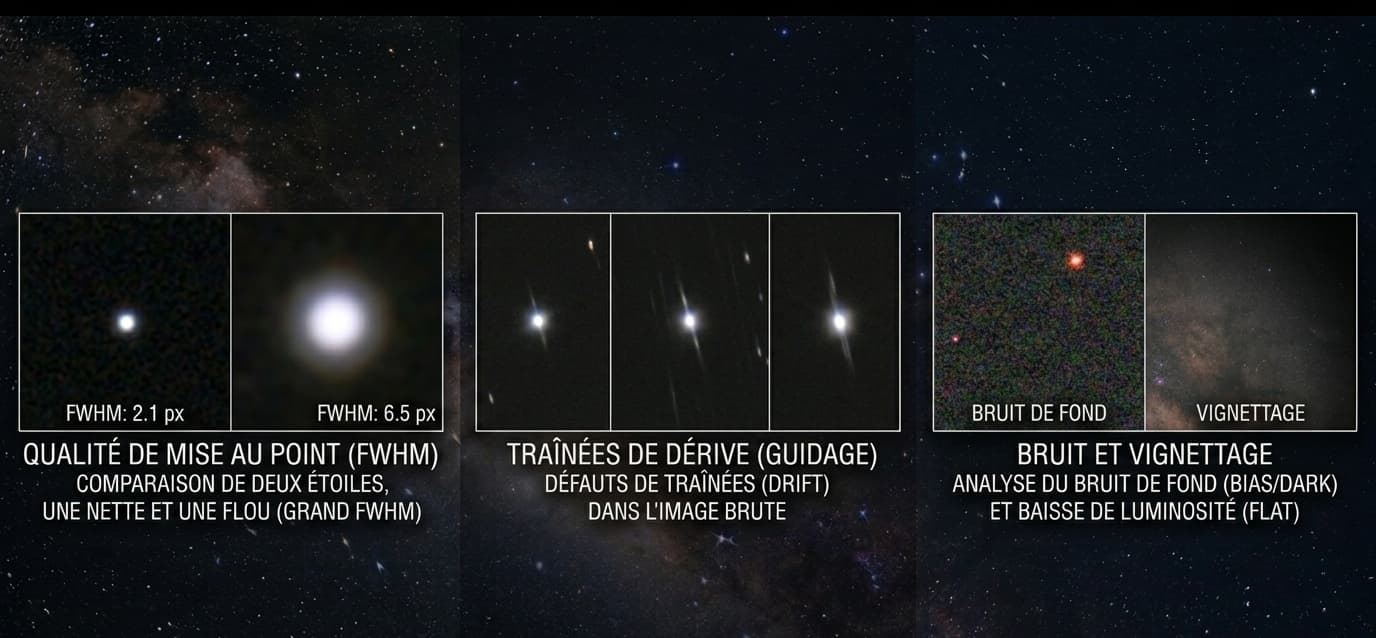
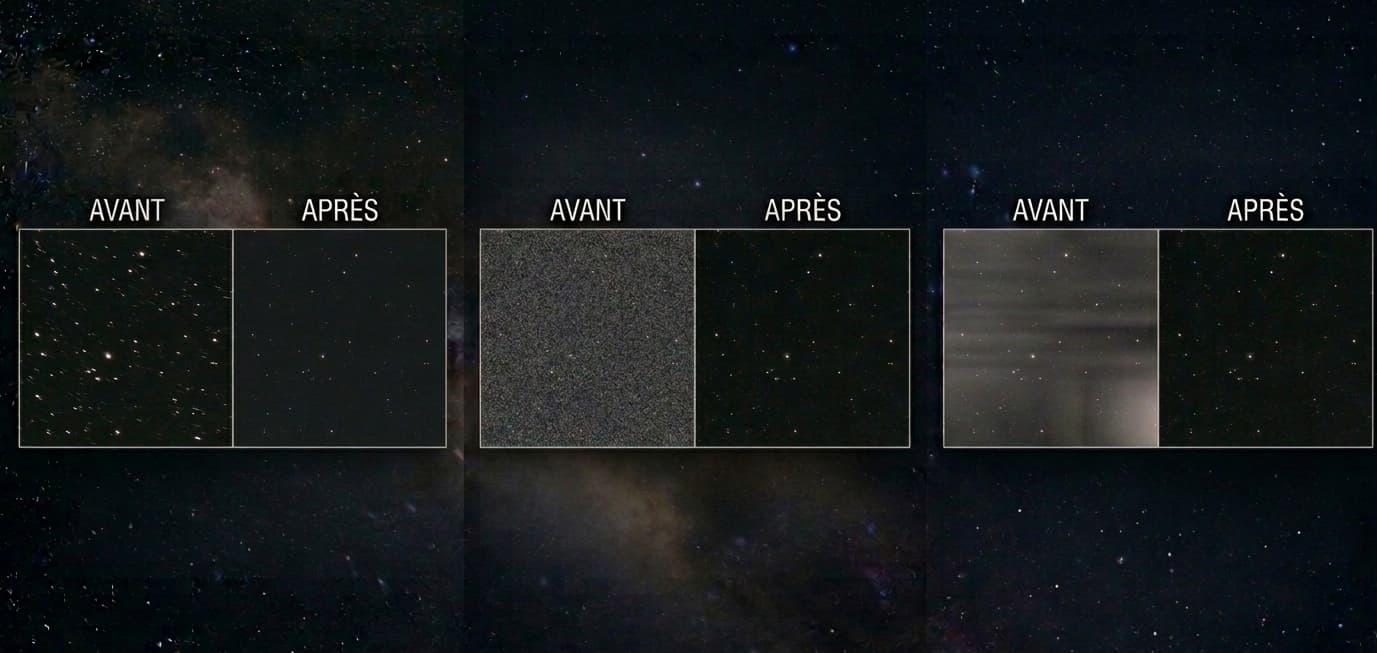
The PSF panel is reassuring on the optics side: homogeneous FWHM (2.4 to 2.7 px), corner/center ratio of only 1.08 and near-zero FWHM asymmetry. No significant tilt, backfocus or coma. However, elongation is consistent everywhere, including the center (elong 1.15 versus a 1.12 floor, PA grouped at 9.2° dispersion). This is the signature of a tracking/guiding drift, not a field defect: it stays low, so stars look nearly round, but it is measurable. Polar alignment and autoguiding are the levers.
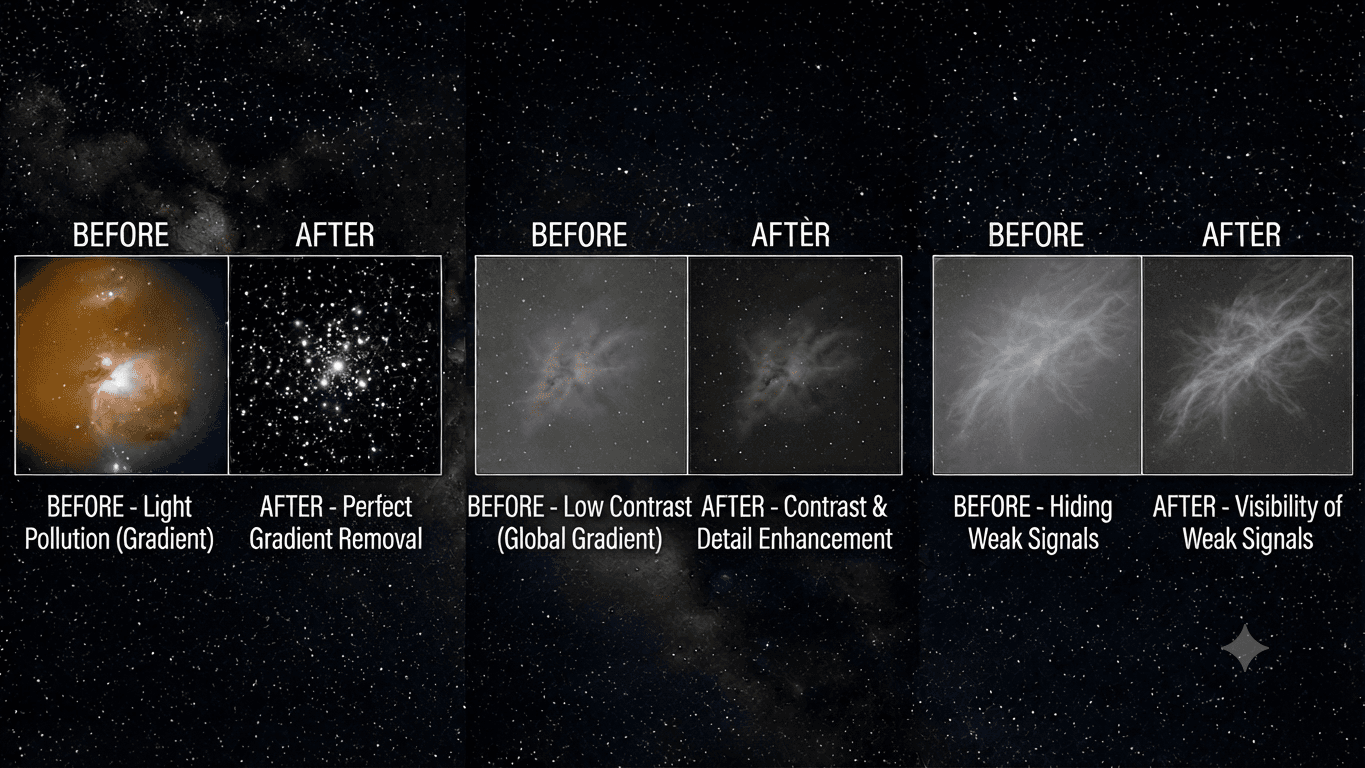
On the background, a linear gradient of about 10% oriented ~244° dominates the radial profile (plane R²=0.70, x3.9). The DSS shows no extended nebulosity here, ruling out IFN: this is indeed a light-pollution artifact, likely reinforced by the 44% Moon. Gradient extraction will easily correct it.
Finally, SNR is the weak point: an e_margin of 1.51 reveals a background barely lifted off the black point, and the spiral arms remain noisy. Three hours in an L filter on a low surface brightness galaxy, under moonlight, is insufficient. More hours and/or longer subs will make the difference.
Priority actions
- Accumulate more integration (aim for 8-12h) with longer subs if guiding allows
- Improve polar alignment and autoguiding (PHD2, RMS < 1 px) to remove the directional drift
- Apply gradient extraction (GraXpert or DBE/ABE) then re-neutralize the background
- Prefer a moonless night for this faint broadband galaxy