Astrophotography diagnosis of NGC7331: Tracking drift, sensor tilt and 1 other
Rawsans filtre240s06 sept. 2026
The Doc examined this image of NGC7331 (raw, sans filtre, 240s). Estimated overall technical quality: 6/10. 3 defects found: Tracking drift (severity 3/5), Sensor tilt (severity 2/5), Satellite trail (severity 1/5).
&w=1920&q=75)
Info
- Cible
- NGC7331
- Date
- 06 sept. 2026, 19:35
- Lune
- Gibbeuse croissante 77.4% (sous l'horizon)
- Site
- Bortle 6 · banlieue dense (VIIRS)
- Position
- 18h39m04s · +39°02'21"
Rather favorable conditions for NGC 7331. The Moon is below the horizon during the exposure, so no lunar pollution despite 77% illumination, and its 115° separation would be comfortable anyway. What remains is Bortle 6, which weighs more heavily on a broadband galaxy shot without a filter: the sky background rises fast and the contrast of NGC 7331's spiral arms suffers. The histogram measurement confirms a background barely lifted off the black point (margin of 2.85, below the sky-limited threshold of 5 to 10), so you are not yet sky-limited at 240s. You can safely lengthen the exposure, or better, accumulate many subs to offset the urban background.
Setup
- Type d'image
- Brut
- Télescope
- C11
- Caméra
- ZWO ASI533MC Pro
- Filtre
- sans filtre
- Monture
- EQ6r pro
- Exposition
- 240s
- Phase de lune
- Dernier croissant (25 %)
- Seeing
- 2.5
- FOV
- 22.0'
Setup coherent in principle, demanding in practice. The C11 at f/6.3 gives 1764mm and a 0.37° field, plenty for NGC 7331 and its companion galaxy group, nicely centered here. However, sampling at 0.44″/px with the ASI533MC's 3.76µm pixels is heavily oversampled for 2.5″ seeing: you spread signal over many pixels and expose every mount error. A stronger reducer, or 2x binning in processing, would bring you back toward 0.9″/px, far more comfortable. On settings, gain 100 (unity) and offset 20 with no dark clipping are healthy, and -5°C is acceptable even though -10°C would further cut dark current.
The diagnosis in detail
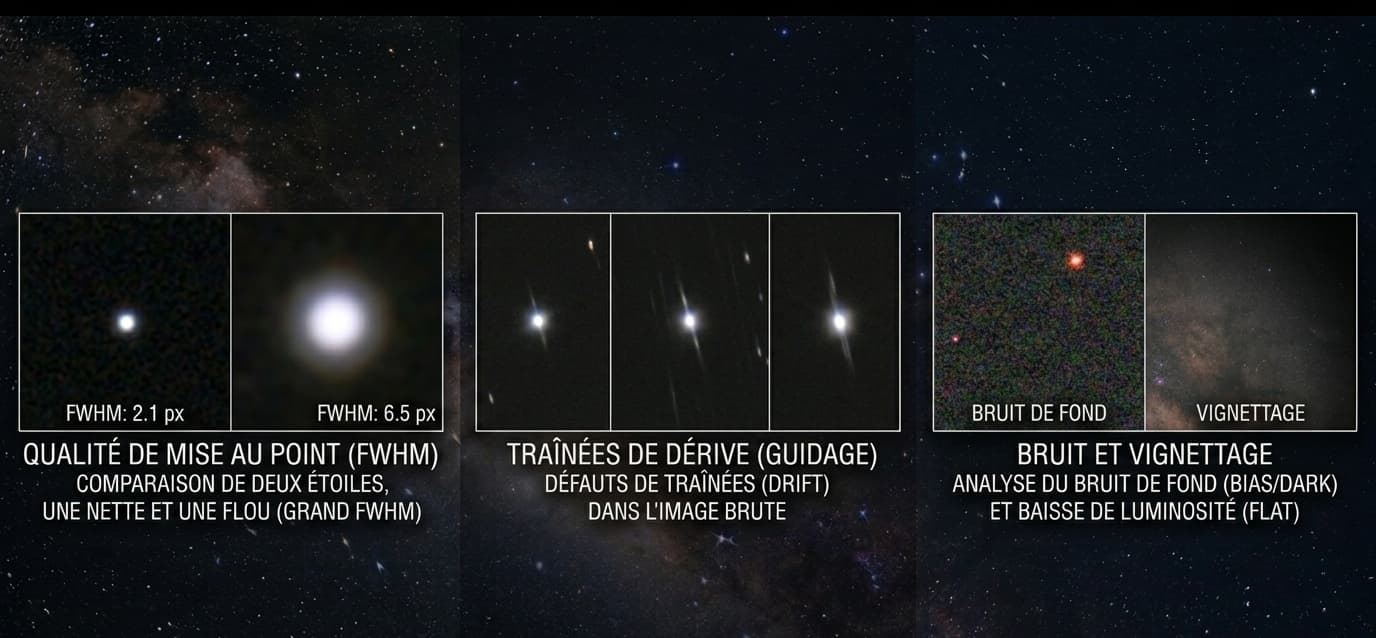
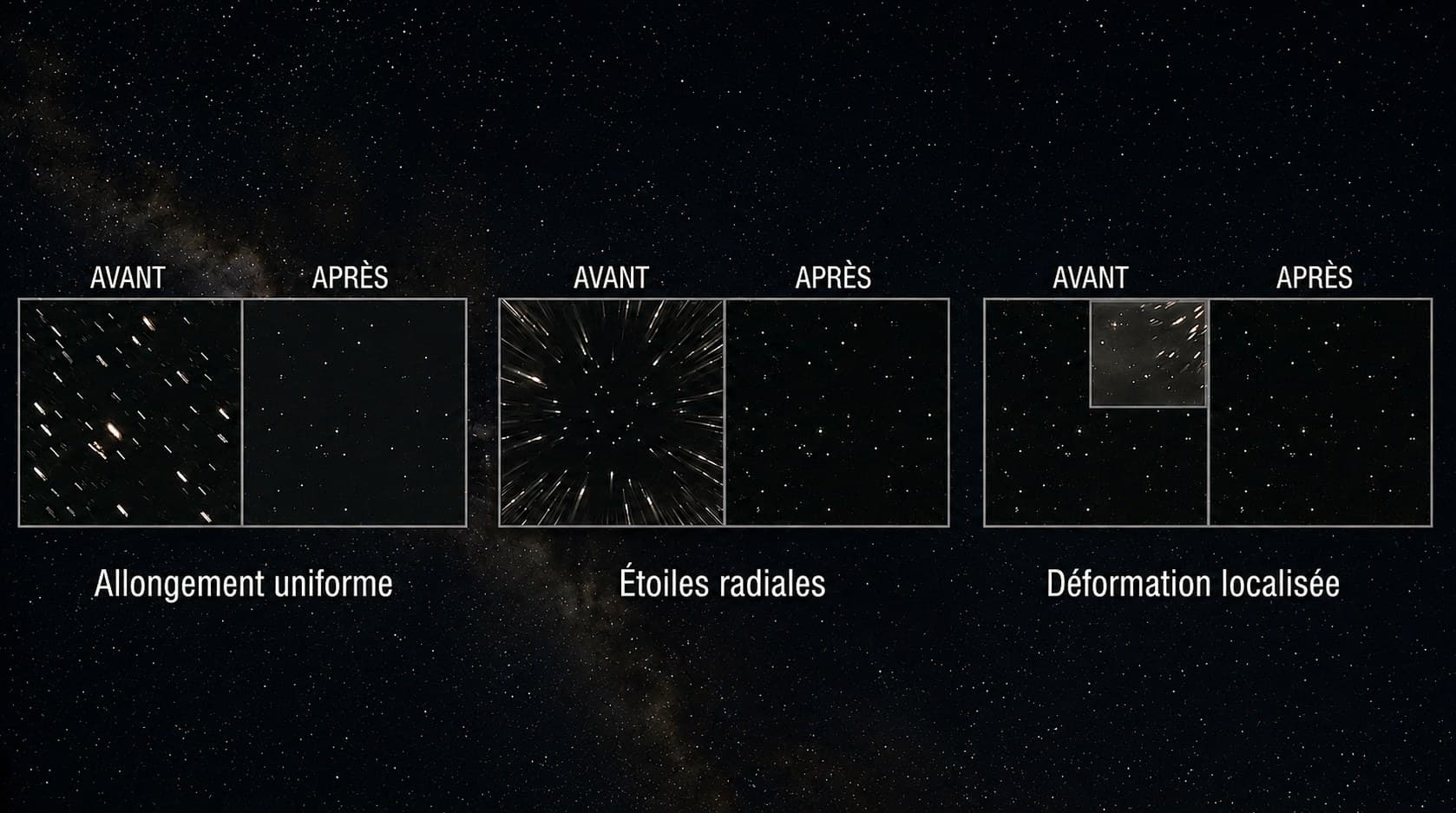
The central issue of this sub is star shape, and the Moffat measurements settle it. Elongation reaches 1.21 at field center, well above the measured OSC floor of 1.11, whereas a field optical aberration would leave the center perfectly round. Since position angle stays consistent across zones (15.9° scatter), the diagnosis is tracking drift rather than guiding oscillation. At 1764mm and 0.44″/px on a 240s exposure, the slightest polar alignment error or flexure immediately shows up as this stretch.
A more discreet optical component sits on top: the corner-to-center FWHM ratio rises to 1.338 with a vertical asymmetry of 0.148, and above all the top-left corner is significantly softer than the bottom-right. This diagonal asymmetry is the signature of tilt, to be distinguished from a backfocus error, which would degrade all four corners equally. Note however that drift itself inflates FWHM, so part of this gap may vanish once tracking is clean.
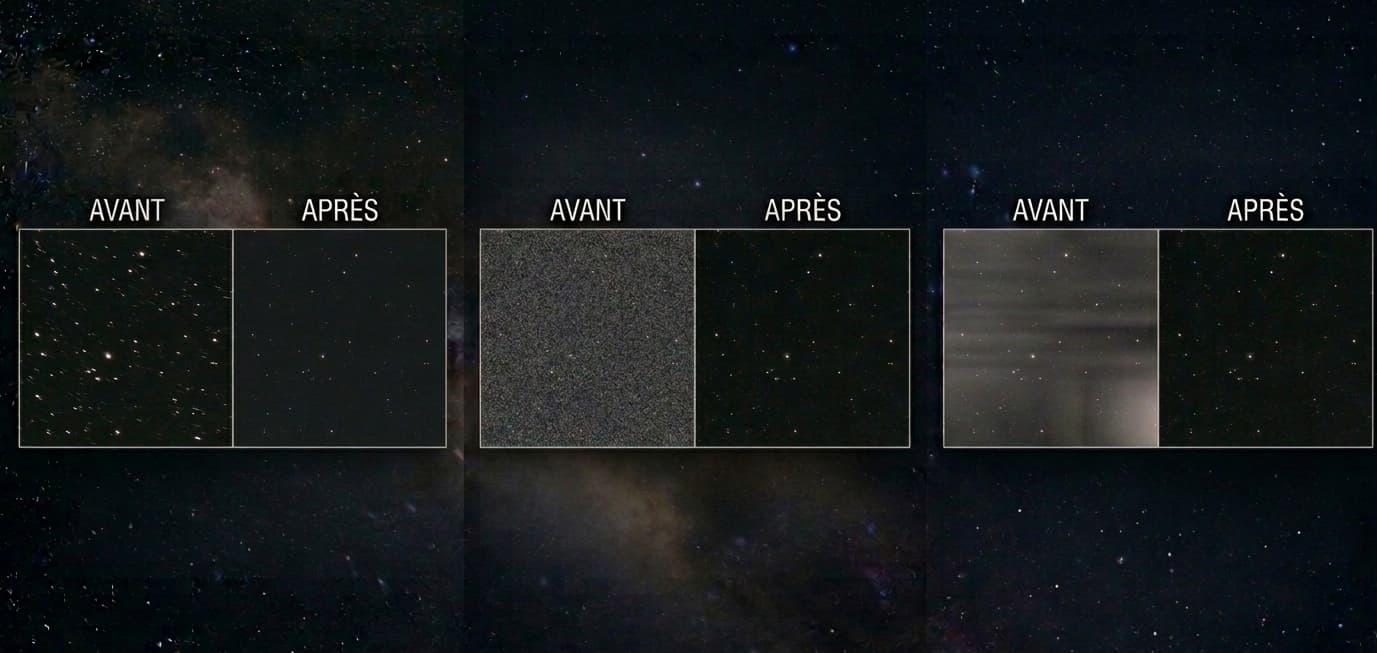
The rest is healthy. The background shows only a gentle 10% radial falloff with no significant oriented gradient, consistent with normal optical vignetting before flats, and with no clipping or saturation. The two satellite trails will disappear in stacking.
Priority actions
- Redo polar alignment and secure autoguiding before any other fix, drift dominates the error budget
- Shorten sub exposure to 120-180s while validating tracking at 1764mm
- Re-measure per-corner FWHM once tracking is clean, before touching imaging train tilt
- Stack with sigma rejection over at least 10 to 15 subs to erase the satellite trails
- Consider 2x binning in processing to bring sampling toward 0.9″/px and gain signal