Astrophotography diagnosis of NGC7331: Sensor tilt
Rawsans filtre30s06 sept. 2026
The Doc examined this image of NGC7331 (raw, sans filtre, 30s). Estimated overall technical quality: 5/10. 1 defect found: Sensor tilt (severity 3/5).
&w=1920&q=75)
Info
- Cible
- NGC7331
- Date
- 06 sept. 2026, 20:09
- Lune
- Gibbeuse croissante 77.7% (sous l'horizon)
- Site
- Bortle 6 · banlieue dense (VIIRS)
- Position
- 18h39m04s · +39°02'21"
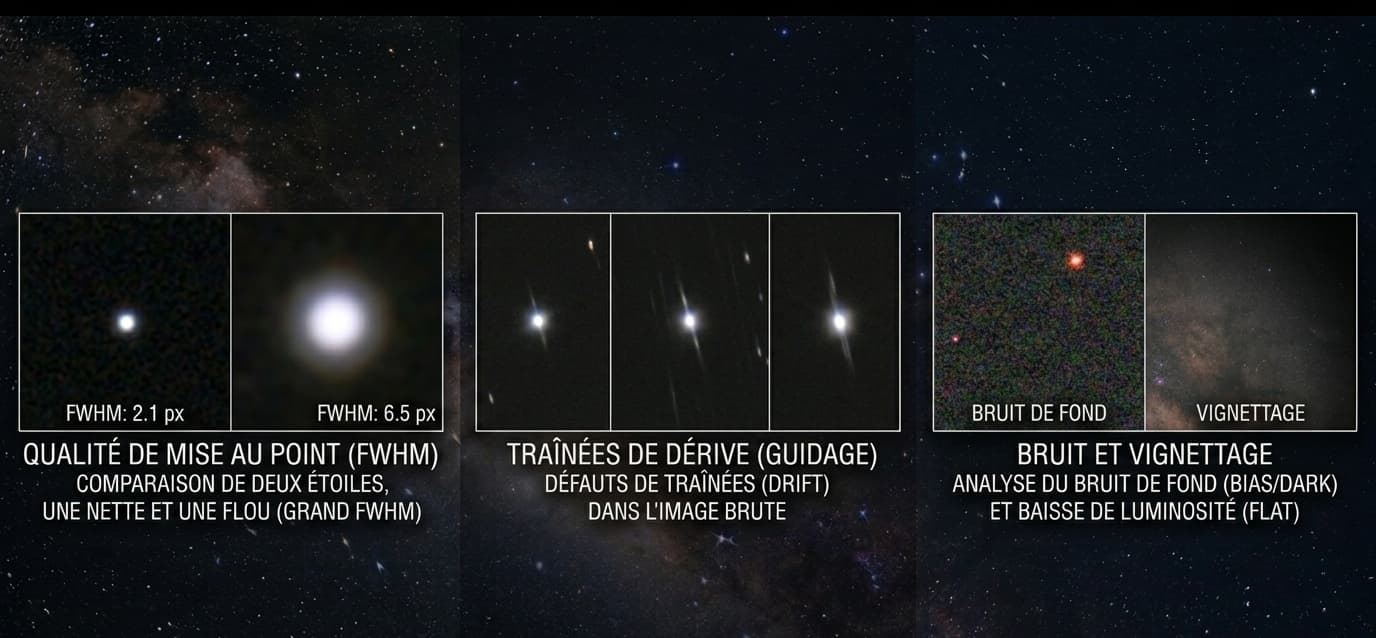
Conditions were fairly favorable for this session: the Moon, although 77.7% gibbous, is below the horizon and 115 deg from the target, so it has no effect on the sky background, which the background map confirms (only a 3% gradient, R2 0.26, so no significant oriented plane). What remains is Bortle 6, which weighs directly on a broadband galaxy shot without a filter: the sky background climbs fast and spiral-arm contrast suffers. With a reported seeing of 2.5 arcsec, the central FWHM of 4.6 px, about 2 arcsec at 0.44 arcsec/px, is consistent and decent. For this kind of target, favor moonless nights and, if possible, a gentle broadband light-pollution filter.
Setup
- Type d'image
- Brut
- Télescope
- C11
- Caméra
- ZWO ASI533MC Pro
- Filtre
- sans filtre
- Monture
- EQ6r pro
- Exposition
- 30s
- Phase de lune
- Dernier croissant (25 %)
- Seeing
- 2.5
- FOV
- 22.0'
The setup is coherent but demanding. The C11 at f/6.3 gives 1764 mm and a 0.37 deg field, well suited to NGC 7331 which fills a comfortable fraction of the frame, leaving Stephan's Quintet outside the field here. Sampling at 0.44 arcsec/px is heavily oversampled for 2.5 arcsec seeing: you lose signal per pixel without gaining resolution, and a 2x binning in post or at the driver would clearly improve the signal-to-noise ratio. On settings, gain 100 is the right spot on the ASI533MC, but offset 20 lets through 1.8% of shadow clipping, raise it. Above all, sensor temperature at 22 C is too high: enable cooling to -10 C to limit dark current.
The diagnosis in detail
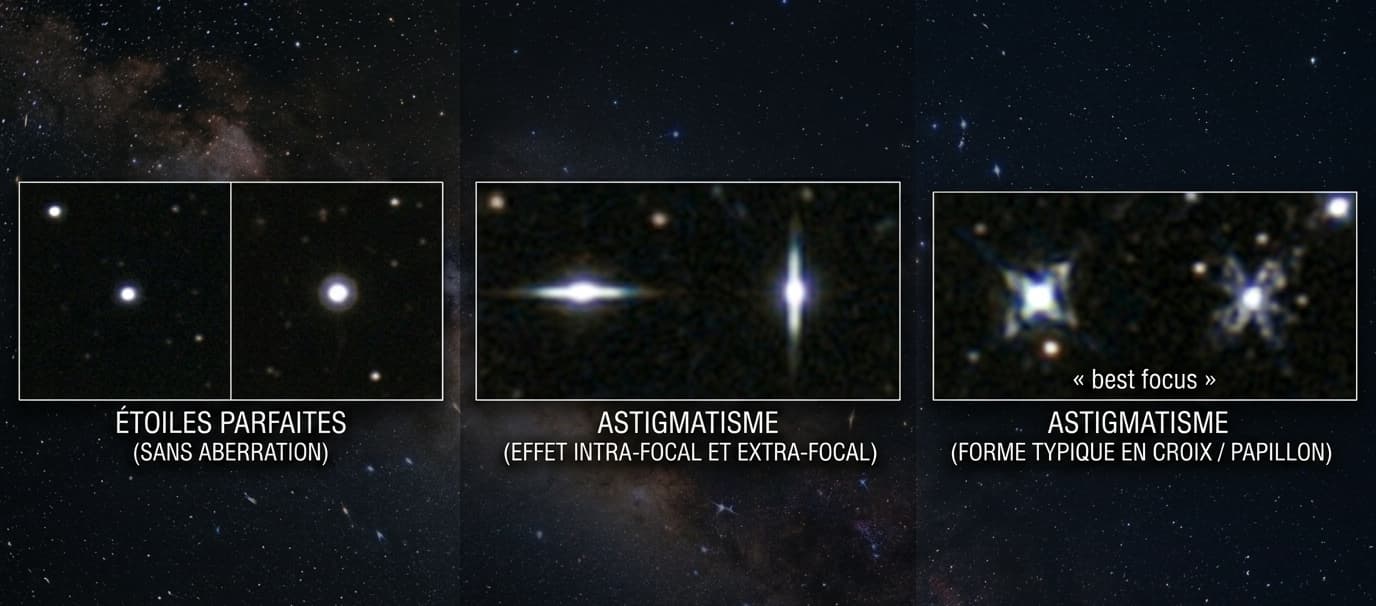
The dominant issue is mechanical. The Moffat measurements show a clean center (FWHM 4.59/3.98, elongation 1.15 against a field floor of 1.09) and a degradation that is not radial but diagonal: the top-left corner climbs to 6.75/5.27 px with an elongation of 1.28, while the bottom corners stay around 4.6-4.7 px. A misset backfocus would produce symmetric degradation on all four corners, which is not the case here. The 1.40 corner/center ratio and the 0.247 vertical asymmetry are the signature of a tilted focal plane, very common on an SCT where the imaging train is long and the cantilever significant.
The second axis is photometric. With 30 s at f/6.3 under a Bortle 6 sky, the background stays glued to the black point: the margin is only 2.87, with 1.8% of pixels clipped in the shadows. The sub is not sky-limited but read-noise-limited, which wastes telescope time. Oversampling at 0.44 arcsec/px makes it worse by spreading the signal over too many pixels.
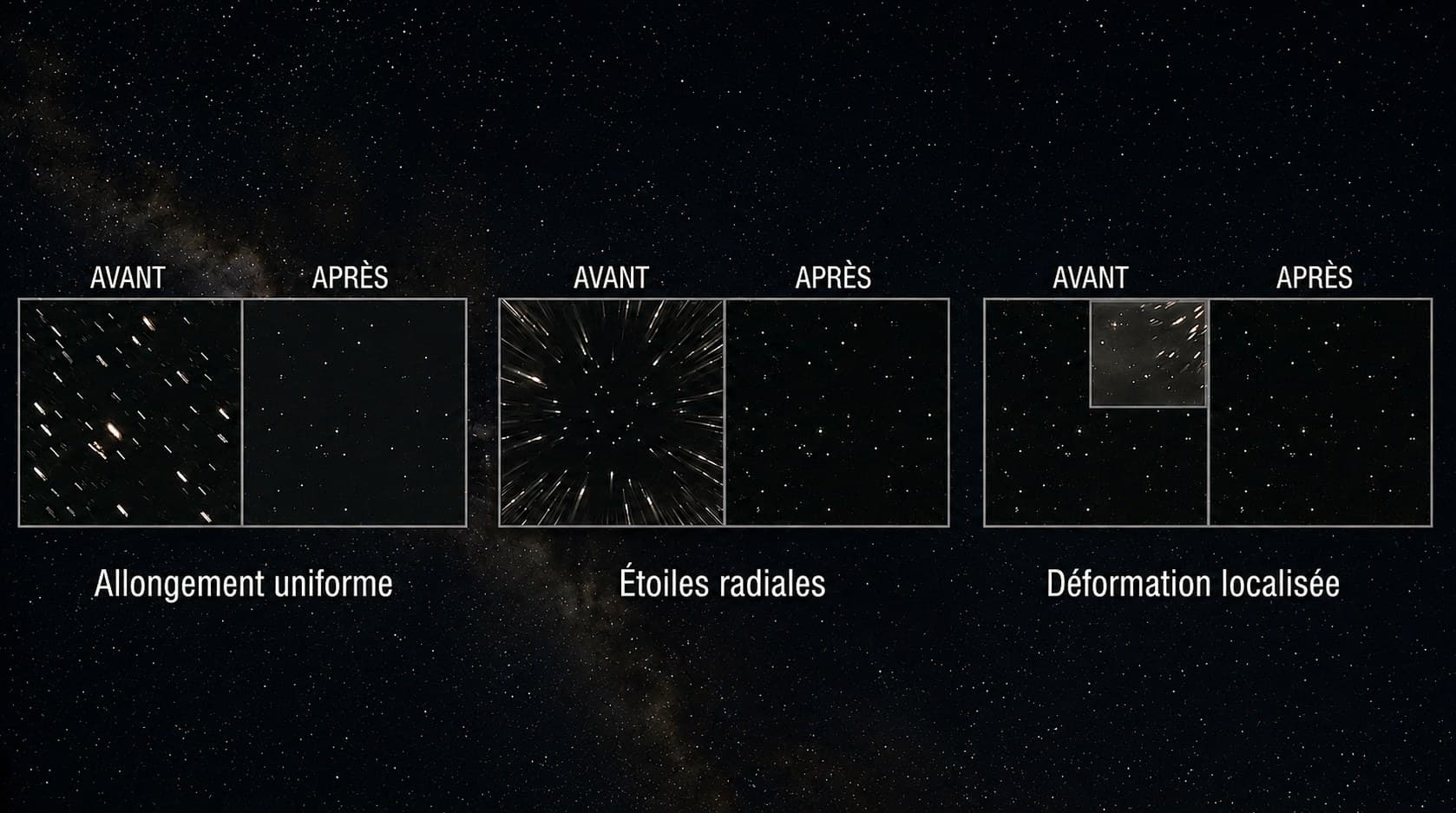
Tracking, on the other hand, deserves credit: over 30 s the central elongation stays at the OSC floor and the 32 deg PA dispersion confirms globally round stars, with no drift or guiding oscillation.
Priority actions
- Fix the imaging-train tilt: cross-tighten and adjust the tilt ring until the corner/center FWHM ratio drops below 1.15
- Lengthen subs to 120-180 s to become sky-limited rather than read-noise-limited
- Enable cooling on the ASI533MC Pro to -10 C instead of the current 22 C
- Raise the offset to 30-50 to remove the 1.8% shadow clipping
- Consider 2x binning given the 0.44 arcsec/px oversampling against 2.5 arcsec seeing