Astrophotography diagnosis of NGC7331: Sensor tilt, tracking drift and 1 other
RawLuminance420s18 août 2025
The Doc examined this image of NGC7331 (raw, Luminance, 420s). Estimated overall technical quality: 7/10. 3 defects found: Sensor tilt (severity 2/5), Tracking drift (severity 2/5), Satellite trail (severity 1/5).
&w=1920&q=75)
Info
- Cible
- NGC7331
- Date
- 18 août 2025, 00:11
- Lune
- Gibbeuse croissante 70.5% (10.2° d'alt., 81.4° de la cible)
- Site
- Bortle 4 · transition rural/banlieue (VIIRS)
- Position
- 22h36m48s · +34°13'04"
Decent conditions. Bortle 4 is a comfortable sky for a galaxy in luminance, and the background measurement confirms no significant oriented gradient (planar amplitude 9%, R2=0.08, so no usable light pollution structure). The 70% gibbous Moon is present but only 10 deg above the horizon and 81 deg from NGC 7331, so its contribution stays marginal on this field, which the very clean background confirms. The background-to-black-point margin of 2.24 is low, but that is consistent with a dark sky and luminance at f/4.5: nothing abnormal here, the 420s exposure is reasonable. You can raise the offset slightly if you want to secure the dark tail (0.02% clipping, already very low).
Setup
- Type d'image
- Brut
- Télescope
- Vinzoographe
- Caméra
- Moravian USB Camera 1 (64 bit) (ASCOM)
- Filtre
- Luminance
- Exposition
- 420s
- Phase de lune
- Dernier croissant (34 %)
- FOV
- 59.5'
Well matched setup for this target. 876mm at f/4.5 gives a 0.99 deg field in which NGC 7331 sits comfortably while keeping Stephan's Quintet in the same frame, the right compromise for that pair. Sampling at 1.74 arcsec/px with 7.4 micron pixels is slightly undersampled for excellent seeing but perfectly suited to typical seeing, and the central FWHM of 2.06 px confirms it (properly sampled stars, nothing wasted). Cooling at -20C is healthy. Luminance at 420s is a good choice on a galaxy; however at f/4.5 the optical train is unforgiving of tilt, hence the importance of stiffening the camera connection.
The diagnosis in detail
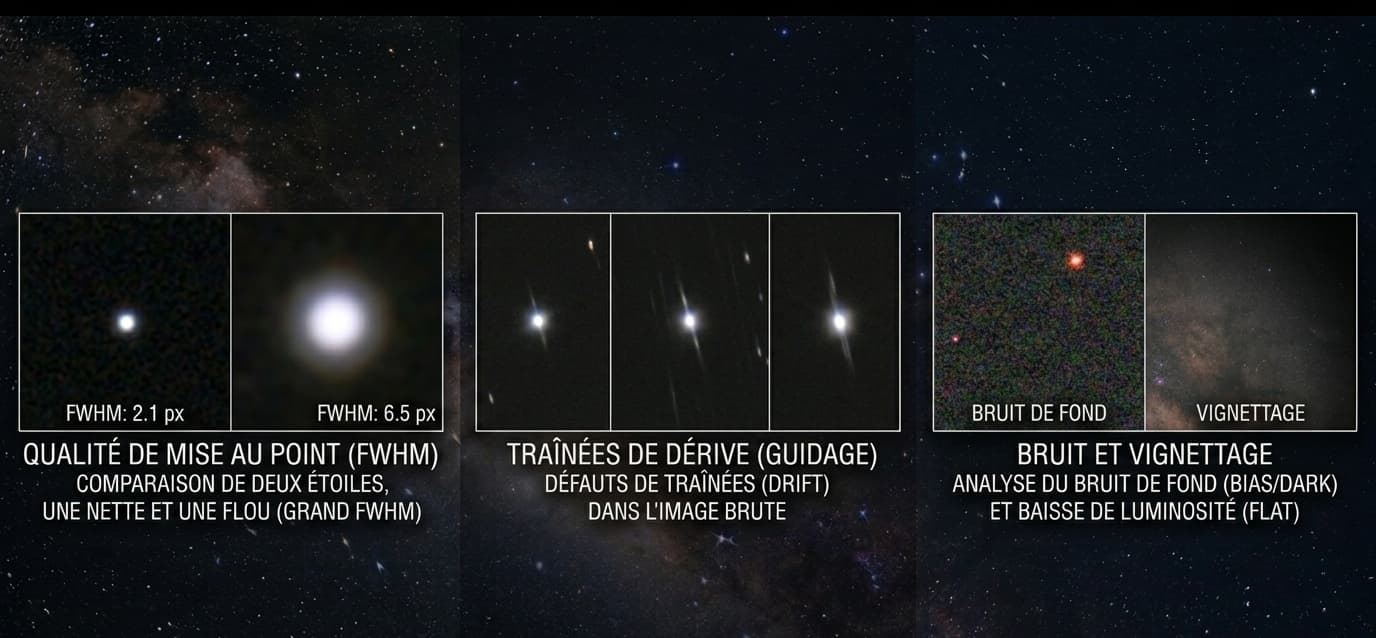
The verdict in one sentence: this is a good sub, with two small mechanical imperfections to fix before running a long session. The central PSF at 2.06/1.77 px is excellent, focus is spot on, and the sky background is clean.
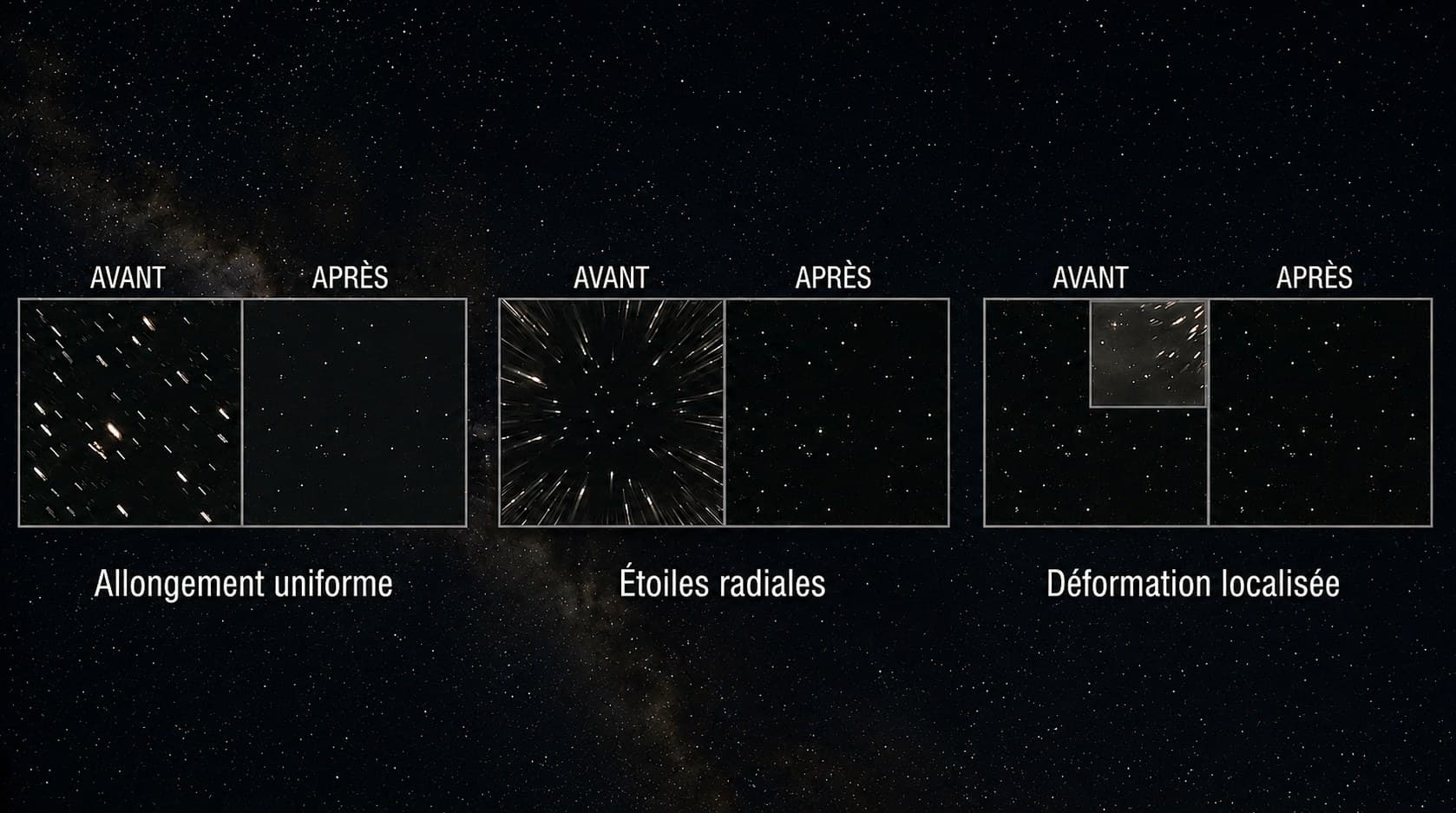
Star shape carries two superimposed signatures. First an elongation present all the way to the center (elong 1.17 against a 1.12 floor) with a coherent direction across the whole field (PA dispersion of only 21 deg): the mark of slight tracking drift over 420s. Second a clearly diagonal asymmetry, TL and BR at elong 1.42 and 1.48 against TR and BL at 1.14 and 1.12: that opposite-diagonal signature, with a sharp center, cannot come from guiding and points to sensor tilt. Both effects share a PA near 40 deg, which makes separation slightly harder, but the corner-to-corner spread above 30% settles it in favor of a real mechanical component.
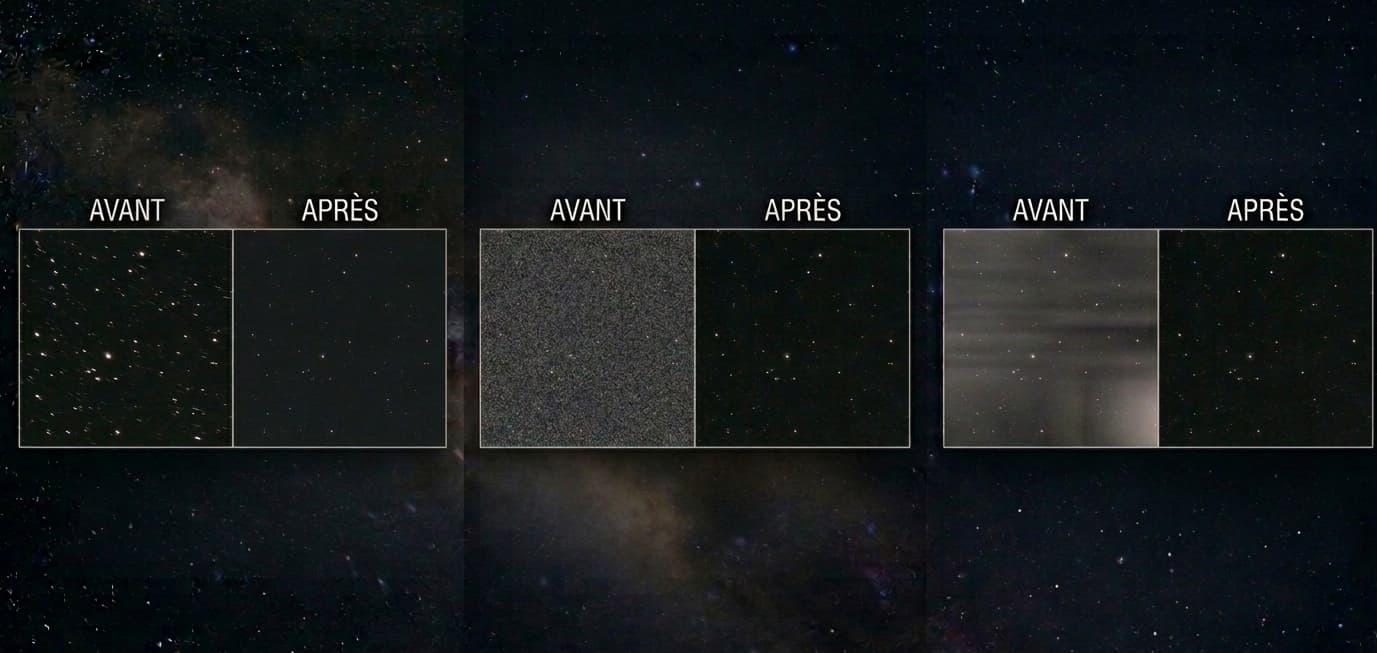
On illumination, the 29% radial falloff is entirely normal optical vignetting on an uncalibrated sub: flats will remove it. Finally a thin trail crosses the left quadrant, harmless, sigma rejection will take care of it.
Priority actions
- Rework the optical train: cross-tighten every connection, check sensor orthogonality, then shoot a control sub
- Refine polar alignment and check guiding RMS in PHD2 (target below 0.6 arcsec for 1.74 arcsec/px)
- Shoot a set of flats and dark-flats with the optical train strictly unchanged
- Stack with Winsorized Sigma Clipping rejection to remove the trail and cosmic rays