Astrophotography diagnosis of NGC7635: Light pollution gradient and clipped stars
ProcessedL-extreme97*300s
The Doc examined this image of NGC7635 (processed, L-extreme, 97*300s). Estimated overall technical quality: 8/10. 2 defects found: Light pollution gradient (severity 3/5), Clipped stars (severity 2/5).

Info
- Cible
- NGC7635
- Site
- Bortle 4 · transition rural/banlieue (saisi)
- Position
- 23h22m10s · +61°22'25"
Very favorable conditions: new moon at 0% and a Bortle 4 sky, about the best possible context for an emission nebula. The L-eXtreme was not strictly necessary under that sky, a plain Ha or even broadband RGB would have caught more continuum signal and given more natural stars. The measured gradient therefore does not come from the moon: look instead at a ground light dome in the 44 degree direction, or a target still low early in the session. With 97 subs of 300s, over 8 hours, the signal budget is more than enough for this sky.
Setup
- Type d'image
- Traitée
- Télescope
- Askar fra400
- Caméra
- zwo asi533 mc pro
- Filtre
- L-extreme
- Exposition
- 97*300s
- Phase de lune
- 0%
- FOV
- 1.57°
A coherent combination for this target. The Askar FRA400 with the ASI533 gives 1.57 degrees of field, which places NGC 7635 at center while taking in M52 at top and Sh2-157 at lower right: successful framing, the whole region breathes. Sampling puts the measured FWHM at 3.5 px at center, slightly above the ideal comfort zone but perfectly workable, and the PSF panel shows round stars right into the corners, a sign that backfocus and tilt are well set. The background to black point margin of 1.63 is low, but that is normal in narrowband: the filter cuts most of the sky background, this is not underexposure.
The diagnosis in detail
On the instrumental side there is nothing to fault. Moffat measurements give elongation from 1.02 to 1.07 depending on the zone, against a field floor of 1.02, and a corner to center FWHM ratio of only 1.09. In other words stars are round everywhere, from center to all four corners, which rules out tilt, backfocus, coma and tracking drift. Over 97 subs of 300s, that is a very good result for the mount and polar alignment.
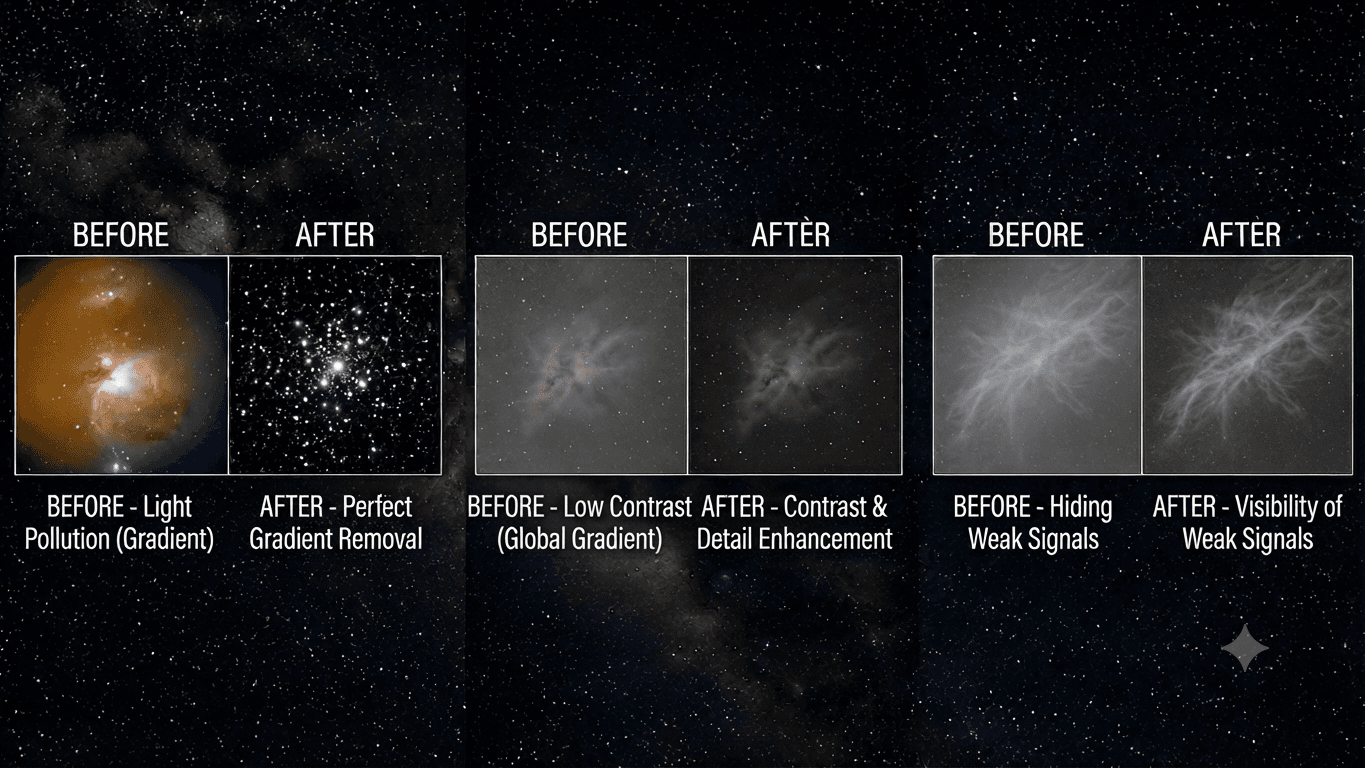
The only structural defect is the sky background. The illumination map shows a linear plane of 34% amplitude oriented at 44 degrees, with an R squared of 0.70, clearly dominating the radial component. This is not vignetting, the flats are doing their job, it is a poorly extracted light pollution gradient. It costs contrast across the whole upper right area and gives the background that slightly dirty brownish tint which dilutes the faint wisps of the region.
Secondarily, a few bright star cores are clipped to white. That is expected with 5 minute subs and stays cosmetic, but a more highlight protective stretch would improve star rendition.
Priority actions
- Redo the gradient extraction while linear with GraXpert or DBE, samples placed outside the nebulosity, to remove the 34% plane oriented at 44 degrees
- Check session to session normalization at integration if the stack mixes several nights
- Protect the highlights during the stretch with a star mask to recover some tint in the saturated cores
- Under this moonless Bortle 4 sky, consider plain Ha or broadband to gain signal and better star rendition