Astrophotography diagnosis of M42: Light pollution gradient, oversaturation and 3 others
Processed30s · ISO 20031 oct. 2026
The Doc examined this image of M42 (processed, 30s · ISO 200). Estimated overall technical quality: 6/10. 5 defects found: Light pollution gradient (severity 3/5), Oversaturation (severity 3/5), Backfocus error (severity 2/5), Clipped stars (severity 2/5), Over-denoising (severity 2/5).

Info
- Cible
- M42
- Date
- 31 oct. 2026, 23:37
- Position
- 5h35m29s · -5°23'40"
Average conditions: a waning gibbous Moon at 65% illumination, which clearly lifts the sky background and limits contrast on M42's faint extensions. The measured 61% linear gradient is consistent with that combination of moonlight plus low-sky light pollution. M42 is a very bright target, so it handles these conditions far better than a galaxy or a faint diffuse nebula: the core and main wisps come through easily. The outer extensions and dark lanes suffer, though. For this target it works; to chase the faint contrasts, aim for a moonless night or wait until M42 climbs higher.
Setup
- Type d'image
- Traitée
- Télescope
- 260mm
- Caméra
- Zwo Seestar S50 Pro
- Exposition
- 30s · ISO 200
- Phase de lune
- Waning gibbous (65 %)
- FOV
- 1.35°
The Seestar S50 is well matched to M42: with a 1.35 degree wide field, the main nebula and the Flame fit comfortably with margin, and the vertical framing uses the area well. The 30s subs are about the limit for this kind of alt-az mount, and tracking keeps up without trouble (center elong 1.04, excellent). The downside is the clipped M42 core: this target has enormous dynamic range, and 30s already saturates the Trapezium. The real answer here is a complementary set of very short exposures for an HDR composite. On the histogram side, the background-to-black-point margin of 2.3 stays low, a sign of a fairly aggressive final stretch in the shadows.
The diagnosis in detail
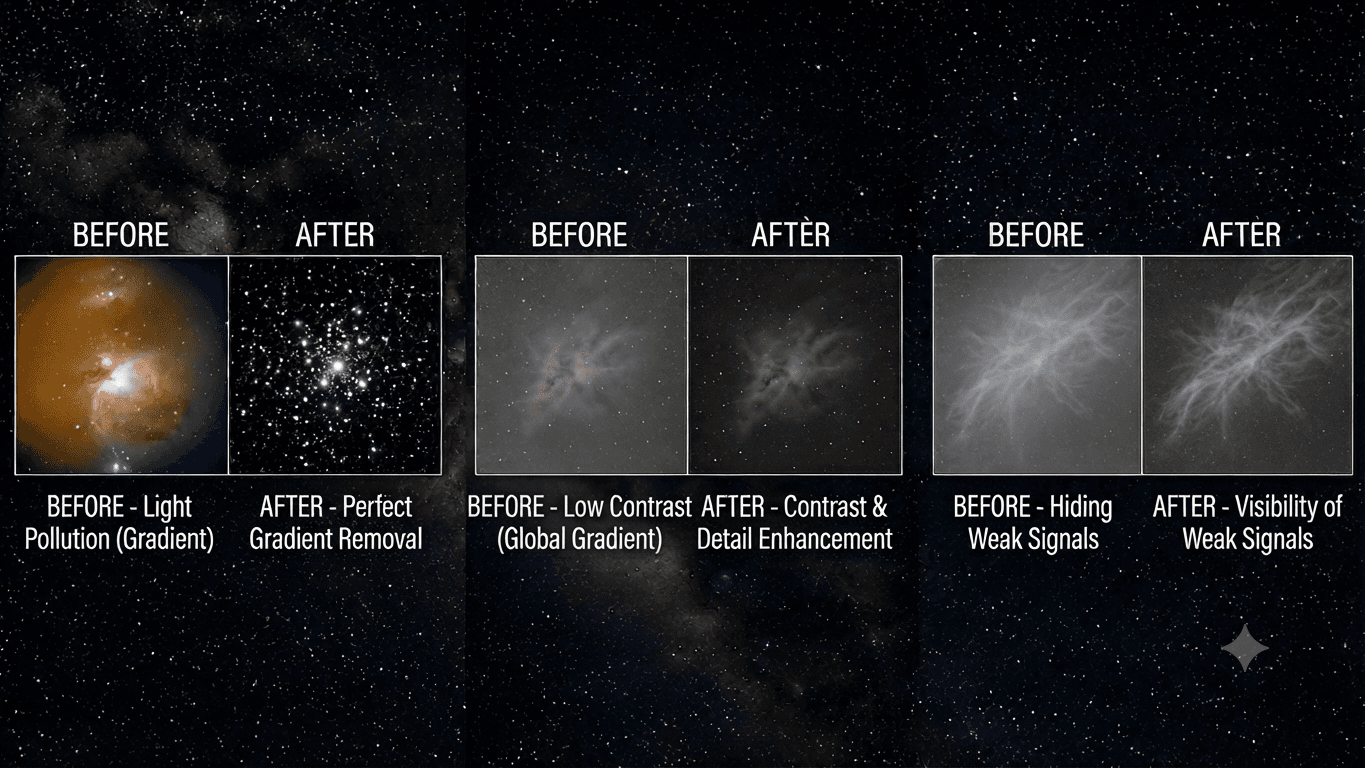
The most damaging issue is the sky background. The background map measures a tilted plane of 61% amplitude oriented at 65 degrees, clearly dominating the radial component (factor 3). This is neither vignetting nor real nebulosity: it is a light pollution gradient, amplified by a 65% Moon, that was never extracted before the stretch. As a result the bottom of the frame is noticeably brighter than the top, and M42's faint extensions drown in that lifted background.
The second axis is dynamic range management. M42 is one of the most demanding targets in the sky on that front, and here the core forms a pure white plateau with no falloff and no hue, the Trapezium being completely unreadable. Several bright field stars share the same fate, white cores with no hint of color. This is recoverable only through additional short exposures and an HDR composite, not by reprocessing the current master.
Optically, the PSF is clean at center (elong 1.04, FWHM 4.3 px) and degrades symmetrically toward the corners (ratio 1.20, elong up to 1.33 at the bottom). This is residual field curvature, structural on this sealed tube, to accept rather than correct. Tracking itself is flawless.
Priority actions
- Extract the gradient on the linear image with GraXpert or DBE before any stretch
- Capture a set of short exposures (1 to 5s) on M42 and build an HDR composite to restore the Trapezium
- Protect stellar cores with a star mask during the stretch to preserve their hues
- Schedule a moonless session to chase the nebula's faint extensions
- Stack the subs outside the app to regain control over denoising