Astrophotography diagnosis of ngc6888: Light pollution gradient, sensor tilt and 1 other
ProcessedL-extreme89x300s
The Doc examined this image of ngc6888 (processed, L-extreme, 89x300s). Estimated overall technical quality: 7/10. 3 defects found: Light pollution gradient (severity 3/5), Sensor tilt (severity 2/5), Clipped stars (severity 2/5).

Info
- Cible
- ngc6888
- Position
- 20h12m03s · +38°21'32"
Moon at 0%, so no lunar contribution: the measured gradient is entirely terrestrial or atmospheric in origin. For an emission target such as NGC 6888 the L-eXtreme is the right choice and these dark night conditions are very favourable, which explains the rich background Ha recovered across the whole Cygnus field. With 89x300s, that is 7h25 of integration under no moon, the signal to noise ratio is comfortable and the background stays clean. The residual 170 degree gradient points instead to the target dropping toward the polluted horizon late in the night: planning the session around meridian transit would limit this at the source.
Setup
- Type d'image
- Traitée
- Télescope
- Askar fra400
- Caméra
- zwo asi533 mc pro
- Filtre
- L-extreme
- Monture
- am5n
- Exposition
- 89x300s
- Phase de lune
- 0%
- FOV
- 1.55°
Coherent setup but short on focal length for this target. The FRA400 with the ASI533 gives a 1.55 degree field: NGC 6888 spans about 18 arcmin, barely a fifth of the frame width, hence a nebula lost at the centre. This framing is defensible if you wanted the Ha context of Cygnus, which is indeed superb here, but twice the focal length would showcase the Crescent. Sampling stays comfortable and the 3.0 px FWHM at centre shows the optics are performing well. The L-eXtreme on an emission target is perfectly suited. The AM5N holds 300s with no measurable drift, the strong point of this setup.
The diagnosis in detail
Tracking is the strongest aspect of this acquisition: 1.02 elongation at centre against a field floor of 1.01, PA scatter of 21.9 degrees, meaning strictly round stars. Over 89 frames of 300 seconds with the AM5N this is exemplary, and no drift, periodic error or guiding oscillation component appears on the PSF panel.
The only optical weakness is a FWHM spread between zones: 3.04 px at centre against 4.00 px bottom right and 3.86 px on the left, with vertical asymmetry ten times the horizontal. Stars stay round, so this is neither coma nor astigmatism but a progressive defocus on one side of the field, the classic signature of mild optical train tilt. The effect stays discreet at the scale of the final image.
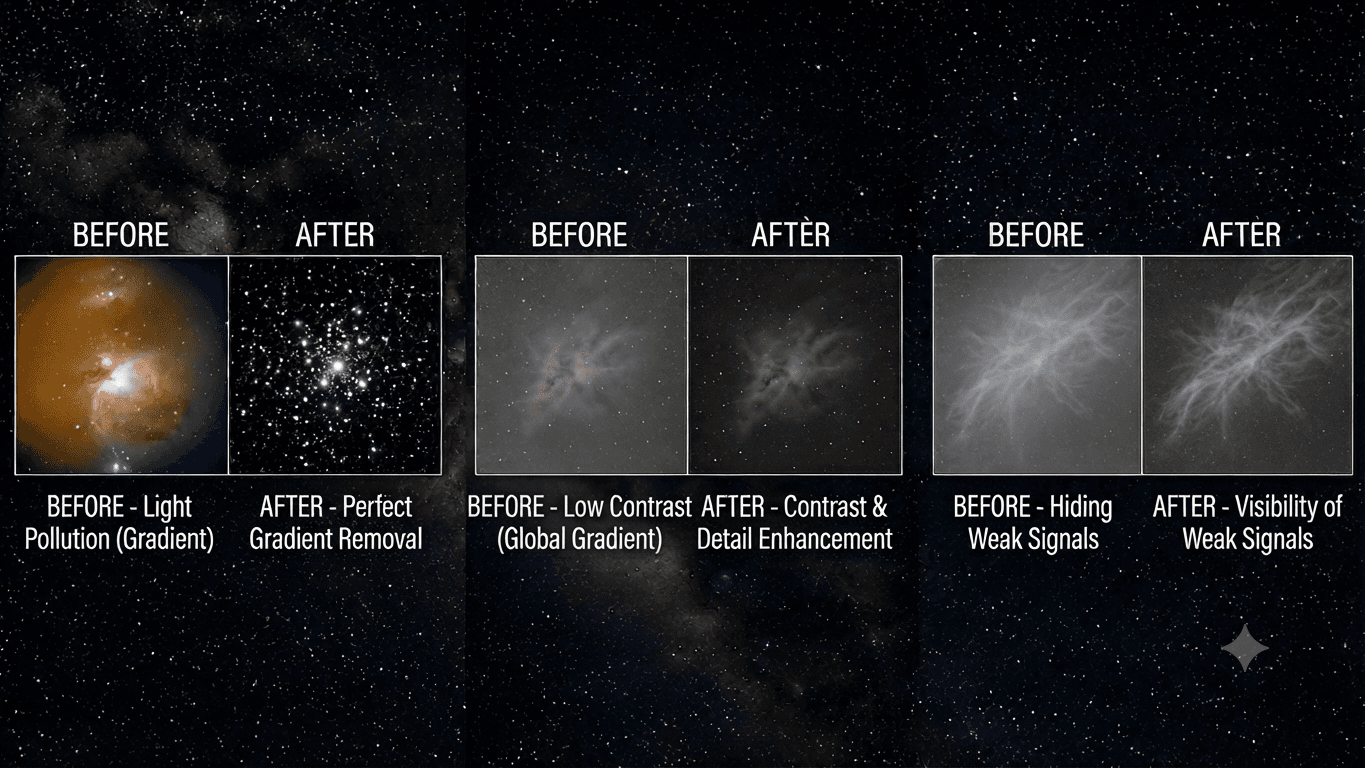
On the background, the 67% linear gradient at 170 degrees dominates the radial component by a factor of 9.5, which rules out vignetting: this really is poorly removed sky gradient. Be careful not to crush it, at the risk of taking with it the genuine diffuse Ha, very present on the left of the field and confirmed by its coherent filamentary structure.
Priority actions
- Redo the gradient extraction while linear with GraXpert RBF, protecting the diffuse Ha of the left half
- Check and retighten the optical train, then rerun an aberration inspector test to confirm the corner/centre FWHM spread has dropped
- Protect bright star cores during the stretch (luminance mask or softened intensity transfer) to recover their colour
- Schedule the target around meridian transit to avoid the low altitude gradient late in the night
- Consider a longer focal length if the goal is NGC 6888 itself rather than the Cygnus context