Astrophotography diagnosis of SH 2-54: Astigmatism and bad seeing
RawH300s05 août 2025
The Doc examined this image of SH 2-54 (raw, H, 300s). Estimated overall technical quality: 6/10. 2 defects found: Astigmatism (severity 2/5), Bad seeing (severity 2/5).
&w=1920&q=75)
Info
- Cible
- SH 2-54
- Date
- 05 août 2025, 21:25
- Lune
- Croissant décroissant 12.8% (16.6° d'alt., 17.8° de la cible)
- Site
- Bortle 5 · banlieue résidentielle (saisi)
- Position
- 18h17m50s · -11°43'55"
Good conditions for an emission target like SH2-54 in Hα. The Moon is only 12.8% illuminated: even at 17.8° from the target and 16.6° above the horizon, its impact on a narrow Hα channel is negligible, and the low background/black-point margin (e_margin 1.97) is normal and expected in narrowband, not a sign of underexposure. Bortle 5 is inconsequential on a narrow Hα band, which rejects most urban light pollution. Nothing to fix on the conditions side: a usable night to stack signal.
Setup
- Type d'image
- Brut
- Télescope
- SkyWatcher 150 PDS Quattro
- Caméra
- ZWO ASI585MM Pro
- Filtre
- H
- Monture
- EQ6-R Pro
- Exposition
- 300s
- Phase de lune
- Gibbeuse croissante (89 %)
- FOV
- 1.23°
Setup consistent with the target. The 150 PDS at 520mm gives a 1.23° field that frames SH2-54 nicely with its surrounding nebulosity centered. The 1.15″/px sampling is comfortable and well suited to typical seeing, but it demands careful focus: your 5.5 px FWHM shows the available resolution isn't yet being used, aim for 3-4 px. The Hα filter on the ASI585MM is the right pick for this HII region under Bortle 5 and a present Moon. Gain 252 and offset 15: no dark clipping (0%), near-zero saturation (0.01%), healthy -10°C cooling. Clean settings, nothing to change.
The diagnosis in detail
The sub is well made for an Hα raw. The PSF panel confirms healthy tracking and mount: central elong of 1.16 right at the field floor, coherent central PA, no trace of drift, guiding oscillation or PE. Framing places SH2-54 at center and the DSS comparison validates all the diffuse nebulosity and IFN filaments seen in the periphery, so the +30% background variation is real signal, not an illumination defect.
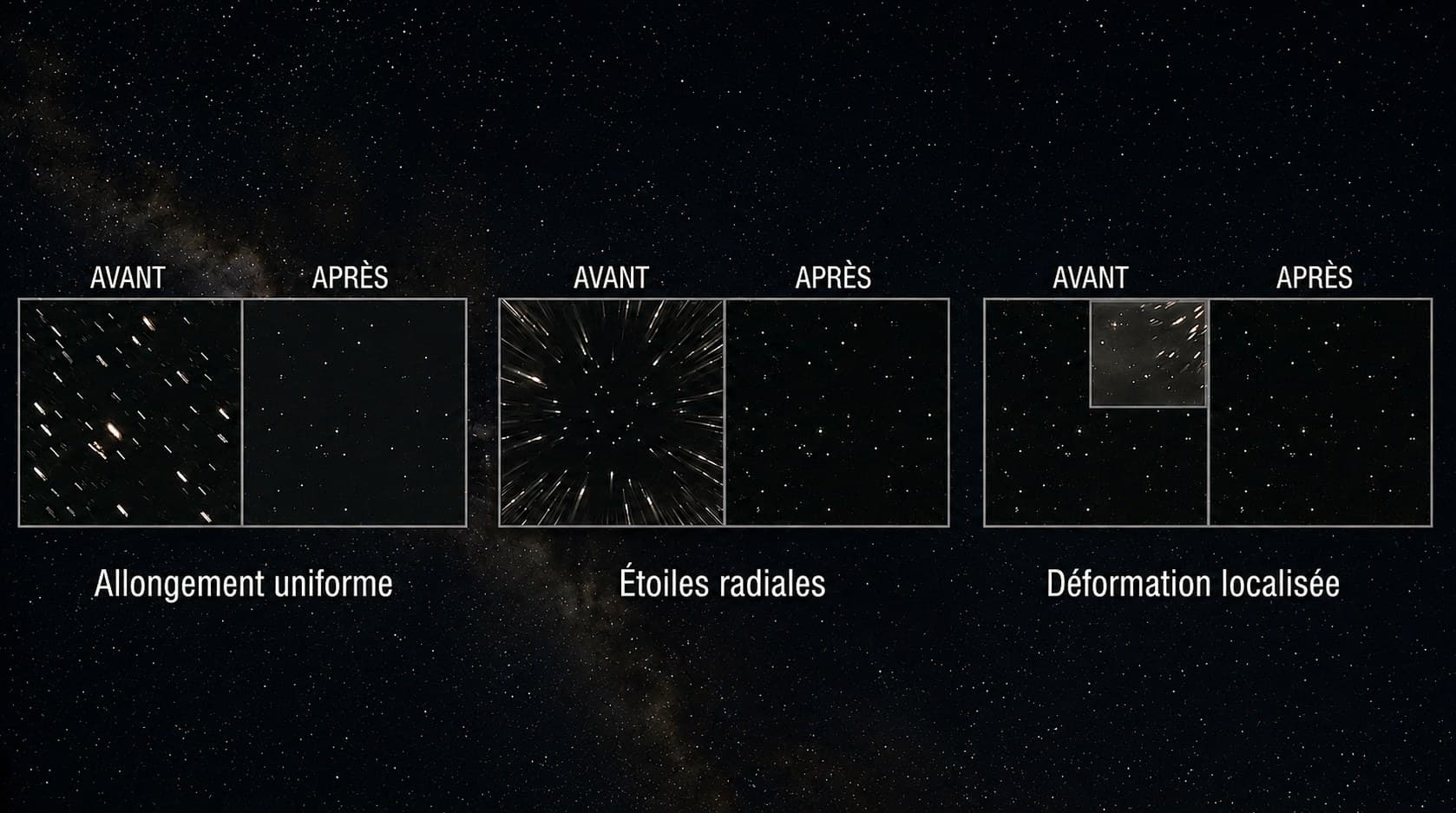
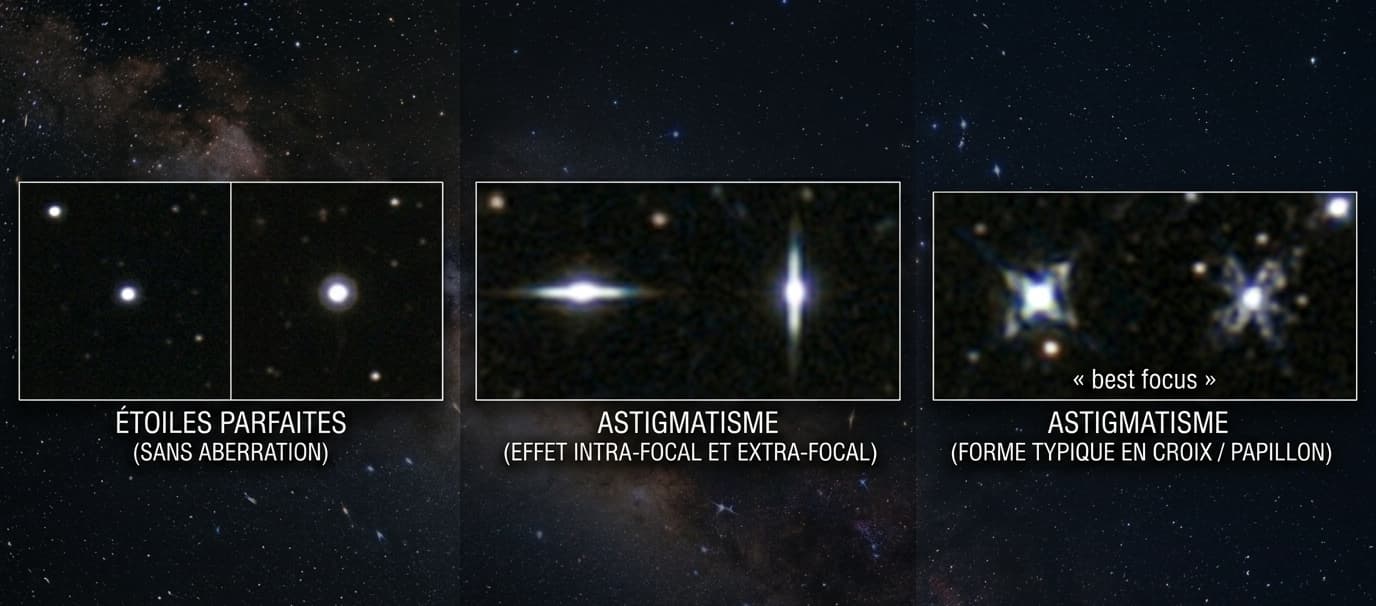
The two limits are optical and atmospheric. Measured field astigmatism raises the elongation in the four corners (1.31 to 1.36) without an FWHM rise and with diverging PAs, which rules out tilt (whose diagonal asymmetry is below threshold here, only 46%) and pure coma. It's a mild defect, typical of a slightly decentered or loosely clamped Newtonian corrector. In parallel, the 5.5 px FWHM (~6.3″) is a bit generous for this optical train: average seeing on the night of August 5 and/or focus not quite optimal, to be settled by checking FWHM stability across the series.
No calibration or post-processing defect applies at this stage (raw). The essentials are already there: stack the series with dithering, nail the focus and re-clamp the corrector, and this base will yield a very good result on SH2-54.
Priority actions
- Nail focus before each run (Bahtinov mask / autofocus) to bring FWHM toward 3-4 px
- Check the centering and clamping of the 150 PDS coma corrector to reduce edge astigmatism
- Verify Newtonian collimation
- Stack the full series with dithering enabled to smooth the field edge and noise