Astrophotography diagnosis of SH 2-73: Tracking drift and satellite trail
RawIDAS LPS D260s15 mai 2026
The Doc examined this image of SH 2-73 (raw, IDAS LPS D2, 60s). Estimated overall technical quality: 6/10. 2 defects found: Tracking drift (severity 2/5), Satellite trail (severity 1/5).
&w=1920&q=75)
Info
- Cible
- SH 2-73 - SH 2-73
- Date
- 15 mai 2026, 22:30
- Lune
- Pleine lune 98.6% (sous l'horizon)
- Site
- Bortle 3 · rural peu pollué (VIIRS)
- Position
- 16h10m14s · +21°52'08"
Favorable conditions: Bortle 3 sky and a full Moon below the horizon, so no lunar pollution (the 132° separation is irrelevant since the Moon isn't up). That's an excellent context for SH 2-73, a faint nebulosity with diffuse IFN that needs a truly dark background. The IDAS LPS D2 filter isn't essential under such a sky but doesn't hurt. Take advantage to stack many hours: this target's signal is weak and SNR is earned through total integration.
Setup
- Type d'image
- Brut
- Télescope
- Askar SQA70 Pro
- Caméra
- ATR585C
- Filtre
- IDAS LPS D2
- Exposition
- 60s
- FOV
- 1.90°
Setup consistent with the target. The SQA70 Pro gives a 1.90° field that comfortably frames SH 2-73 and its diffuse surroundings. The SQA70/ATR585C sampling lands around 1.7-2''/px, comfortable and well suited to current seeing. The measured FWHM (4.7-5.3 px at center) mostly reflects single-sub noise and tracking drift rather than the optics. On settings, gain 1000 is very high for this camera: it cuts dynamic range and saturates bright stars quickly; a more moderate gain with slightly longer subs would be preferable. e_margin 2.77 shows a background barely lifted, normal at 60s.
The diagnosis in detail
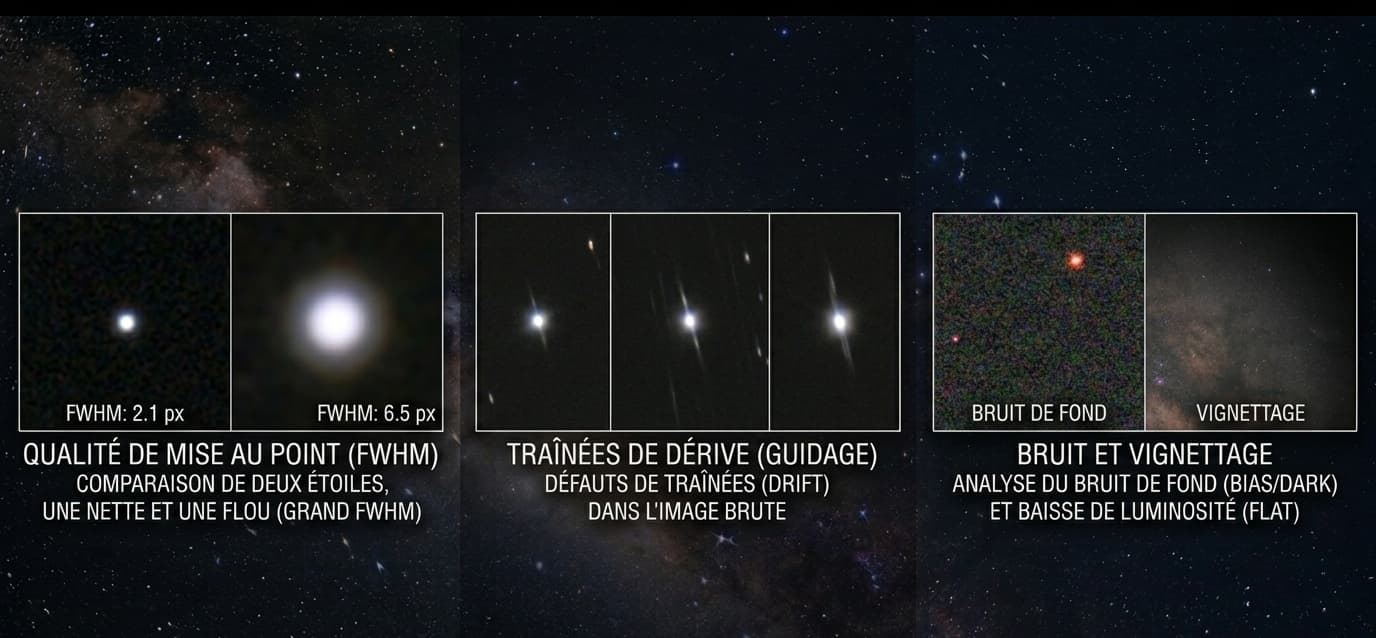
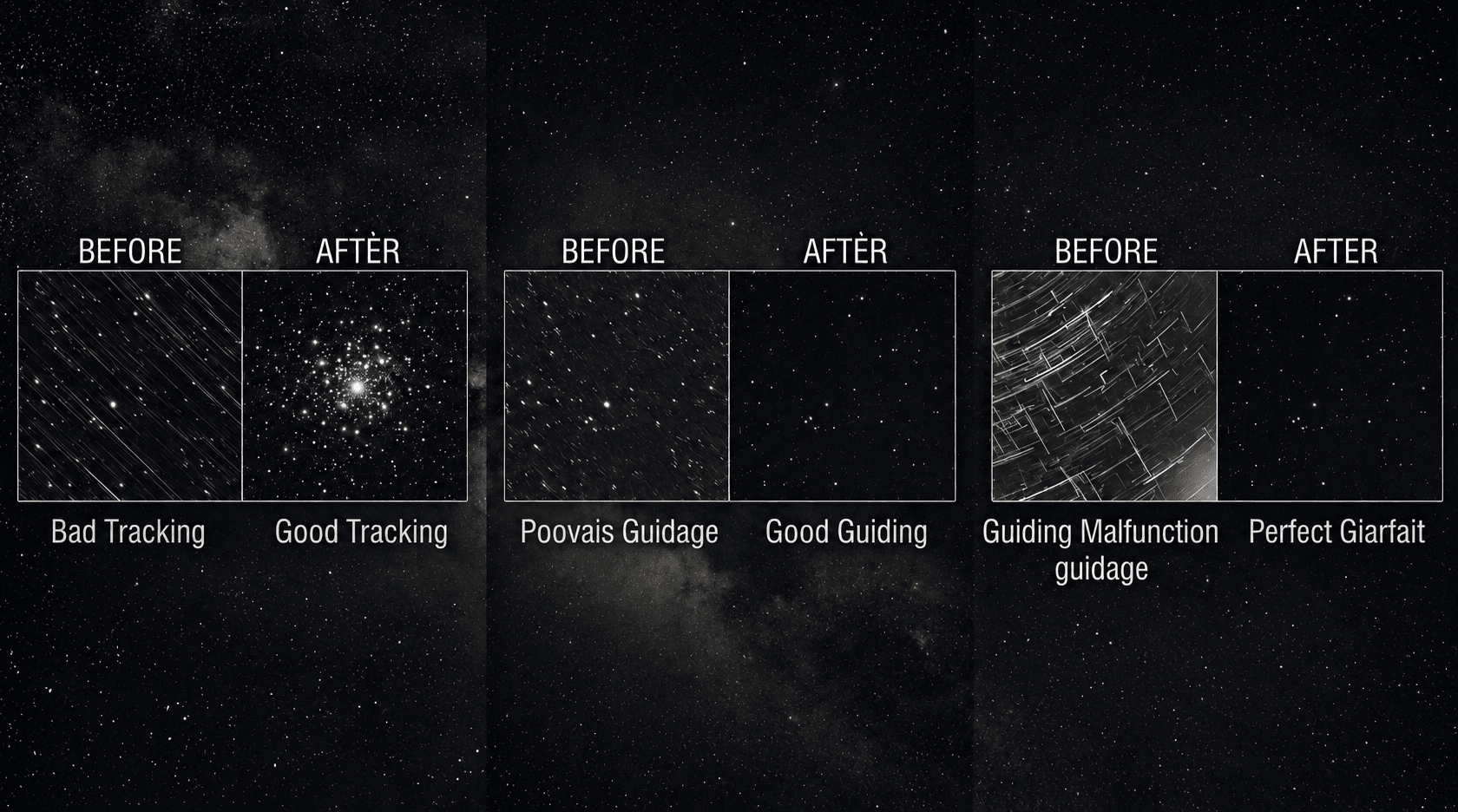
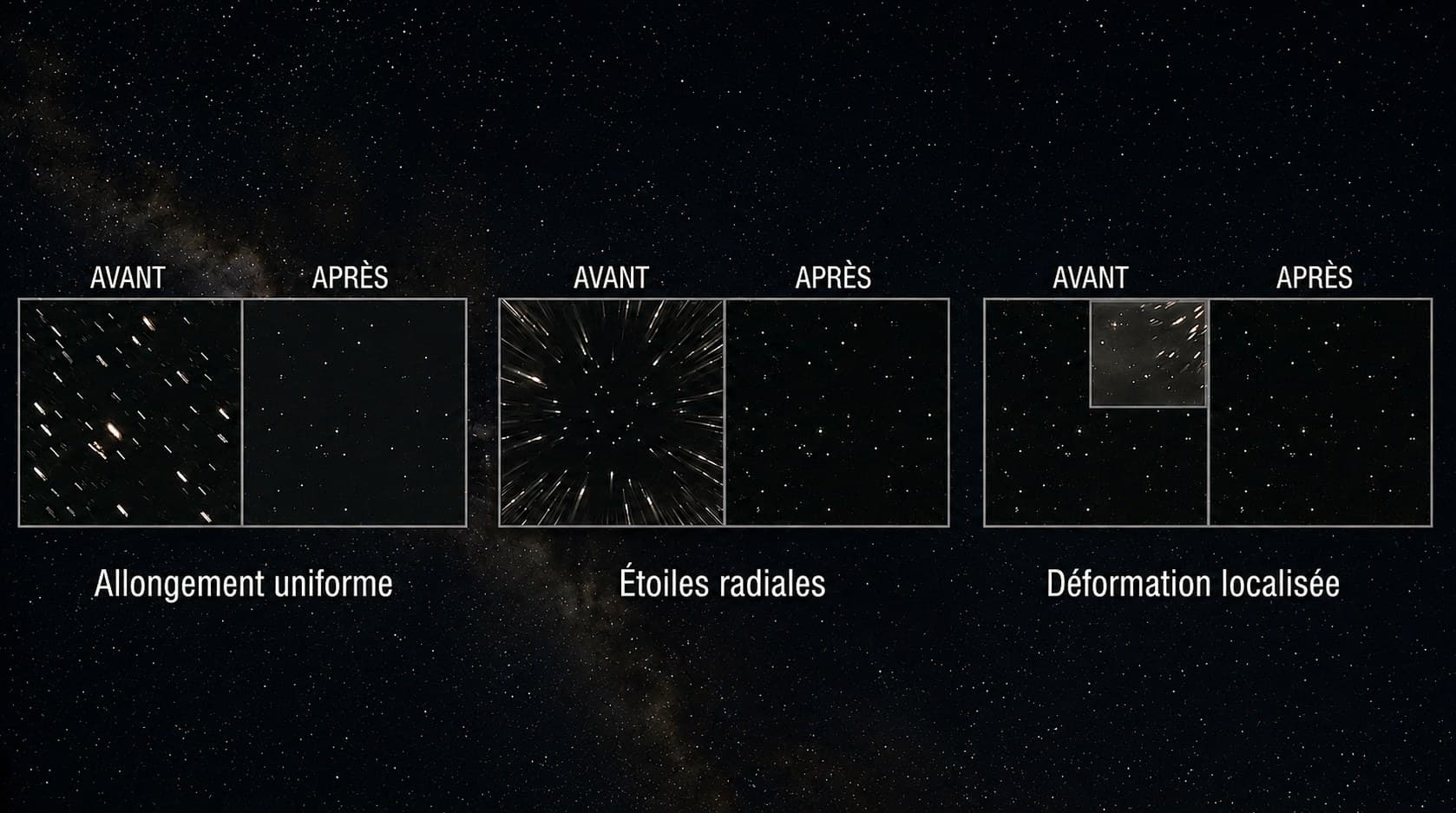
The PSF panel is clear: the center C already shows elongation (1.18) above the field floor (1.13), and this elongation keeps a very consistent PA from zone to zone (7.1° spread, axis ~57-72°). This profile, uniform elongation in a common direction reaching the image core, rules out a field optical defect (corner/center ratio is only 1.16, with no diagonal asymmetry or radial comet shape) and points to moderate tracking drift during the 60s exposure. The cause is likely absent or imperfect guiding, or a slight residual in polar alignment.
The rest is healthy: no tilt, no coma, a background with near-radial symmetry and vignetting/gradient at only 2%, so nothing to flag on illumination. The trail crossing the lower-right quadrant is just a satellite/aircraft pass, harmless as long as you stack several subs with sigma rejection.
The high FWHM values (4.7-5.8 px) should be kept in perspective: on a single uncalibrated sub, noise inflates the fit, and tracking drift adds to it. With better controlled tracking and deep integration, this setup should deliver a good rendering of SH 2-73.
Priority actions
- Improve tracking at 60s: enable/refine autoguiding and improve polar alignment to tighten the stars
- Stack several subs with sigma rejection to remove the satellite trail
- Lower the gain (1000 is very high) for better dynamic range, even if it means slightly longer subs
- Accumulate many hours of integration, the target is diffuse and faint