Astrophotography diagnosis of SH2-114: Tracking drift
RawL300s25 sept. 2026
The Doc examined this image of SH2-114 (raw, L, 300s). Estimated overall technical quality: 7/10. 1 defect found: Tracking drift (severity 2/5).

Info
- Cible
- SH2-114
- Date
- 25 sept. 2026, 23:40
- Lune
- Nouvelle lune 0.7% (45.4° d'alt., 49.9° de la cible)
- Site
- Bortle 2 · rural typique (VIIRS)
- Position
- 21h22m23s · +38°39'50"
Very favorable conditions. The moon context reports 0.7% illumination, essentially a new moon: no lunar pollution to expect despite it sitting 45° above the horizon and 49.9° from the target, so that factor can be ignored. Bortle 2 is a luxury for SH2-114, a very low surface brightness supernova remnant that specifically demands a dark sky. The background map confirms these conditions: only a 3% gradient and near-zero azimuthal anisotropy. Under this sky, broadband luminance still makes sense, and a long integration will deliver far better SNR than any urban site would allow.
Setup
- Type d'image
- Brut
- Télescope
- EQMod Mount
- Caméra
- ZWO ASI2600MM Air
- Filtre
- L
- Exposition
- 300s
- Phase de lune
- Pleine lune (100 %)
- FOV
- 1.61°
Setup well matched to the target. 836mm of focal length on the 6248x4176 sensor gives a 1.61° field, and SH2-114 spans about one degree so it fits comfortably, framing is fine. Sampling at 0.928"/px is somewhat fine for a measured FWHM of 5.3 px at center, about 4.9": that is clear oversampling, and binning 2 at integration would gain SNR without losing any real resolution. On the settings side, gain 100 at unity and offset 50 are healthy, with no shadow clipping. One caveat: sensor temperature sits at -0.1°C, and cooling to -10°C would noticeably cut dark current on 300s exposures.
The diagnosis in detail
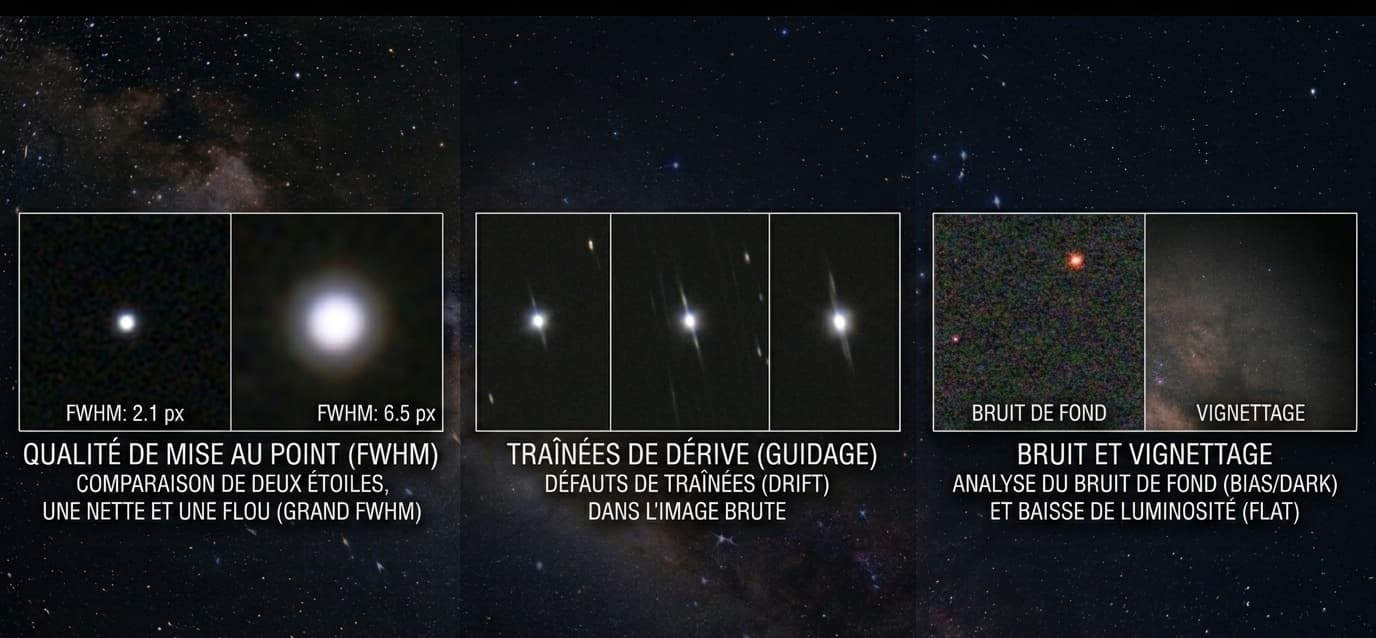
This sub is healthy. The PSF panel shows nine very homogeneous zones, FWHM from 5.13 px at the bottom edge up to 5.93 px at top right, a corner/center ratio of only 1.09. No field aberration signature: no radial comet shapes, no diagonal asymmetry, no tangential ovalization in the corners. The optical train and backfocus are therefore well set, and the sensor is properly square to the optical axis.
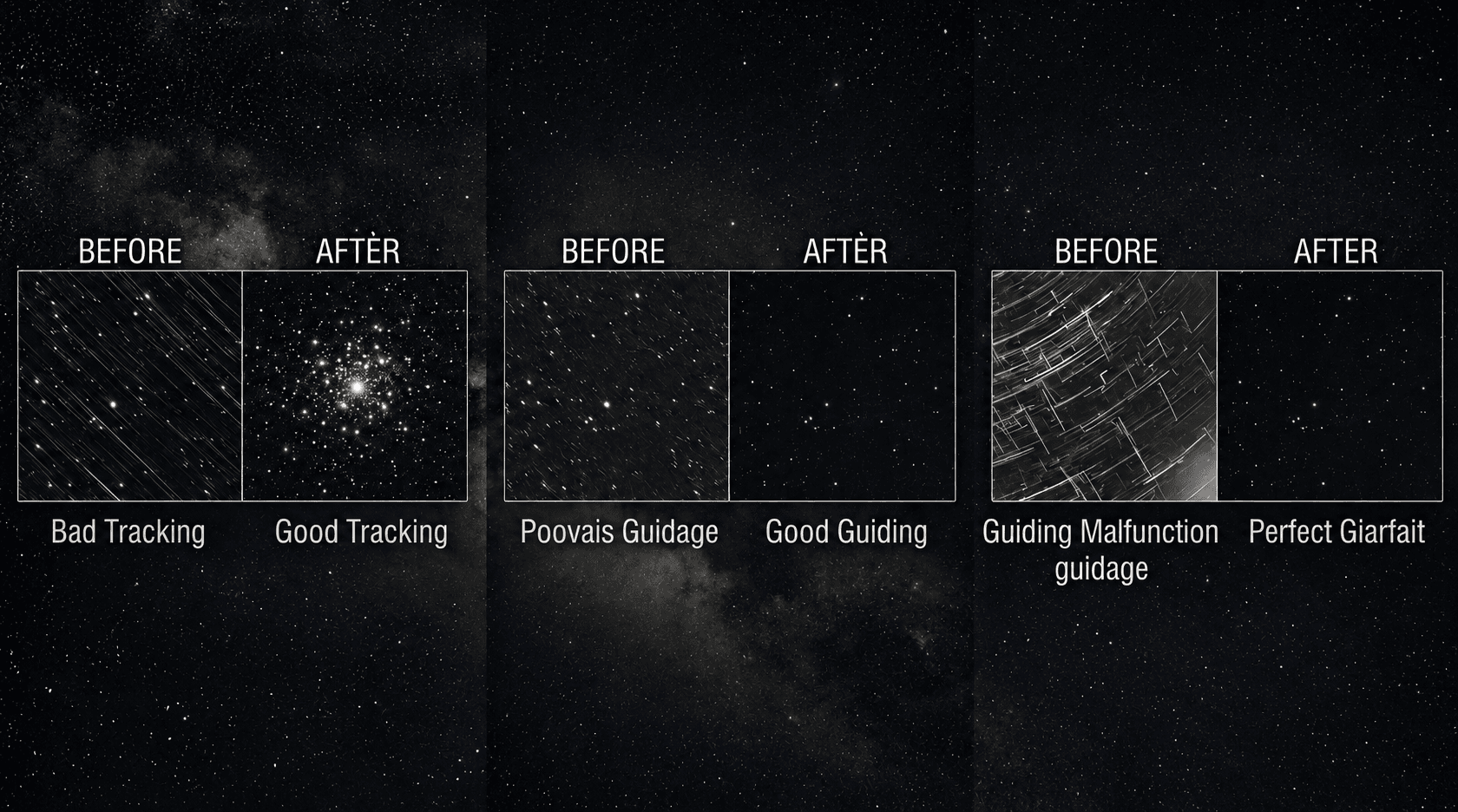
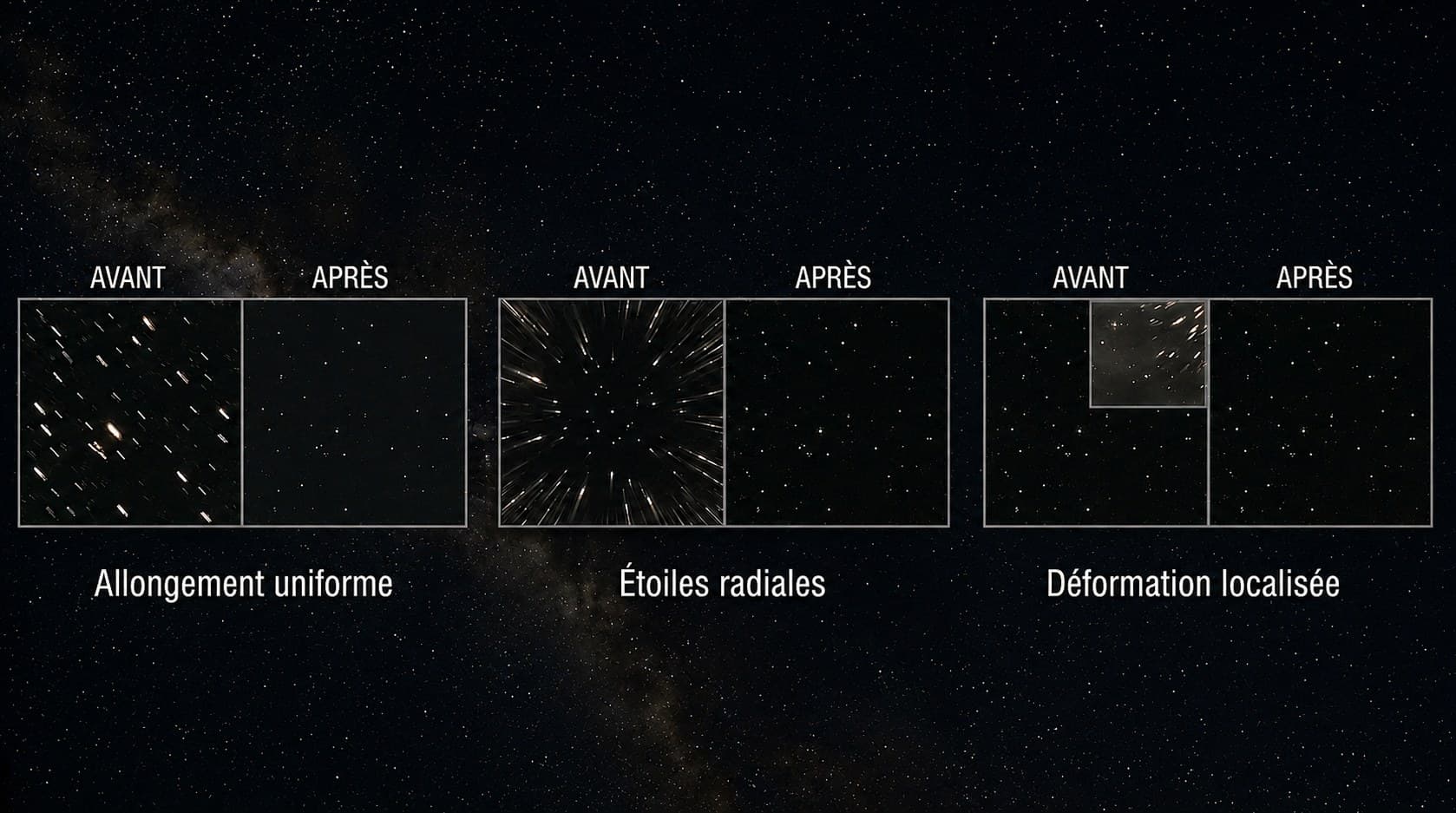
The only measured defect is a uniform elongation of 1.14 at center where the field floor sits at 1.06. Since it is present at the center and the position angle disperses by only 12.2° between zones, the cause is mechanical rather than optical: the mount drifted slightly during the 300 seconds. The amplitude stays low, roughly 8% difference between the two PSF axes, so the sub is usable as is.
On the background side, the illumination map gives a 3% gradient oriented at 167.6° and a 2% radial falloff, values too small to constitute a defect under Bortle 2. Comparison with the DSS confirms that the darker patches visible at the bottom of the frame match real structures rather than artifacts. The background to black point margin of 2.28 is low but normal for luminance under a dark sky.
Priority actions
- Redo polar alignment and check the PHD2 guiding RMS to remove the residual drift
- Bring sensor temperature down to -10°C or -20°C, currently at -0.1°C on 300s exposures
- Consider binning 2 at integration, sampling at 0.928"/px is clearly oversampled for a 4.9" FWHM