Astrophotography diagnosis of SH2-114: Tracking drift and backfocus error
RawG300s25 sept. 2026
The Doc examined this image of SH2-114 (raw, G, 300s). Estimated overall technical quality: 6/10. 2 defects found: Tracking drift (severity 3/5), Backfocus error (severity 2/5).

Info
- Cible
- SH2-114
- Date
- 25 sept. 2026, 21:26
- Lune
- Nouvelle lune 0.8% (40.5° d'alt., 50.3° de la cible)
- Site
- Bortle 2 · rural typique (VIIRS)
- Position
- 21h20m51s · +38°45'22"
Excellent conditions: Bortle 2 and a moon at 0.8% illumination, so essentially no lunar contribution despite its 40.5° altitude and 50.3° separation. The measured background confirms it, with a plane gradient of only 1% amplitude and zero azimuthal anisotropy. Under such a dark sky, a faint target like SH2-114 is perfectly workable in broadband, including on the G filter. The background-to-black-point margin e_margin of 2.2 stays low, but that is normal behavior for a Bortle 2 sky at 300s and gain 100: you are close to the read-noise-limited regime, which argues against shortening the exposures.
Setup
- Type d'image
- Brut
- Télescope
- EQMod Mount
- Caméra
- ZWO ASI2600MM Air
- Filtre
- G
- Exposition
- 300s
- Phase de lune
- Pleine lune (100 %)
- FOV
- 1.61°
The setup matches the target. At 835 mm and 0.93"/px on a 6248x4176 sensor, the 1.61° field frames the SH2-114 region well; the nebula extends well beyond it but the targeted portion is correctly placed. Sampling is slightly fine for typical seeing: with a measured FWHM around 5 px at center you are in practice limited by seeing and drift rather than by the optics, and 2x binning at integration would gain signal to noise with no real loss of detail. Gain 100 (unity) and offset 50 are healthy, with no measured dark clipping. One point to watch: sensor temperature at 0°C, cooling to -10°C would noticeably cut dark current on 300s subs.
The diagnosis in detail
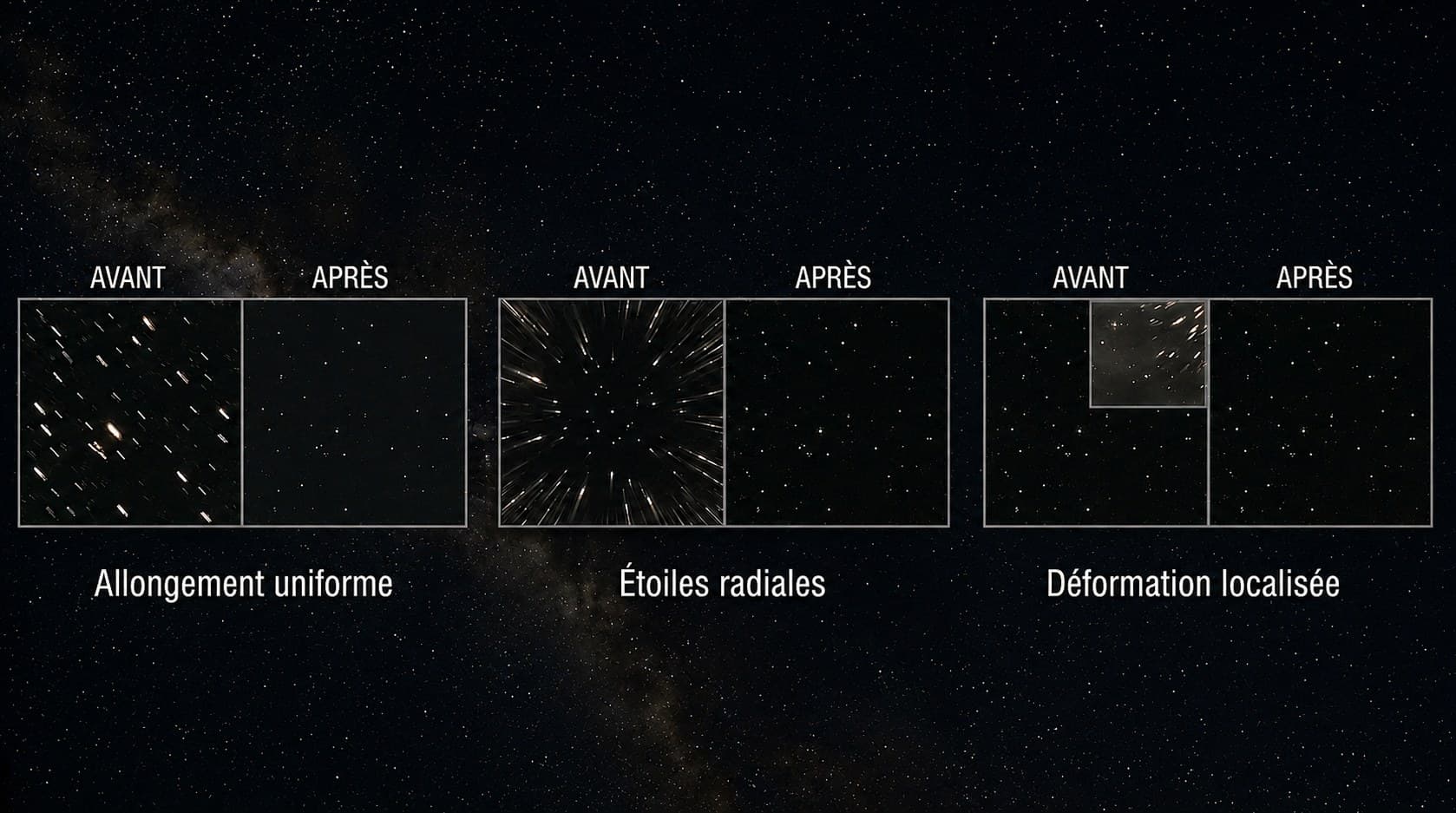
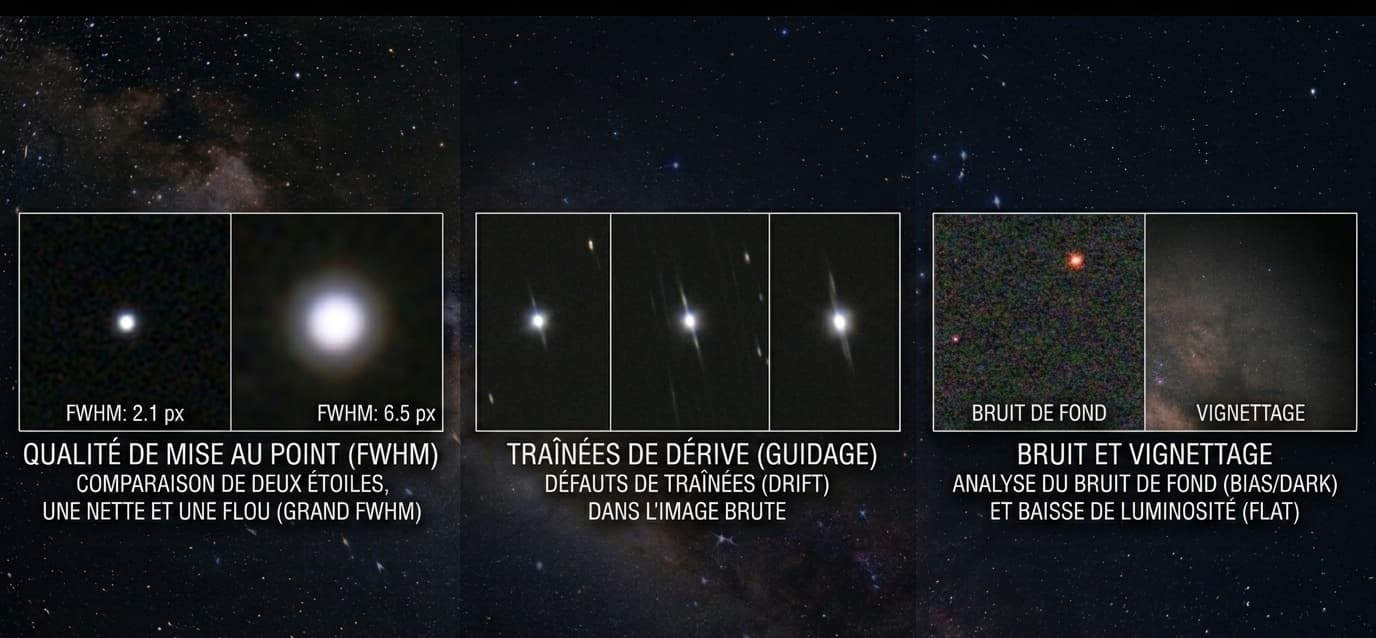
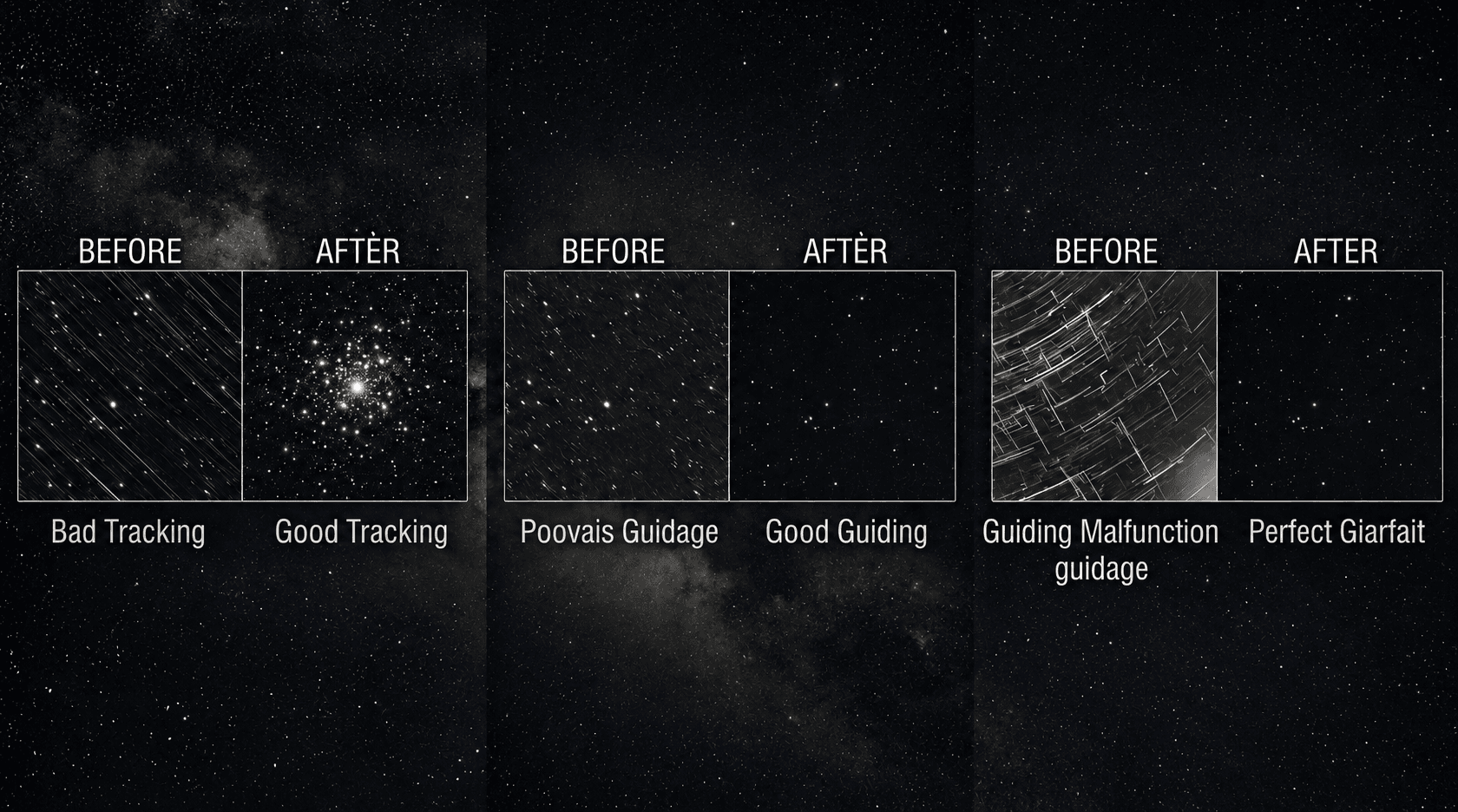
The diagnosis comes down to a single dominant mechanism. The elongation is not an edge phenomenon: it is already present at the center of the field (elong 1.26 against a measured floor of 1.20) and its direction is remarkably stable across the nine zones, with a PA spread of only 7.7°. An optical aberration would leave the center round and make orientations diverge radially; here it is the opposite, the signature of uniform field motion during the exposure, hence tracking drift.
Behind that, a second, more discreet component shows up in the FWHM: minimum at center at 5.0 px, rising steadily toward the periphery up to 5.8 px at top right, a corner/center ratio of 1.155. That is the classic signature of residual field curvature or a backfocus slightly out of tolerance. The horizontal asymmetry of 0.141 stays modest and does not justify concluding sensor tilt.
On the background side there is nothing to report: radial profile at +2%, plane gradient at 1%, zero anisotropy, all consistent with Bortle 2 and a nearly new moon. Comparison with the DSS confirms that the faint filaments visible at the bottom of the field are real nebulosity, not an artifact. Fix the tracking and this sub becomes very usable.
Priority actions
- Redo polar alignment and review the PHD2 log to identify which axis drifts over 300s
- Test 180s subs to check whether elongation falls back to the 1.20 field floor
- Verify backfocus including the filter's optical thickness, once guiding is cleaned up
- Lower sensor cooling to -10°C to limit dark current on long exposures