Astrophotography diagnosis of SH2-129: Astigmatism
ProcessedAltair Ha+OIII ULTRA DualBand 3.5nm CERTIFIED CMOS 2"51300
The Doc examined this image of SH2-129 (processed, Altair Ha+OIII ULTRA DualBand 3.5nm CERTIFIED CMOS 2", 51300). 1 defect found: Astigmatism (severity 2/5).
&w=1920&q=75)
Info
- Cible
- SH2-129
- Site
- Bortle 8 · centre-ville (saisi)
Bortle 8 with a last-quarter moon at 41 percent: clearly unfavorable conditions in broadband, but workable here since you are shooting SH2-129, a very faint emission nebula, behind a 3.5 nm dual-band. That filter cuts most of the urban background and lunar scatter, so it is the right call. SH2-129 nonetheless remains an extremely tenuous target in both Ha and OIII: under this sky, signal comes at the price of integration time, and 51300 s (about 14 h) is a minimum rather than a comfort. If you can, save moonless nights for the OIII layer, the most fragile one, and keep moonlit nights for Ha.
Setup
- Type d'image
- Traitée
- Télescope
- Sky-Watcher 150 PDS
- Caméra
- ZWO ASI2600MC Pro
- Filtre
- Altair Ha+OIII ULTRA DualBand 3.5nm CERTIFIED CMOS 2"
- Monture
- HEQ5 Pro
- Exposition
- 51300
- Phase de lune
- Last quarter (41 %)
The 150 PDS with corrector and the ASI2600 form a coherent pairing for SH2-129, a wide nebular complex that benefits from the field the APS-C sensor gives at 750 mm. Sampling lands around 1 arcsecond per pixel, comfortable and well matched to the measured FWHM of 2.9 to 3.6 px depending on zone. The 3.5 nm dual-band is the right choice on an emission target under Bortle 8. The weak point remains the corrector and its backfocus distance: it governs how clean the edges are, and the elongation measured in the corners shows there is still margin to reclaim. The exported file itself is clipped at 99.87 percent in the shadows: review your export, not your gear.
The diagnosis in detail
The file as delivered is photometrically unusable: the background median sits at 0, shadow clipping reaches 99.87 percent and the background-to-black-point margin is zero. In other words, all the signal was crushed below the black point on export. This is not an under-exposure at capture, but a stretch or 8-bit conversion problem. Under these conditions it is impossible to rule on sky background, calibration, color or framing, and so I do not.
What remains readable is star shape, measured on native stars before downscaling. There the verdict is fairly encouraging: the center is excellent, 1.07 elongation, exactly the field floor, with a FWHM of 2.94 px. The scatter of position angles between zones (32.9 degrees) rules out any tracking component, which validates how the HEQ5 behaved this session despite the long integration.
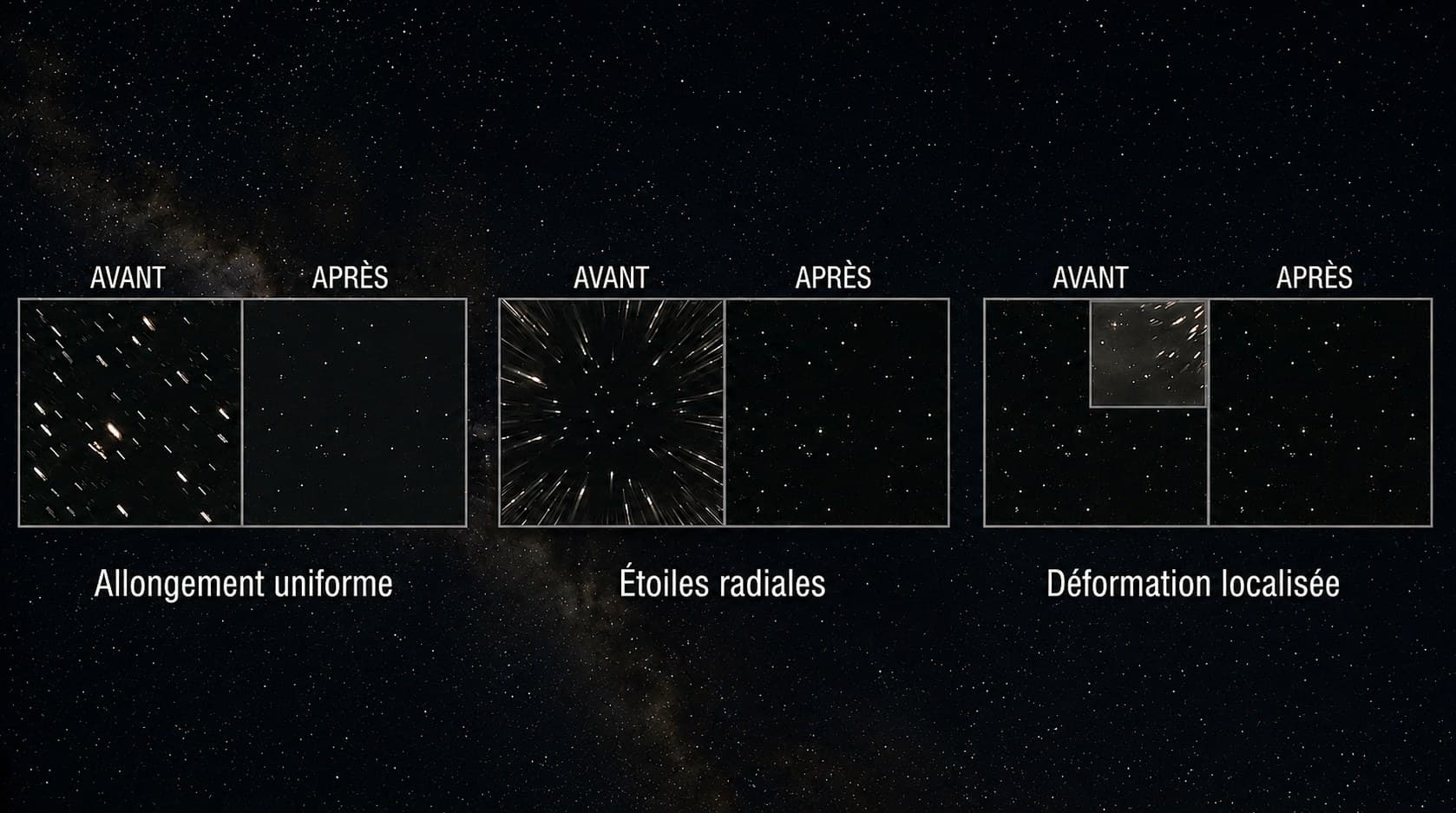
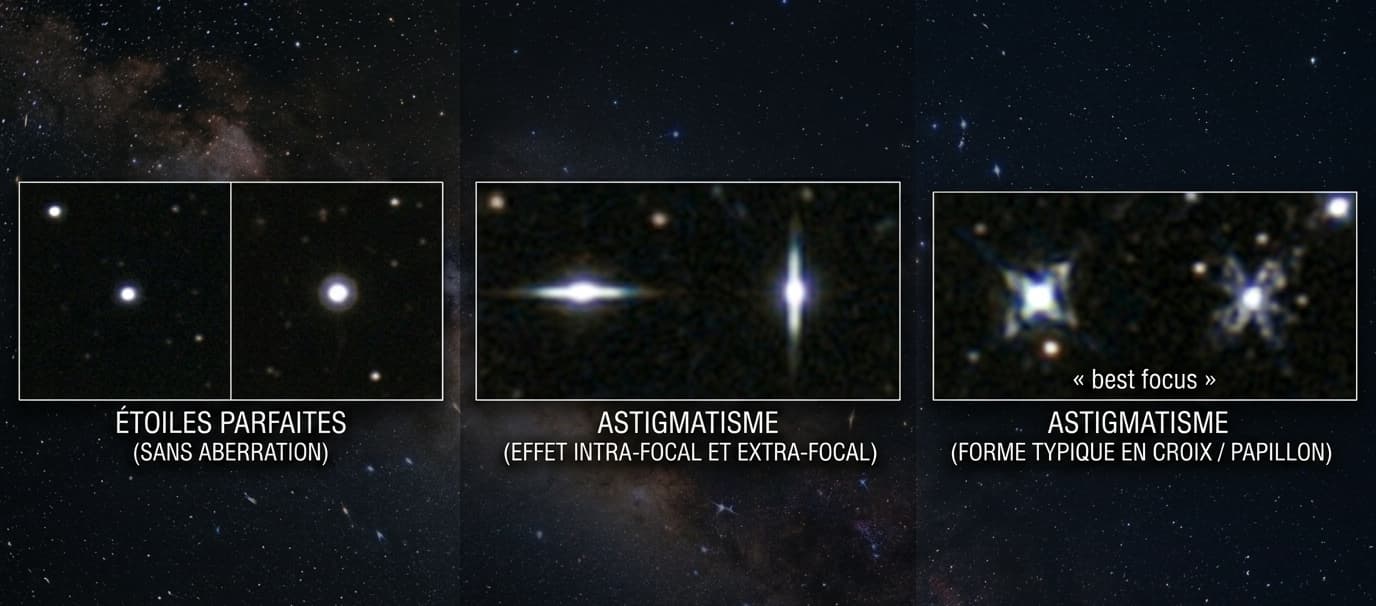
The one isolated defect is moderate field astigmatism: elongation rising to 1.22 on the left, 1.32 on the right and 1.64 in the bottom-right corner, with no proportional FWHM increase (corner/center ratio only 1.106). That is the classic signature of a slightly strained imaging train or imperfect backfocus behind the corrector, not of missed focus. The marked asymmetry of the bottom-right corner relative to the others also points to a small mechanical strain to hunt down at the mirror cell or focuser.
Priority actions
- Re-export the image with a proper stretch: the current file is clipped at 99.87 percent in the shadows and blocks any background, color or processing diagnosis
- Measure the backfocus distance behind the coma corrector with calipers and tune it with thin spacers
- Check the primary mirror clip tension on the 150 PDS, a mechanical strain would explain the bottom-right corner asymmetry
- Redo a careful defocused-star collimation before the next session