Astrophotography diagnosis of SH2-129: Noise / underexposure, astigmatism and 1 other
ProcessedAltair Ha+OIII ULTRA DualBand 3.5nm CERTIFIED CMOS 2"51x300
The Doc examined this image of SH2-129 (processed, Altair Ha+OIII ULTRA DualBand 3.5nm CERTIFIED CMOS 2", 51x300). Estimated overall technical quality: 4/10. 3 defects found: Noise / underexposure (severity 4/5), Astigmatism (severity 2/5), Clipped stars (severity 2/5).
&w=1920&q=75)
Info
- Cible
- SH2-129
- Site
- Bortle 8 · centre-ville (saisi)
Bortle 8 with a last-quarter moon at 40 percent is a very demanding context for faint signal, but the 3.5 nm dual-band is exactly the right tool, cutting most urban pollution and lunar scatter. The real issue is not the filter but the signal budget: SH2-129 is a very faint Ha nebula, and 4h15 under this sky is not enough to bring it out cleanly. Under Bortle 8, aim for 15 to 25 cumulative hours across several nights, favoring windows when the moon is below the horizon or well away from the target, which will markedly improve final contrast.
Setup
- Type d'image
- Traitée
- Télescope
- Sky-Watcher 150 PDS
- Caméra
- ZWO ASI2600MC Pro
- Filtre
- Altair Ha+OIII ULTRA DualBand 3.5nm CERTIFIED CMOS 2"
- Monture
- HEQ5 Pro
- Exposition
- 51x300
- Phase de lune
- Last quarter (40 %)
The 150 PDS with the ASI2600MC Pro is a coherent pairing: at 750 mm with 3.76 micron pixels you sit around 1 arcsecond per pixel, sound without being oversampled, and the large APS-C sensor gives a wide field suited to an extended nebula like SH2-129. The 3.5 nm dual-band is the right call in Bortle 8. The measured FWHM values, between 5.6 and 7.2 px, are however high for this sampling: that points to focus or collimation to improve, or mediocre seeing, rather than to the instrument itself. The HEQ5 Pro handles the load well, and the scattered PA values with a round center show tracking free of drift.
The diagnosis in detail
The central issue with this image is not an optical defect but a signal and stretch problem. The histogram is unambiguous: median at zero, 77 percent dark clipping, zero background-to-black-point margin. In other words the entire bottom of the dynamic range has been crushed against black. On a target like SH2-129, a diffuse and faint emission nebula, that is precisely where the useful signal lives, and it has vanished. Two causes likely combine: a black point set too high in processing, and insufficient integration (4h15) under a Bortle 8 sky with moonlight. The first step is to go back to the linear master and check whether the Ha is actually there before drawing conclusions.
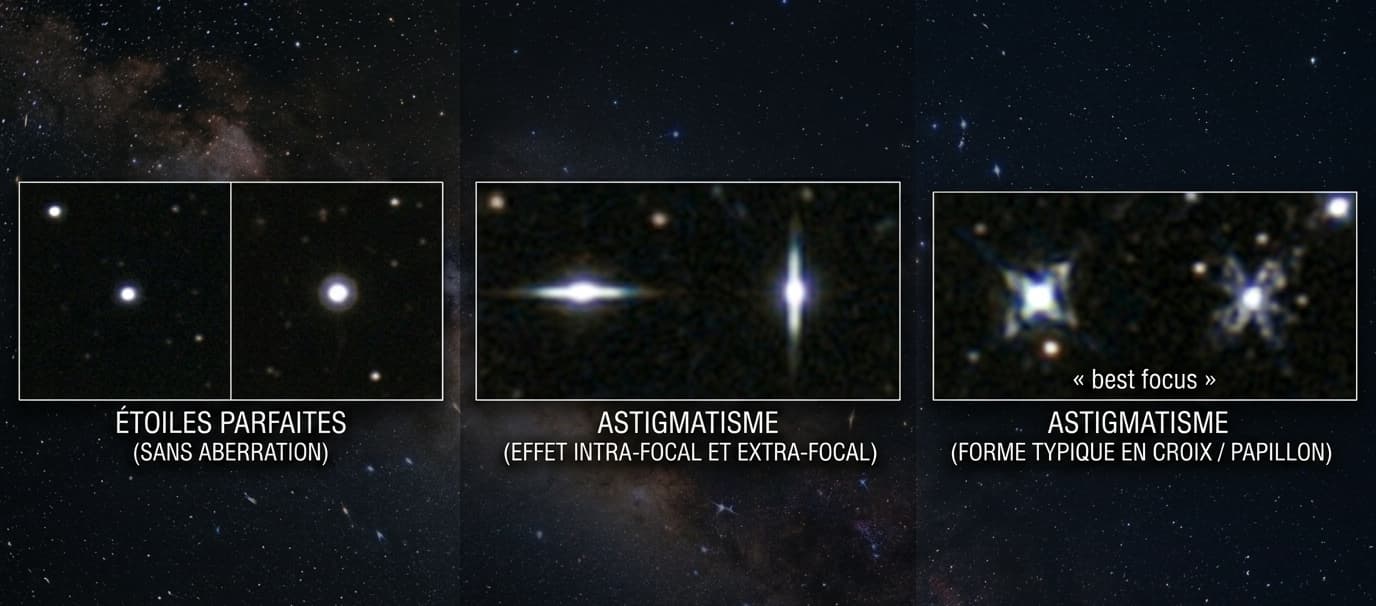
Optically, the PSF measurement is clear and moderate: the center is clean (elong 1.09 against a field floor of 1.04), elongation rises toward the edges without a proportional FWHM increase (corner/center ratio 1.166), the signature of field astigmatism. The bottom-right corner is worst at 1.32. On a 150 PDS this almost always comes down to coma corrector spacing and collimation, occasionally to an over-tight primary mirror clamp.
Absolute FWHM values, between 5.6 and 7.2 px, remain high and warrant systematic focus checks at the start of and during the session, especially with overnight thermal drift.
Priority actions
- Redo processing from the linear master, keeping the background median near 0.10 instead of crushing it to zero
- Check on that linear master whether SH2-129 Ha signal is actually present, before blaming the processing
- Accumulate far more integration on SH2-129, aiming for 15 to 25 hours under this Bortle 8 sky
- Adjust the coma corrector backfocus and redo a full collimation of the 150 PDS to correct the field astigmatism
- Monitor focus through the night with autofocus to bring FWHM below 5 px