Astrophotography diagnosis of SH2-129: Light pollution gradient, sensor tilt and 2 others
ProcessedAltair Ha+OIII ULTRA DualBand 3.5nm CERTIFIED CMOS 2"51x300
The Doc examined this image of SH2-129 (processed, Altair Ha+OIII ULTRA DualBand 3.5nm CERTIFIED CMOS 2", 51x300). Estimated overall technical quality: 6/10. 4 defects found: Light pollution gradient (severity 4/5), Sensor tilt (severity 2/5), Clipped stars (severity 2/5), Background chroma noise (severity 2/5).
&w=1920&q=75)
Info
- Cible
- SH2-129
- Site
- Bortle 8 · centre-ville (saisi)
Tough conditions, but compatible with this target. Under Bortle 8 with a last quarter Moon (41%), any broadband imaging would be lost: the 3.5 nm Ha+OIII dual-band choice is the right one, it cuts most of the urban background and lets SH2-129 come through despite the sky. That said, the measurement shows the filter does not cancel everything: the 79% background gradient is the direct signature of the light dome, possibly reinforced by the Moon if it was on the same side of the sky. Practically: shoot the target near the meridian and as high as possible, avoid nights where the Moon sits within 60 degrees of Cepheus, and above all do not rely on the filter to skip a careful gradient extraction.
Setup
- Type d'image
- Traitée
- Télescope
- Sky-Watcher 150 PDS
- Caméra
- ZWO ASI2600MC Pro
- Filtre
- Altair Ha+OIII ULTRA DualBand 3.5nm CERTIFIED CMOS 2"
- Monture
- HEQ5 Pro
- Exposition
- 51x300
- Phase de lune
- Last quarter (41 %)
The setup is coherent for this target. The 150 PDS (750 mm) with the ASI2600MC Pro gives roughly 1.03 arcsec per pixel, a comfortable sampling under typical seeing, and a field wide enough to frame the extended nebulosity of SH2-129, which is well composed here. The 5.4 px central FWHM is nevertheless fairly high for that sampling: focus deserves refining and seeing was probably mediocre. On settings, the background to black point margin e_margin of 1.94 is low, but that is normal in 3.5 nm narrowband even at 300 s: do not push the exposure longer, an unguided HEQ5 would struggle. No dark clipping, so the offset is fine.
The diagnosis in detail
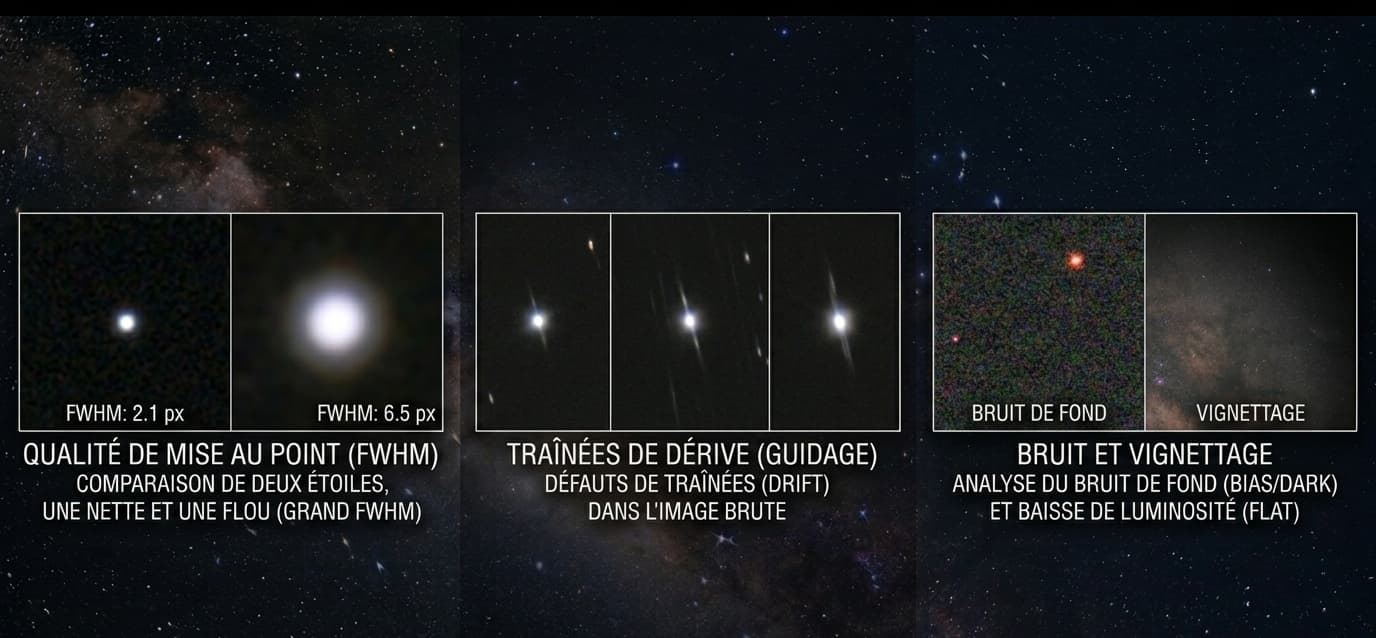
The image reads as two distinct layers. The acquisition layer is broadly healthy: tracking holds, with a central elongation of 1.11 against a field floor of 1.09, so round stars at center, which rules out any drift or guiding oscillation over 300 s. The only measured instrumental defect is a tilted focal plane: the corner/center FWHM ratio reaches 1.27, with vertical asymmetry of 0.079 versus 0.005 horizontal, and it is the two bottom corners that fall off (elong 1.24 and 1.27) while the top-right stays pointlike. It is moderate and workable, but it points to flexure or uneven clamping in the imaging train on the 150 PDS focuser.
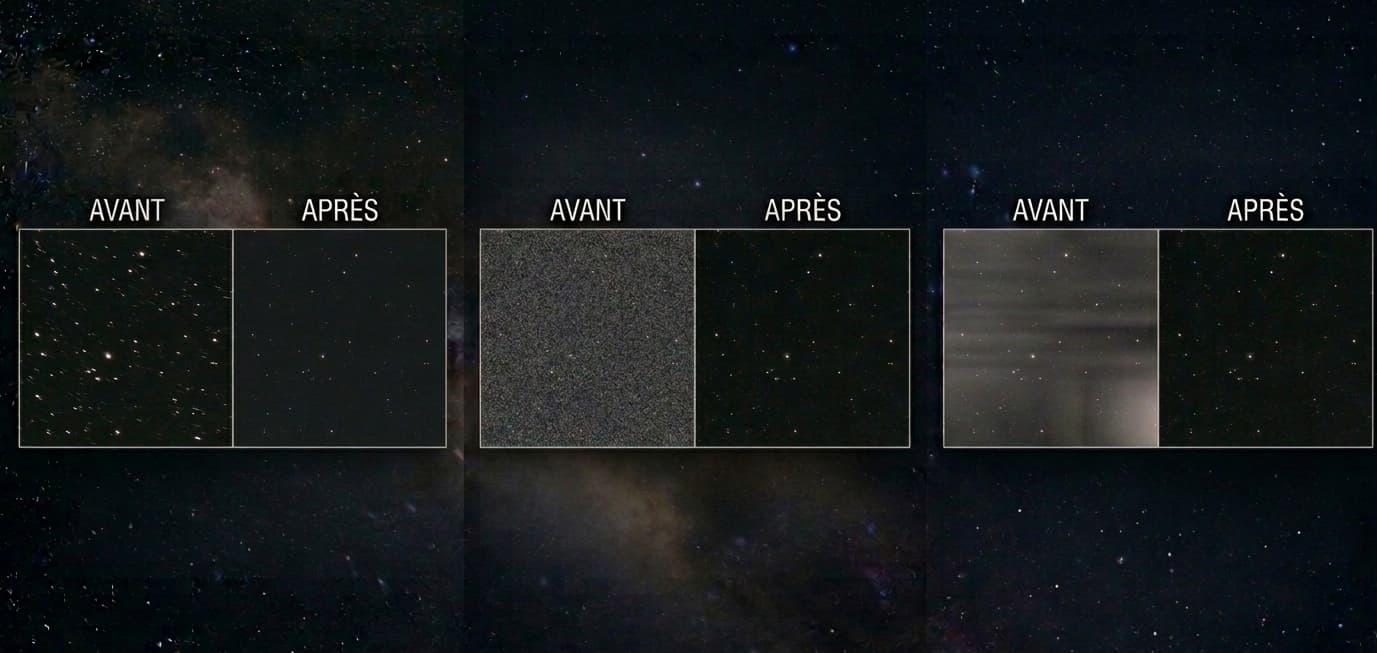
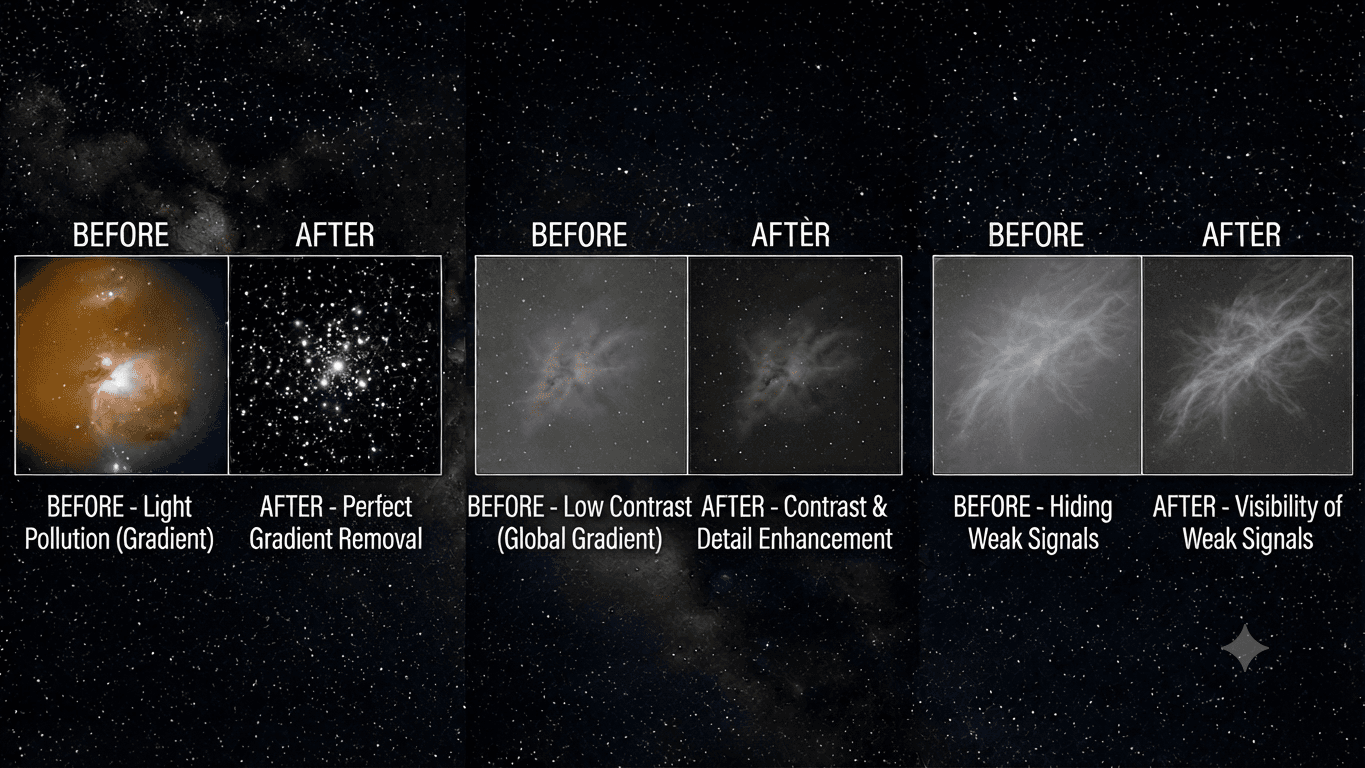
The processing layer carries the real problem. The 79% gradient oriented at 193 degrees with an R2 of 0.96 is a near perfect plane with no rotational symmetry: this is neither vignetting nor a bad flat, it is the light dome of a Bortle 8 sky that was never extracted. It pulls the entire left edge toward a green-cyan cast that also spoils background neutrality and makes the chroma mottling of the dark areas visible. These three points are connected: fix the gradient first, neutralize next, and the chroma noise will become far less visible without heavy denoising.
In short, the data is good, it is the step from master to final image that costs the most quality here. Reprocessing would recover most of it without another night under the sky.
Priority actions
- Go back to the master and extract the gradient with GraXpert or DBE, then neutralize the background before any stretch
- After extraction, apply targeted chroma noise reduction on the background rather than a global denoise
- Check the clamping and backfocus of the 150 PDS imaging train to correct the tilt degrading both bottom corners
- Add short 10 to 30 s exposures to rebuild the clipped cores of the bright stars
- Accumulate more integration (aim for 8 h or more under Bortle 8) to strengthen background SNR